Why Track Family Spending Habits for Better Budgeting

Most families believe they have a rough handle on where their money goes. They are wrong. Research shows that households underestimate monthly spending by 20 to 30%, which can quietly add up to thousands of dollars in unaccounted expenses every year. Understanding why track family spending habits matters is not about anxiety or restriction. It is about getting an honest, clear picture of your financial reality so you can make decisions that actually reflect your values and goals.
Table of Contents
- Key takeaways
- Why tracking spending clarifies real family expenses
- Key categories to monitor in household expenses
- Practical tools and techniques for tracking
- Using spending data to build a realistic family budget
- My honest take on why most families avoid tracking
- How Amanahfund helps your family take control
- FAQ
Key takeaways
| Point | Details |
|---|---|
| Guessing causes budget failure | Most families underestimate actual spending; tracking reveals what estimates miss. |
| Small expenses add up fast | Subscriptions, fees, and impulse buys are the biggest hidden drains on household budgets. |
| Four weeks of data is enough | You do not need to track forever; about four weeks builds a reliable spending baseline. |
| Tracking enables realistic budgets | Spending data replaces assumptions with facts, making category limits far more accurate. |
| Family participation matters | Involving spouses and children builds shared accountability and reduces financial stress. |
Why tracking spending clarifies real family expenses
Ask most parents to estimate what their family spends each month on food, and they will give you a number. Ask them to break it down by groceries, coffee runs, school lunches, and last-minute takeout orders, and suddenly the number looks very different. That gap between assumption and reality is exactly where family budgets fall apart.
Families that rely on guessing rather than recording often face the same cycle: they set a budget at the start of the month, feel confident for a week or two, and then find themselves puzzled when the checking account runs low. Budgeting without real spending data frequently leads to debt and missed financial goals, not because families overspend recklessly, but because they are working with inaccurate information.
The numbers behind this problem are striking. Research has identified $1,200 in average monthly invisible spending among households that did not actively track, which translates into up to $15,000 in potential annual savings. That is not a rounding error. That is a Hajj savings fund, a children’s education account, or a fully stocked emergency reserve.
The most common categories where money quietly disappears include:
- Subscription services that auto-renew and are rarely used
- Convenience fees on delivery apps and one-click purchases
- Impulse purchases made without comparing to the monthly budget
- Bundled retailer purchases where one transaction covers groceries, clothing, and electronics
When families start tracking daily, even for a few weeks, something shifts. Awareness alone changes behavior. People who track daily expenses report 15% higher life satisfaction due to the sense of control that comes with financial clarity. Seeing your actual numbers is not discouraging. For most families, it is genuinely motivating.
Key categories to monitor in household expenses

One of the reasons families avoid tracking is the feeling that it requires logging every single transaction in exhaustive detail forever. That is not what effective tracking looks like. The goal is visibility, not perfection. You need enough data to identify patterns, not a forensic accounting trail.
Start with these core categories:
- Housing: rent or mortgage, utilities, internet, and insurance
- Food: groceries separated from dining out and food delivery
- Transportation: fuel, parking, public transit, and ride-shares
- Children’s expenses: school fees, activities, clothing, and supplies
- Subscriptions: streaming, apps, memberships, and software renewals
- Personal care and health: medications, personal items, and medical appointments
- Savings and giving: zakat, sadaqah, emergency funds, and long-term goals
One category that causes a specific problem is lumped retailer spending. A single Costco or Target transaction might include groceries, household supplies, clothing, and a toy. If you log that as one transaction, you lose the ability to understand what you actually spent across categories. Splitting itemized transactions by category prevents this “budget blindness” and gives you real insight into your true spending patterns.
Pro Tip: Start with just five to seven spending categories for the first month. Once you have a rhythm, add more detail. Trying to track twenty categories from day one usually leads to giving up by week two.
Looking at your household’s common overspending categories can also help you prioritize where to focus first, especially if some areas are already causing concern.
Practical tools and techniques for tracking
The right tool for tracking family spending depends on how your household operates, your level of comfort with technology, and how much you want to automate. There is no single correct method. There are, however, methods that are more sustainable than others.
Manual tracking works well for families who want full control and awareness of every entry. A notebook or a simple spreadsheet gives you visibility without relying on apps or bank connectivity. The tradeoff is time. Logging transactions manually requires a consistent daily habit, and the effort of doing it by hand is actually one of its benefits. The act of writing down what you spent keeps it fresh and honest.
App-based tracking is faster and more consistent for most families. Modern expense tracking apps can connect to your bank accounts and automatically categorize transactions, reducing the burden of manual entry. The challenge is that automated categorization is not always accurate. A transaction at a gas station might include snacks and a car wash alongside the actual fuel. Regular reviews are necessary to catch and correct these mismatches.
Here are techniques that help maintain the tracking habit long-term:
- Set a weekly 15-minute “money check-in” for reviewing transactions together as a couple or family
- Use calendar reminders to categorize transactions before the end of each week
- Assign age-appropriate tracking roles to children to build financial literacy early
- Flag unusual or unrecognized transactions immediately rather than waiting until month-end
Budgeting together as a family builds trust, lowers financial stress, and gives children a meaningful understanding of household responsibility. When everyone participates, the habit sticks.
Pro Tip: You do not need to track indefinitely. About four weeks of consistent tracking is enough to build a reliable financial baseline. After that, focus on a few key numbers like your discretionary spending ratio and income remaining after essentials.
Using spending data to build a realistic family budget
There is an important distinction between tracking and budgeting. Tracking is the act of recording what you actually spend. Budgeting is the plan you build based on that information. You need both, and in that order. A budget built on assumptions fails. A budget built on four weeks of honest spending data has a realistic chance of success.
Here is how to move from data to decisions:
- Total your spending by category for your tracking period and calculate monthly averages.
- Compare actual spending to what you thought you were spending. The gap is your first area of focus.
- Identify non-negotiable fixed costs (housing, utilities, insurance) and separate them from flexible variable spending.
- Set realistic category limits based on actual behavior, not aspirational numbers. If your family has been spending $800 on food monthly, a $400 food budget will fail immediately.
- Find one or two areas to reduce rather than trying to cut everything at once. Gradual changes last longer.
- Schedule a monthly review to compare actual spending against your category targets and adjust.
The table below shows how tracking transforms guesswork into a working budget framework.
| Without tracking | With tracking |
|---|---|
| Budget based on rough estimates | Budget based on four weeks of actual data |
| Surprised by end-of-month shortfalls | Category limits reflect real spending patterns |
| Subscriptions go unnoticed for months | Regular audits catch unused auto-renewals |
| Impulse purchases feel isolated and harmless | Patterns become visible and can be addressed |
| Zakat and savings treated as afterthoughts | Savings goals are built in as non-negotiable line items |
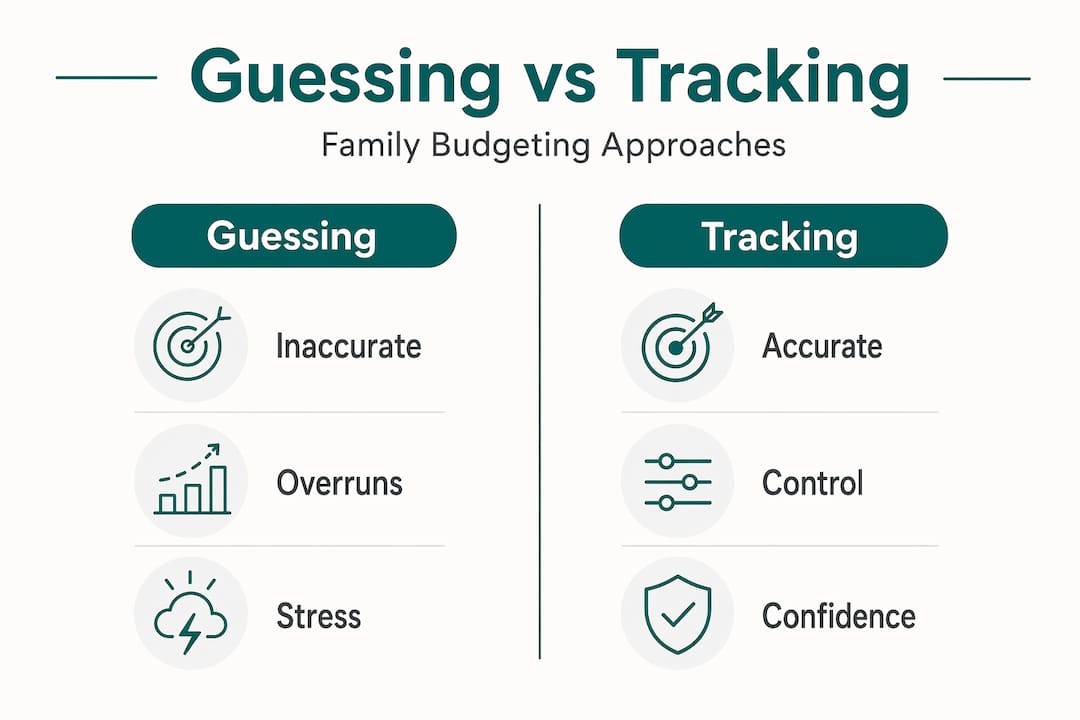
One practical tool that comes from the research is the 48-hour rule for non-essential purchases. When tracking reveals a pattern of impulse buying, implementing a two-day waiting period before completing non-essential purchases reduces those transactions by roughly 60%. It is a small structural change with a measurable financial impact.
Families who also review their subscriptions regularly can expect to recover around $450 in annual savings on average. That number may sound modest until you realize it represents canceled auto-renewals for apps you forgot you subscribed to.
For Muslim families specifically, tracking also makes zakat calculation far more accurate. You cannot calculate zakat on wealth you have not properly accounted for. And savings goals for Hajj, Umrah, Ramadan, and Eid become much more achievable when you have a clear picture of what is left after your actual monthly commitments.
If you want a practical place to start, the best budgeting strategies for Muslim families resource walks through how to apply these principles within an Islamic financial framework.
My honest take on why most families avoid tracking
I have had many conversations with families who say they want to manage money better, but feel resistance when it comes to actually logging their spending. The reason almost always comes down to one of two things: fear of what they will find, or the belief that tracking means restricting every small joy.
What I have learned is that both of those concerns dissolve within the first two weeks. Yes, you will likely discover some uncomfortable numbers. Most families find that a single category, often dining out or subscriptions, is running significantly higher than expected. But seeing it clearly is not demoralizing. It is clarifying. And clarity is the starting point for every real financial improvement.
The psychological benefit here is significant. Tracking spending aligns actual behavior with core family values rather than letting impulsive habits run unchecked. When your spending reflects your values, the guilt and anxiety that come with financial uncertainty go away. That emotional relief is as real as any number in a spreadsheet.
My strongest advice is to avoid perfectionism. You do not need to capture every single transaction with category-level precision from day one. Start simple, stay consistent, and let the habit build naturally. Tracking is not a punishment. It is the most honest conversation your family can have about what matters most.
— Imran
How Amanahfund helps your family take control
If you are ready to move from awareness to action, Amanahfund is built specifically to support Muslim families in managing their finances with intention.

Amanah Budget gives your household a halal-first budgeting experience with spending categories that reflect Islamic values, built-in zakat calculation, and savings goals for Hajj, Umrah, Eid, and emergencies. You can connect your bank accounts securely, receive AI-assisted transaction categorization, and share your household budget with your spouse or family members. If you and your spouse are working through budget disagreements together, the app is designed to make those conversations easier. No ads. No interest-based products. No selling of your data. Just a practical, values-aligned tool built by Muslims, for Muslims. Start tracking your family’s spending at Amanahfund.
FAQ
Why is tracking family spending habits so important?
Tracking reveals the gap between what families think they spend and what they actually spend. Research shows that gap can reach 20 to 30% per month, which adds up to thousands of dollars annually.
How long does a family need to track spending?
About four weeks of consistent tracking is enough to build a reliable financial baseline. After that, you can shift to reviewing a few key spending ratios each month.
What are the most overlooked spending categories?
Subscription services, food delivery fees, and lumped retailer transactions are the most commonly missed. Splitting purchases by category and auditing subscriptions regularly can recover hundreds of dollars per year.
Does tracking spending reduce financial stress?
Yes. Research links daily expense tracking to a 15% increase in life satisfaction, largely because financial clarity reduces anxiety about where money is going.
How can families track spending together effectively?
A weekly 15-minute review of transactions as a family, combined with shared budgeting tools, builds accountability and teaches children financial responsibility at the same time.
Recommended
Ready to manage your amanah?
Track halal spending, calculate zakat, save for Hajj — all in one app. Free forever.
Create Free Account