Spousal Financial Transparency: What Couples Must Know

TL;DR:
- Spousal financial transparency involves openly sharing all relevant financial details to build trust and partnership. It helps prevent conflicts, balance power, and foster shared decision-making in marriage. Regular communication and organized structures ensure mutual awareness and reinforce the value of openness.
Spousal financial transparency is defined as the practice where both married partners openly disclose and discuss all relevant financial details, including income, debts, spending habits, savings, and goals. This full financial openness is the foundation of trust and equal partnership in marriage. Research from Dew and Stewart (2012) and Saxey et al. (2022) confirms that regular financial transparency correlates directly with higher relationship satisfaction and fewer conflicts. Understanding what is spousal financial transparency, and why it matters, is the first step toward building a marriage where money works for both of you.
What is spousal financial transparency in a marriage?
Spousal financial transparency is the ongoing practice of sharing your complete financial picture with your spouse, not just the highlights. It covers income from all sources, outstanding debts, monthly spending patterns, savings balances, investment accounts, and long-term financial goals. The standard industry term for this practice in legal and advisory contexts is financial disclosure, and both terms apply here.

Transparency does not mean handing over control of your finances to your spouse. Transparency is not control. It means accountability and partnership, without policing each other’s every purchase. The goal is that both partners can make informed decisions together, not that one partner monitors the other.
A fully transparent financial picture between spouses typically includes:
- All income sources, including salary, freelance work, rental income, and business revenue
- Outstanding debts such as student loans, credit cards, car loans, and personal loans
- Bank accounts, investment accounts, and retirement accounts
- Monthly spending habits and recurring expenses
- Savings goals, including emergency funds, education savings, and retirement targets
- Account titling and beneficiary designations, which determine who legally owns or inherits assets
- Insurance policies and their coverage amounts
Account structure details like titling and beneficiary designations are often overlooked. Ignoring them creates real financial vulnerability if a spouse dies or if accounts need to be accessed in an emergency.
Why is financial transparency important in a marriage?
Financial openness in marriage directly protects the health of your relationship. Studies link open financial communication to greater trust, fewer arguments, and stronger shared decision-making. Money is one of the leading causes of marital conflict, and secrecy around finances accelerates that conflict.
Financial transparency prevents power imbalances and financial abuse by ensuring both spouses have knowledge and access to money. When one partner controls all financial information, the other becomes dependent and vulnerable. That dynamic erodes trust over time, even when no harm is intended.
“Financial transparency reveals power dynamics in relationships and helps prevent destructive imbalances before conflicts escalate.” — Psychology Today
The opposite of transparency is financial infidelity, which includes hiding accounts, understating income, or concealing debt. Financial infidelity produces the same emotional damage as other forms of betrayal in a marriage. Couples who avoid it by maintaining open financial communication report significantly stronger relationship satisfaction.
The psychological benefits of financial openness are equally real. When both partners know the full picture, anxiety around money decreases. Decisions about major purchases, career changes, or family planning become shared conversations rather than unilateral moves. That shared ownership of financial decisions builds genuine partnership.
Pro Tip: Schedule a dedicated money conversation once a month, separate from everyday household logistics. Mixing financial discussions into busy daily routines leads to rushed decisions and missed details.
Common models for achieving financial transparency
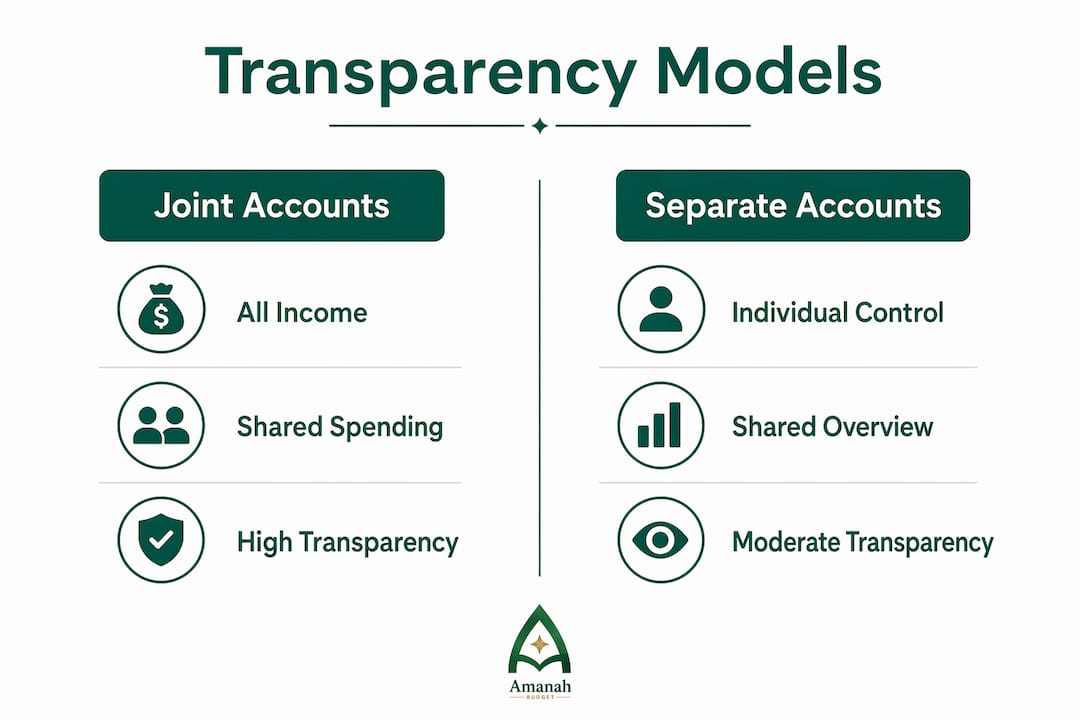
Couples use several different structures to manage finances transparently. No single model works for every marriage, but each effective model shares one feature: both partners have full visibility into the household’s financial picture.
| Model | Structure | Transparency level | Best for |
|---|---|---|---|
| Fully joint accounts | All income and spending flows through shared accounts | High | Couples who prefer unified financial management |
| Separate accounts with shared overview | Individual accounts plus a shared account for household expenses | High with autonomy | Couples who value personal spending independence |
| Designated manager with full access | One spouse manages day-to-day finances; both have login access | High if access is maintained | Couples where one partner has more financial expertise |
| Informal arrangement | No formal structure; finances discussed as needed | Variable, often low | Couples early in marriage or avoiding structure |
Fidelity Investments recommends annual financial summits for couples to review all accounts, advisor contacts, and liabilities together. This practice keeps both spouses fully aware of the household’s financial position, regardless of which model they use day to day.
Delegating financial tasks is common, but both spouses must retain enough knowledge and access to avoid vulnerability. A spouse who never reviews accounts or knows login credentials is exposed to serious risk if the managing partner becomes ill, passes away, or the relationship ends.
The separate accounts with shared overview model is increasingly popular among couples who want personal autonomy without sacrificing transparency. Each partner maintains an individual account for personal spending, while all shared expenses flow through a joint account. Both partners review the joint account regularly and share full statements from their individual accounts at agreed intervals. For Muslim couples managing finances with Islamic values, joint budgeting practices that respect both shared responsibility and individual accountability align naturally with this model.
How to ensure financial transparency in your marriage
Building genuine financial openness requires consistent habits, not a single conversation. These steps give couples a practical path to full transparency.
-
Start with a full financial inventory. Both partners list every account, debt, income source, and recurring expense. Include account numbers, login credentials, and the name of any financial advisor or institution involved.
-
Agree on a regular money meeting. Monthly is the minimum. Use this time to review spending, track progress toward shared goals, and flag any changes in income or expenses. Couples who align on financial values through regular discussion experience greater trust and fewer conflicts.
-
Set clear spending boundaries together. Decide on a threshold above which either partner will consult the other before spending. A common approach is agreeing that any purchase above a set amount requires a brief conversation first.
-
Review account titling and beneficiary designations annually. Life changes, including job changes, new children, and inheritance, affect who should be named on accounts. Reviewing these details once a year prevents costly surprises.
-
Address resistance with curiosity, not accusation. If your spouse is reluctant to share financial details, ask what feels uncomfortable rather than demanding disclosure. Financial secrecy often comes from shame, fear, or past experiences rather than deliberate deception.
-
Use shared tools to maintain visibility. A shared budgeting app or spreadsheet gives both partners real-time access to the household’s financial position. This removes the need for one partner to report to the other and replaces reporting with shared awareness. For practical guidance on setting this up, sharing a budget with your spouse using a dedicated app is one of the most effective ways to maintain ongoing transparency.
Pro Tip: If legal separation ever becomes relevant, formal financial disclosure is legally required, including full reporting of assets and debts. Keeping accurate, organized financial records throughout your marriage makes this process far less stressful.
Key takeaways
Spousal financial transparency is the practice of both partners sharing their complete financial picture, and it is the single most effective way to build trust and prevent conflict in a marriage.
| Point | Details |
|---|---|
| Full disclosure is the standard | Share all income, debts, accounts, goals, and account titling with your spouse. |
| Transparency is not control | Both partners maintain autonomy; the goal is shared awareness, not policing. |
| Regular money meetings matter | Monthly financial reviews keep both spouses informed and aligned on shared goals. |
| Account structure details count | Review beneficiary designations and account titling annually to avoid surprises. |
| Consistent habits build trust | Transparency is an ongoing practice, not a one-time conversation. |
Financial openness is about values, not just numbers
Working with couples on financial communication over the years has taught me one consistent truth: the couples who struggle most with transparency are not hiding numbers. They are avoiding conversations about values.
Money represents different things to different people. For one spouse, saving aggressively feels like security. For the other, spending freely feels like enjoying the life they worked for. When those values are never named, financial decisions become personal attacks rather than practical choices. Transparency without that values conversation is just data sharing. It does not build trust on its own.
The couples I have seen build genuine financial openness share one habit: they talk about what money means to them, not just what they have. They discuss whether stability, generosity, education, or experiences matter most. From that foundation, the numbers become a shared language rather than a source of conflict. For Muslim couples especially, this conversation connects naturally to the concept of amanah, the idea that wealth is a trust, not just a resource.
The other mistake I see regularly is complacency. Couples establish transparency early in their marriage and then stop reviewing it. Accounts change, income shifts, and beneficiary designations go years without an update. Transparency is not a box you check once. It is a living practice that requires attention every year.
— Imran
How Amanahfund supports couples in financial transparency
Amanahfund’s Amanah Budget app is built specifically for Muslim families who want to manage money with both clarity and Islamic values at the center.

Couples can share household budgets directly within the app, giving both partners real-time visibility into spending, savings goals, and zakat obligations. Amanah Budget includes halal-aware spending categories, AI-assisted transaction categorization, and dedicated savings goals for Hajj, Umrah, Ramadan, and education. For families ready to build genuine financial openness, Amanahfund’s budgeting tools make shared financial management practical and values-aligned from day one. No ads, no data selling, and no interest-based products.
FAQ
What is spousal financial transparency?
Spousal financial transparency is the practice where both married partners openly share all relevant financial information, including income, debts, accounts, and goals, to support informed joint decisions and mutual trust.
Does financial transparency mean combining all accounts?
No. Transparency means both partners have full visibility into the household’s financial picture. Couples can maintain separate accounts while still sharing statements, goals, and spending information regularly.
What counts as financial infidelity?
Financial infidelity includes hiding accounts, understating income, concealing debt, or making significant financial decisions without a spouse’s knowledge. It causes the same trust damage as other forms of deception in a marriage.
How often should couples review their finances together?
Monthly money meetings are the minimum for maintaining financial openness. Fidelity recommends an annual financial summit to review all accounts, beneficiary designations, and advisor contacts in full.
What if my spouse refuses to be financially transparent?
Start by asking what feels uncomfortable rather than demanding disclosure. Financial secrecy often comes from shame or past experience. If resistance continues, a financial counselor or couples therapist can help facilitate the conversation in a neutral setting.
Recommended
- Examples of Family Financial Transparency That Build Trust — Amanah Budget Blog
- Examples of Family Financial Transparency That Build Trust — Amanah Budget Blog
- Joint Budgeting for Spouses Explained: A Practical Guide — Amanah Budget Blog
- Joint Budgeting for Spouses Explained: A Practical Guide — Amanah Budget Blog
Ready to manage your amanah?
Track halal spending, calculate zakat, save for Hajj — all in one app. Free forever.
Create Free Account