Halal Restaurant Spending: Costs, Trends, and Budgeting
TL;DR:
- Halal restaurant spending includes all costs at establishments meeting Islamic dietary laws, from quick service to catering. Costs vary by service level, location, and certification, with hidden fees often increasing the total by 20-30 percent. Families can better manage expenses by planning for seasonal spikes, tracking all related costs, and using specialized budgeting tools.
Halal restaurant spending is defined as the money consumers allocate for dining at establishments that comply with Islamic dietary laws, covering everything from quick-service meals to formal catering events. The global halal food market has grown into one of the most significant food segments worldwide, and dining costs within it vary widely based on service style, certification standards, and location. For Muslim families trying to manage their finances with both cultural integrity and financial discipline, understanding what drives these costs is the first step toward smarter budgeting.
What is halal restaurant spending, and what does it typically cost?
Halal restaurant spending covers every dollar spent at a dining establishment that meets Islamic dietary requirements, including food, service charges, and any event-related fees. The term “halal dining costs” is the practical, everyday phrase most consumers use, but the formal industry classification falls under certified food service expenditure within the broader halal economy.

Quick service halal dining typically costs $7–$12 per visit. Full-service halal restaurants range from $18–$40 per visit, depending on geography and menu complexity. That gap reflects not just food quality but the cost of maintaining halal certification, staff training, and supply chain compliance.
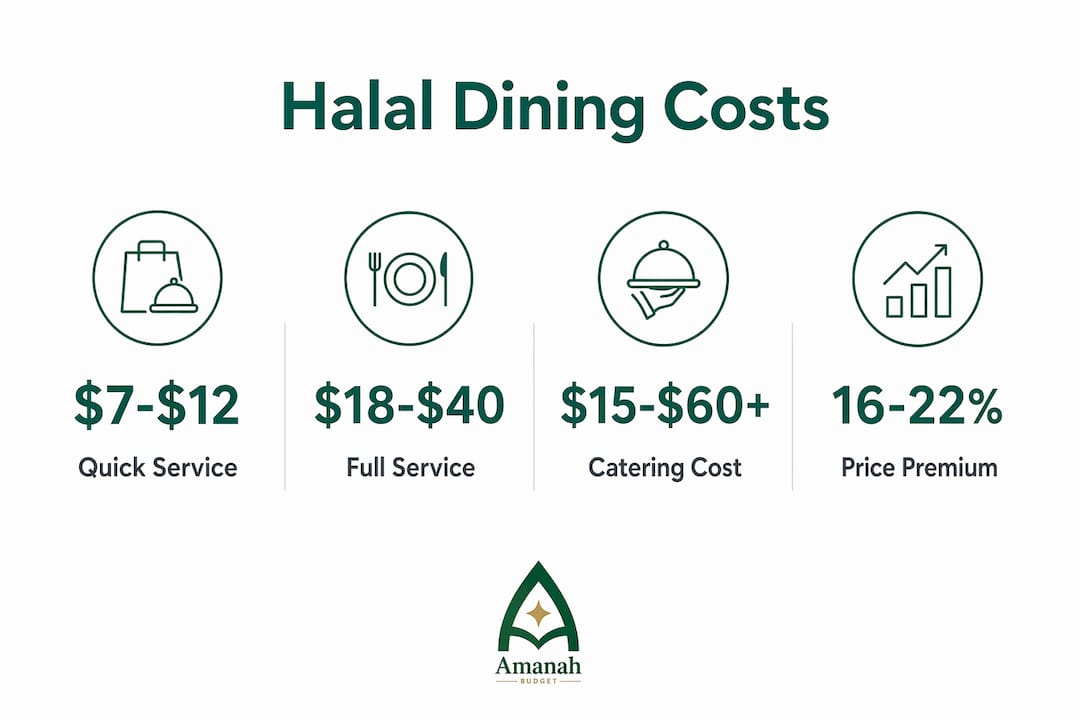
Halal catering adds another layer of cost. Catering runs $15–$60+ per person, with buffet-style events sitting at the lower end and full-service plated dinners with staff and setup pushing toward $60 or more per person. For a family event of 50 guests, that difference translates to a budget gap of over $2,000.
Hidden fees are where most budgets break down. Service charges, gratuities, parking, and children’s pricing add 20–30% to advertised halal dining prices. A meal listed at $25 per person can realistically cost $32 or more once all fees are applied.
Key cost components to track before booking any halal dining experience:
- Base menu price per adult and child (often priced differently)
- Mandatory service charges and gratuities, which are sometimes non-negotiable
- Parking or valet fees at urban venues
- Certification surcharges some venues pass on to customers
- Minimum spend requirements for group bookings
Pro Tip: Always request a fully itemized quote before confirming any halal catering booking. Ask specifically whether gratuity is included, whether children are priced separately, and whether there is a minimum spend threshold.
How do geography and culture affect halal dining costs?
Location is one of the strongest predictors of halal restaurant spending. In Muslim-majority countries, halal certification is the default standard, which keeps certification costs low and competition high. In Western markets, the smaller supply of certified establishments gives those restaurants more pricing power.
In Saudi Arabia, the average spend per restaurant visit was SAR 85 (approximately $22.70) in 2023, with halal-certified restaurants holding 70% of the market. That market dominance keeps prices competitive because consumers have many certified options to choose from.
In Western cities, the dynamic flips. Fewer certified restaurants and higher operational costs push prices upward. Urban Muslim consumers dine out 2.8 times more frequently than rural populations. That frequency, combined with higher urban prices, means city-dwelling Muslim families face a compounding spending pressure that rural families do not.
| Region | Avg. spend per visit | Halal market context |
|---|---|---|
| Saudi Arabia | ~$22.70 | 70% of restaurants are halal-certified |
| Western urban markets | $18–$40 | Limited certified options, higher premiums |
| Quick service (global) | $7–$12 | Most accessible price point for regular dining |
| Halal catering (per person) | $15–$60+ | Varies by service level and event scale |
Cultural expectations also shape pricing. In communities where halal certification carries deep religious significance, restaurants can justify higher prices by investing in verified supply chains and transparent sourcing. Consumers in those communities accept the premium because the certification itself is non-negotiable.
What drives consumer behavior in halal dining choices?
Consumer behavior in halal dining is shaped by a combination of religious conviction, trust in certification, and the dining environment itself. These are not the same factors that drive spending in general foodservice markets.
Stronger religiosity correlates with lower price sensitivity when dining halal, particularly when certification and Islamic norms are respected. A diner who prioritizes their faith will pay more for verified halal food than for a cheaper, uncertified alternative. This is a fundamentally different spending psychology than what drives most restaurant choices.
72% of halal patrons prioritize ingredient quality and compliance, a rate higher than general foodservice consumers. That priority creates a market where transparency is a competitive advantage. Restaurants that clearly display their certification, sourcing, and preparation standards attract and retain customers more effectively.
Factors that consistently influence halal dining decisions include:
- Certification visibility: Consumers want to see the certification, not just hear about it.
- Ingredient sourcing transparency: Where the meat comes from matters as much as how it is prepared.
- Prayer accessibility: Venues that accommodate prayer times, including Maghrib during Ramadan, are preferred for group events.
- Dining environment: Alcohol-free settings and modest atmospheres are valued by many Muslim families.
“Religious affiliation heavily moderates dining expenses, influencing willingness to pay premiums for verified halal options and appropriate dining environments.” — Halal Food Market Consumer Behavior Study
Halal restaurants that emphasize certification and ingredient transparency command 16–22% price premiums over non-certified competitors. That premium is not a penalty. It reflects the real cost of maintaining a certified supply chain and the value consumers place on it.
How can families budget effectively for halal restaurant spending?
Budgeting for halal meals requires a clear-eyed view of all cost components, not just the menu price. Most families underestimate their monthly halal dining costs because they track only the base meal price and ignore service charges, tips, and the cumulative effect of frequent dining out.
Meal planning and bulk shopping reduce monthly halal food costs and prevent impulsive spending. Families who combine weekly meal prep with intentional grocery purchases of halal staples spend significantly less on restaurant dining without sacrificing dietary compliance. The key is treating home-cooked halal meals as the default and restaurant dining as the planned exception.
High-frequency halal dining among urban Muslims can cause significant budget leakage if it is not balanced by home cooking. Urban consumers who dine out 8–12 times per month at an average of $20 per visit are spending $160–$240 monthly on restaurant meals alone. That figure does not include hidden fees or catering events.
A practical budgeting framework for halal restaurant spending:
- Set a monthly dining-out limit. Decide how many restaurant meals fit your household budget before the month begins.
- Separate catering from regular dining. Treat event catering as a separate budget line, not part of your weekly food spend.
- Account for hidden fees. Add 25% to any quoted restaurant or catering price to estimate the true cost.
- Track every transaction. Use a halal-aware budgeting tool that categorizes food spending correctly, including the difference between grocery and restaurant expenses.
- Plan for Ramadan and Eid separately. Iftar gatherings and Eid celebrations drive significant spikes in halal dining costs. Budget for them in advance, not after the fact.
For families managing household halal spending, the most effective approach combines meal prep discipline with a clear monthly ceiling on dining out. Digital tools that categorize halal-specific expenses make this significantly easier to maintain consistently.
Pro Tip: When planning Ramadan Iftar bookings, always confirm whether the venue accommodates Maghrib prayer and whether the timing is fixed or flexible. Venues that do not accommodate prayer schedules often create rushed, stressful dining experiences that are not worth the cost.
Digital ordering platforms with halal certification verification raise customer transaction frequency by 2.3 times among halal restaurants. That convenience is real, but it also means it is easier to overspend. Tracking your halal grocery and restaurant spending together, as part of a single food budget, gives you a complete picture of where your money goes.
For a structured approach to setting up your food budget, the family halal budget setup guide from Amanahfund walks through the full process step by step.
Key Takeaways
Halal restaurant spending is shaped by certification costs, geographic location, and hidden fees that routinely add 20–30% to advertised prices, making proactive budgeting a necessity for Muslim families.
| Point | Details |
|---|---|
| Cost varies by service level | Quick service runs $7–$12 per visit; full-service halal dining costs $18–$40. |
| Hidden fees inflate real costs | Service charges, gratuities, and parking add 20–30% beyond menu prices. |
| Location drives price differences | Saudi Arabia averages $22.70 per visit; Western urban markets run significantly higher. |
| Religiosity lowers price sensitivity | Highly observant diners consistently pay premiums for verified halal certification. |
| Meal planning cuts dining costs | Combining bulk halal grocery shopping with meal prep reduces reliance on restaurant spending. |
My honest take on halal restaurant spending
Most conversations about halal dining costs focus on the menu price. That is the wrong number to watch. The real cost of halal restaurant spending shows up in the total bill, and for families who dine out regularly, the gap between what they expect to pay and what they actually pay is often 25–30% wider than anticipated.
I have seen families budget carefully for a Ramadan Iftar buffet, only to be caught off guard by mandatory gratuity, a parking fee, and a separate children’s price that was not listed on the booking page. That is not a rare experience. It is the norm for event-style halal dining, and it catches people who have not done the full cost accounting.
The other thing worth saying plainly: halal certification premiums are legitimate. Restaurants that maintain verified halal supply chains carry real operational costs. When you pay 16–22% more at a certified establishment, you are paying for something real. The mistake is not paying that premium. The mistake is paying it without budgeting for it.
What I find most useful is treating halal restaurant spending as its own budget category, separate from groceries and separate from general entertainment. When it sits inside a vague “food” line, it disappears. When it has its own number, you can actually manage it. That shift alone changes how most families relate to their dining costs.
The families who manage this best are not the ones who eat out less. They are the ones who know exactly what they spend, plan for the spikes like Eid and Ramadan in advance, and use tools that reflect their values rather than generic finance apps that lump halal groceries and restaurant meals together without distinction.
— Imran
Amanahfund and halal dining budget planning
Tracking halal restaurant spending is straightforward when you have a tool built for it. Amanahfund is a halal-first budgeting app designed specifically for Muslim families, with spending categories that reflect how you actually live, including separate tracking for restaurant dining, groceries, Ramadan, and Eid expenses.
Amanahfund connects securely to your bank accounts through Plaid and uses AI-assisted categorization to sort your transactions automatically. You can set a monthly ceiling for halal dining costs, track where your food budget goes in real time, and plan ahead for seasonal spending spikes without scrambling at the end of the month. No ads, no data selling, and no interest-based products. Built by Muslims, for Muslims.
FAQ
What is halal restaurant spending?
Halal restaurant spending is the total amount consumers spend at dining establishments that comply with Islamic dietary laws, including food, service charges, and event fees. It covers everything from quick-service meals to formal catering.
How much does a typical halal restaurant meal cost?
Quick-service halal dining typically costs $7–$12 per visit, while full-service halal restaurants range from $18–$40 per visit depending on location and menu.
Why do halal restaurants charge more than non-certified restaurants?
Halal-certified restaurants command 16–22% price premiums over non-certified competitors because maintaining a verified halal supply chain carries real operational costs, including certification fees and sourcing compliance.
How can I reduce my halal restaurant spending?
Meal planning and bulk shopping reduce monthly halal food costs significantly. Setting a firm monthly dining-out limit and accounting for hidden fees like gratuity and parking prevents budget overruns.
Does location affect how much I spend at halal restaurants?
Yes. In Saudi Arabia, the average restaurant visit costs approximately $22.70, supported by a market where 70% of restaurants are halal-certified. In Western urban markets, limited certified options push prices considerably higher.
Recommended
- Halal Grocery Budgeting: Why Muslim Families Spend More (and How to Plan for It) — Amanah Budget Blog
- Halal Grocery Budgeting: Why Muslim Families Spend More (and How to Plan for It) — Amanah Budget Blog
- Household halal spending: a guide for Muslim families — Amanah Budget Blog
- Household halal spending: a guide for Muslim families — Amanah Budget Blog
Ready to manage your amanah?
Track halal spending, calculate zakat, save for Hajj — all in one app. Free forever.
Create Free Account