What Is Values Based Spending? A Clear Guide
TL;DR:
- Values-based spending aligns your money with your core priorities, fostering intentional and confident financial decisions. It involves identifying personal values, evaluating current expenses, and funding priorities before cutting back on non-essential spending. Regular reviews and targeted ethical commitments help keep your spending aligned with your evolving life goals.
Values-based spending is the practice of intentionally directing your money toward what matters most to you, so every dollar reflects your personal priorities and life goals. Most budgeting advice tells you to spend less. Values-based spending tells you to spend right. The difference is significant. Resources like Phroogal and SoFi describe this approach as a mindset shift away from guilt and restriction, toward purpose and confidence. For Muslim families especially, this framework resonates deeply. Spending with intention is not just a financial strategy. It is a reflection of character and faith.
What is values based spending, and how does it work?
Values-based spending is defined as a 4-step financial practice: identify your core values, evaluate your current spending, prioritize expenses that reflect those values, and reduce spending that does not. The industry also calls this approach “values-based budgeting,” and both terms describe the same framework. The goal is financial values alignment, not just a balanced spreadsheet.

The core insight is simple. Your money goes where your attention goes. If you value family connection but spend most of your discretionary income on subscriptions you rarely use, there is a gap between your stated values and your actual behavior. Values-based spending closes that gap by making your priorities visible and then funding them first.
Phroogal’s financial glossary notes that this approach shifts the emotional experience of money management from restriction and guilt to intentional direction. That shift matters because decision fatigue and buyer’s remorse are direct results of spending that feels misaligned. When your purchases reflect what you actually care about, confidence replaces second-guessing.
How does values-based spending differ from traditional budgeting?
Traditional budgeting sorts expenses into needs and wants, then sets limits on each category. Values-based budgeting replaces that structure with a focus on value impact over spending limits. The category is not “dining out.” The category is “family connection,” and dining out may or may not belong there depending on your values.
| Feature | Traditional budgeting | Values-based budgeting |
|---|---|---|
| Primary focus | Spending limits by category | Alignment with personal values |
| Emotional tone | Restriction and guilt | Intention and purpose |
| Category logic | Need vs. want | Value contribution |
| Flexibility | Fixed monthly limits | Adaptive to life changes |
| Decision rule | “Can I afford this?” | “Does this reflect what I care about?” |
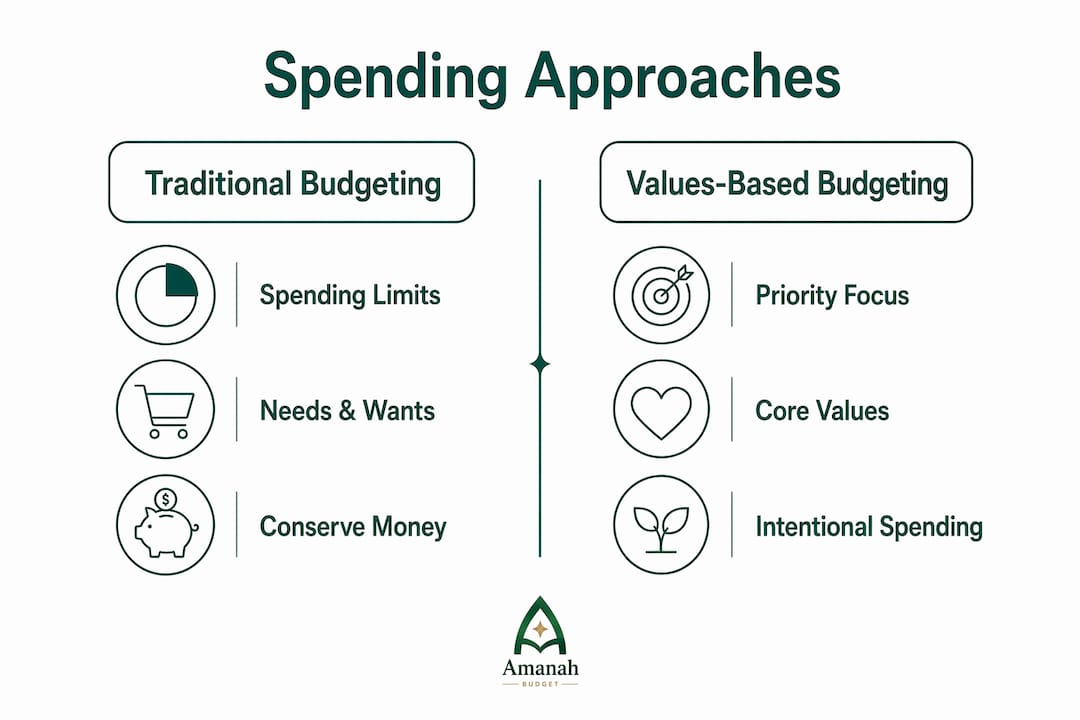
The mindset shift is the most important difference. Traditional budgets treat money as a resource to conserve. Values-based budgeting treats money as a tool to express priorities. You are not cutting back. You are redirecting.
Pro Tip: Before labeling a purchase as a “want,” ask whether it contributes to a value you have named. If it does, it belongs in your plan. If it does not, that is useful information.
One common misconception is that values-based spending means spending more freely. It does not. Essentials and safety nets still come first. The difference is that once those are covered, the remaining funds go to categories you have consciously chosen, not categories you defaulted into.
What are the practical steps to create a values-based spending plan?
Building a purpose-driven spending plan takes honest reflection before it takes any math. Follow these steps to build yours.
-
Identify your core values. Write down five to seven things that matter most to you. Common examples include family, faith, education, health, community, and experiences. Be honest. People often misidentify their values by listing what they think they should prioritize rather than what actually drives their decisions. Look at where you already spend freely and without regret. That reveals your real values.
-
Evaluate your current spending. Pull three months of bank and credit card statements. Tag each transaction with a value category or mark it as unaligned. Tools like family spending tracking make this process faster and more accurate. The gaps between your stated values and your tagged transactions are where the work begins.
-
Apply the values allocation formula. Disposable income minus essentials, savings, and debt payments equals your value allocation fund. This is the pool of money you distribute across your value buckets. Essentials and debt minimums are non-negotiable. Everything else is a choice.
-
Set up value buckets. A value bucket is a named spending category tied directly to a core value. If you value faith, one bucket might cover zakat, sadaqah, and Islamic education. If you value health, another covers groceries, gym membership, and medical care. Fund the highest-priority buckets first.
-
Automate transfers and reduce misaligned spending. Set up automatic transfers to savings goals tied to your buckets. Review subscriptions and recurring charges. Cancel anything that does not map to a named value. This is where common budgeting mistakes tend to hide.
-
Turn buckets into daily decision rules. Value buckets work best when they become fast, practical rules at the moment of purchase. “Does this belong in my family connection bucket?” is a faster and more honest question than “Can I afford this?” It stops autopilot spending before it starts.
Pro Tip: If you share finances with a spouse or family members, align on your shared values before building buckets. A shared household budget built on agreed values prevents conflict and builds financial trust.
How can you maintain and adapt your values-based spending over time?
Values-based spending is not a one-time setup. Life changes, and your spending plan should change with it. Quarterly or semi-annual financial reviews are the standard recommendation for keeping your plan aligned with your actual life. That cadence gives you enough time to see patterns without letting misalignment go unaddressed for too long.
During each review, ask these questions:
- Have any of my core values shifted in priority? A new child, a career change, or a health event can reorder everything.
- Are my value buckets still funded at the right levels? A bucket that made sense last year may need more or less now.
- Where did unaligned spending creep back in? Subscriptions, convenience purchases, and social pressure are the usual culprits.
- Do my savings goals still reflect what I am working toward? Hajj savings, emergency funds, and education goals all evolve.
The flexibility of values-based budgeting is one of its greatest strengths. Values set priorities first, and spending categories follow. When priorities shift, the categories shift too. You are not locked into a rigid structure that stops reflecting your life. This is what separates intentional spending practices from traditional budgeting systems that feel outdated six months after you build them.
How does values-based spending support ethical and moral financial choices?
Ethical spending habits sit naturally inside a values-based framework. If sustainability, fair labor, or halal compliance are among your core values, they become named buckets with real funding. The framework does not treat ethics as an add-on. It treats ethics as a priority, funded like any other.
The challenge is cost. Ethical and sustainable products carry price premiums that range from 20% to 220% above conventional alternatives. That range is wide, and it explains why people who genuinely care about ethical shopping often buy differently in practice. The premium is real, and most budgets cannot absorb it across every category.
| Ethical spending category | Typical premium range | Practical strategy |
|---|---|---|
| Organic food | Moderate to high | Prioritize produce; buy conventional for packaged goods |
| Fair trade clothing | High | Buy less, buy better; focus on core wardrobe pieces |
| Halal-certified products | Low to moderate | Seek community suppliers for bulk purchasing |
| Ethical banking | Varies | Switch primary account; keep secondary accounts conventional |
The solution is targeted ethical spending. Rather than committing to buy everything ethically, which is financially unsustainable for most families, you identify the two or three categories where your ethical commitment has the most impact and fund those fully. You allow compromises elsewhere. This approach respects both your values and your cash flow.
Pro Tip: Research shows that framing ethical premiums as quantity trade-offs rather than price increases improves purchase follow-through. Instead of “this costs 30% more,” think “I buy three quality pieces instead of ten cheap ones.” The math often works out.
For Muslim families, the ethical dimension of spending aligned with values includes halal certification, avoiding riba (interest), and fulfilling zakat obligations. These are not optional add-ons. They are foundational values that belong in the first tier of your value buckets. The role of intention in spending shapes not just what you buy, but why, and that distinction matters in an Islamic framework.
Key takeaways
Values-based spending works because it replaces arbitrary category limits with a clear priority system rooted in what you actually care about, making every financial decision faster and more intentional.
| Point | Details |
|---|---|
| Definition is clear | Values-based spending directs money toward named personal priorities, not just away from overspending. |
| Formula matters | Subtract essentials, savings, and debt from disposable income to find your value allocation fund. |
| Ethical spending needs targeting | Focus ethical commitments on two or three high-impact categories to stay within real budget limits. |
| Regular reviews keep it alive | Quarterly or semi-annual check-ins prevent value drift and keep spending aligned with life changes. |
| Daily decision rules are the key | Turning value buckets into fast purchase questions stops autopilot spending at the moment it happens. |
Why I think most people get values-based spending backwards
Most people start by looking at their budget and asking what they can cut. That is the wrong starting point. The right starting point is a blank page and an honest answer to one question: what do I actually want my life to look like?
I have seen families build detailed budgets with perfectly balanced categories, and still feel financially stressed. The stress comes from misalignment, not math. When your money goes to things that do not reflect your real priorities, no amount of spreadsheet precision fixes the feeling that something is off.
The hardest part of this process is not the math. It is the honesty. Identifying true values requires separating what you think you should care about from what you actually do. That gap is where most people get stuck. They write “health” on their values list and then track their spending and find it goes mostly to convenience food and streaming. That is not a failure. That is useful data.
The long-term benefit of getting this right is less decision fatigue. When your value buckets are clear, most spending decisions make themselves. You do not agonize over whether to buy something. You check whether it belongs in a bucket you have funded. That clarity is worth more than any budgeting app feature. It is the difference between managing money and understanding it.
— Imran
Amanahfund: built for families who spend with purpose
For Muslim families, values-based spending is not a new concept. It is the way money has always been meant to work within an Islamic framework. The challenge is finding financial tools that actually reflect that.
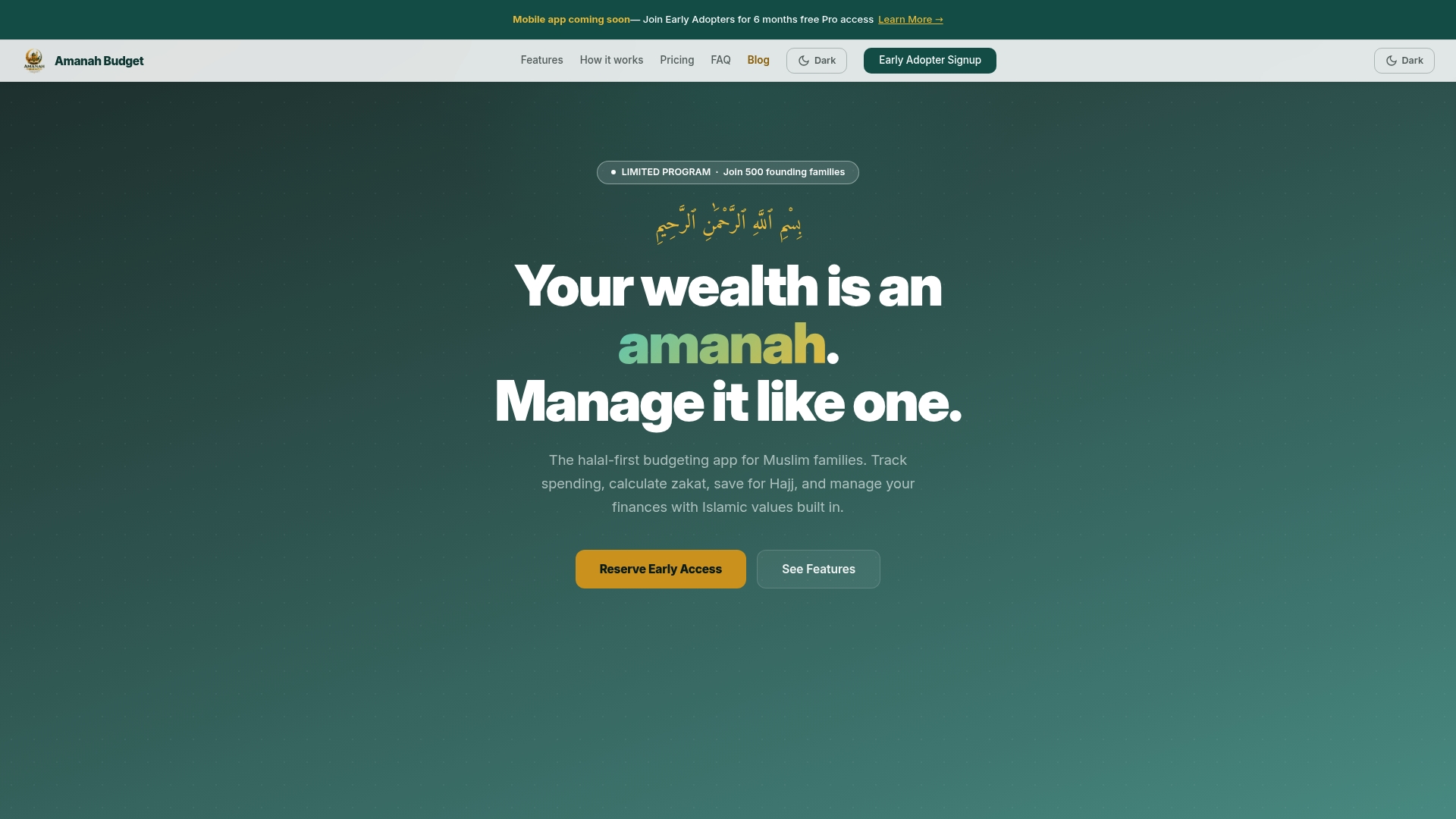
Amanahfund is a halal-first budgeting app built specifically for Muslim households. It includes halal-aware spending categories, zakat calculation by madhab, and savings goals for Hajj, Umrah, Ramadan, and Eid. Families can share household budgets with spouses and connect bank accounts securely through Plaid. AI-assisted transaction categorization helps you see where your money actually goes, so you can align it with where you want it to go. No ads, no data selling, and no interest-based products. Start budgeting with values at the center of every decision.
FAQ
What is values-based spending in simple terms?
Values-based spending means directing your money toward what matters most to you personally, rather than following generic budget categories. It replaces “need vs. want” thinking with a question: does this purchase reflect a value I have named?
How is values-based budgeting different from a regular budget?
A regular budget sets spending limits by category. Values-based budgeting sets priorities by personal values first, then builds spending categories around those priorities, making it more flexible and personally meaningful.
How do I find my real values for a spending plan?
Look at where you already spend freely and without regret. Your actual spending behavior reveals your real values more accurately than a list of what you think you should prioritize.
Can values-based spending include ethical or halal commitments?
Yes. Ethical spending habits, halal certification, zakat, and avoiding riba all belong as named value buckets. Targeted ethical spending focuses your commitment on the categories where your impact and conviction are strongest.
How often should I review my values-based spending plan?
Quarterly or every six months is the recommended review cadence. Life changes shift priorities, and your spending plan should reflect your current values, not the ones you held a year ago.
Recommended
Ready to manage your amanah?
Track halal spending, calculate zakat, save for Hajj — all in one app. Free forever.
Create Free Account