What Is Spending Mindfulness? A Practical Guide
TL;DR:
- Spending mindfulness involves making intentional financial decisions aligned with personal values rather than reacting impulsively. Implementing habits like 24-hour pauses, purchase tracking, and automated savings improves awareness and reduces household expenses significantly. It emphasizes understanding emotional triggers like HALT states and deepens traditional budgeting by addressing the motivations behind spending.
Spending mindfulness is the practice of making conscious, intentional financial decisions aligned with your values and needs, rather than reacting impulsively or emotionally to spending triggers. In personal finance circles, the recognized term is mindful spending, and it draws directly from mindfulness psychology applied to money behavior. It does not require deprivation or guilt. It requires awareness. Common tools include purchase tracking, the 24-hour pause rule, and automated savings, each designed to interrupt the automatic spending patterns most people never examine.
What is spending mindfulness and why does it matter?
Mindful spending is defined as the deliberate act of pausing before a financial decision to assess whether it reflects your actual priorities. The concept borrows from clinical mindfulness practice, where non-judgmental awareness of thoughts and feelings is used to change behavior. Applied to money, it means you notice the urge to spend, examine what is driving it, and then decide consciously rather than automatically.

The distinction from ordinary budgeting is significant. Budgeting tells you how much you spent. Spending mindfulness asks why you spent it and whether it served you. A family tracking their grocery bill in a spreadsheet is budgeting. A family pausing before an unplanned restaurant visit to ask whether they are genuinely hungry or just tired is practicing mindful spending.
This practice matters because most financial stress does not come from income alone. It comes from the gap between what people earn and what they spend without thinking. Tracking without guilt improves spending patterns over time, because awareness without shame is the foundation of sustainable behavior change.
What are the proven mindful spending techniques?
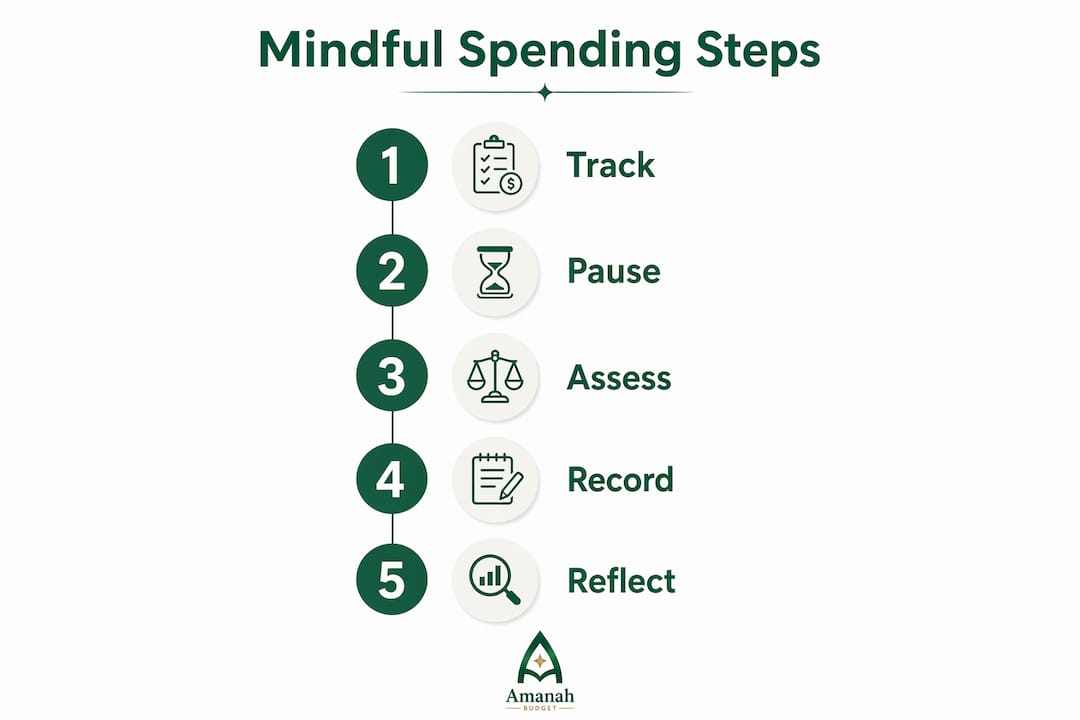
Five evidence-based habits consistently reduce household expenses and build financial confidence. Each one works by interrupting the automatic, emotion-driven cycle that leads to regret.
-
Track every purchase for 30 days. Write down what you bought, how much it cost, and how you felt at the time. This single habit boosts financial confidence by 23% within four weeks, because patterns become visible only when they are recorded.
-
Apply the 24-hour rule. Before any non-essential purchase over $30, wait a full day. The 24-hour pause reduces impulse buying by up to 40%. The mechanism is neurological: dopamine-driven urges that feel urgent in the moment fade significantly within hours.
-
Set a weekly discretionary spending limit. Assign a fixed dollar amount to non-essential categories each week. When the limit is reached, spending stops. This creates a natural checkpoint without requiring you to track every category in detail.
-
Shop with a written list. Whether for groceries, clothing, or household goods, a pre-written list reduces in-store or in-app impulse additions. The list externalizes your intentions before the shopping environment activates emotional responses.
-
Automate savings before spending. Move savings to a separate account on payday, before discretionary spending begins. This removes the decision entirely.
Together, these five habits can reduce household expenses by $200 to $400 monthly. That is not a trivial number. For a Muslim family saving toward Hajj or building an emergency fund, that margin is the difference between a goal reached and a goal deferred.
| Technique | Primary benefit |
|---|---|
| 30-day purchase tracking | Reveals hidden spending patterns |
| 24-hour rule | Reduces impulse purchases by up to 40% |
| Weekly spending limits | Creates natural checkpoints without micromanaging |
| Shopping lists | Blocks in-environment impulse additions |
| Automated savings | Removes willpower from the savings equation |
Pro Tip: When you record a purchase, add one word describing your emotional state. “Tired,” “bored,” or “excited” next to a transaction tells you more about your spending than the dollar amount alone.
How does spending mindfulness differ from frugality and budgeting?
These three concepts are related but not interchangeable. Confusing them leads to frustration, because the strategies and mindsets required are genuinely different.
Frugality is a value system that prioritizes minimizing spending as an end in itself. A frugal person may decline a quality purchase even when it aligns with their values, simply because it costs money. Frugality can produce financial results, but it often creates a scarcity mindset that generates its own stress.
Budgeting is a planning and tracking system. Tools like spreadsheets, envelope budgeting, or apps help you allocate income across categories and measure whether you stayed within those allocations. Budgeting is quantitative. It answers the question of how much.
Spending mindfulness adds the emotional and intentional layer that neither frugality nor budgeting addresses. It allows discretionary spending with full awareness. You can spend on something you love, as long as that choice is conscious and aligned with your priorities. The goal is not to spend less. The goal is to spend in ways that genuinely reflect what matters to you.
Consider the difference in practice:
- A frugal approach says: “I should not buy this because it costs $80.”
- A budgeting approach says: “I have $120 left in my clothing budget, so I can buy this.”
- A mindful spending approach says: “I want this. Does it reflect my values? Will I use it? Am I buying it because I need it or because I am stressed?”
The third question is the one that changes behavior over time. Mindful spending does not conflict with budgeting. It deepens it. When you understand why you overspend in certain categories, you can address the root cause rather than just the symptom.
What psychological factors drive impulsive spending?
The HALT acronym, developed in behavioral psychology and now widely used in financial counseling, identifies four emotional states that reliably trigger impulsive spending: Hungry, Angry, Lonely, Tired. When you are in any of these states, your brain seeks a fast reward. A purchase delivers a dopamine hit that temporarily relieves the discomfort. The HALT framework gives you a simple checkpoint before spending: identify which state you are in, address the actual need, and then decide whether the purchase still makes sense.
A second psychological trap is hedonic adaptation. Research shows that purchases provide short-term happiness that fades quickly as the new item becomes the new normal. This is why lifestyle creep is so persistent. Each upgrade feels satisfying briefly, then becomes the baseline, and the next upgrade is needed to recreate the feeling. Mindful spending interrupts this cycle by asking whether a purchase will provide lasting value or only temporary relief.
Emotional state tracking is the most direct tool for addressing both traps. Recording how you feel at the moment of purchase, not just what you bought, reveals whether you are spending to meet a genuine need or to manage an emotional state. Over time, this data shows your personal impulse patterns with precision that no budget spreadsheet can match.
Pro Tip: Before any unplanned purchase, run through HALT. If you are Hungry, Angry, Lonely, or Tired, address that state first. Eat something, take a walk, call someone, or rest. Then return to the purchase decision with a clearer mind.
How to practice spending mindfulness daily
Building spending awareness into your daily routine does not require hours of journaling or complex systems. The most effective practices are small, consistent, and attached to existing habits.
- Morning intention: Before the day begins, review your planned spending for the day. This takes two minutes and sets a conscious frame for financial decisions.
- Real-time tracking: Log each purchase immediately using a notes app or a dedicated budgeting tool. The act of recording in the moment creates a brief pause that itself reduces impulsive follow-on spending.
- Evening review: Spend five minutes at the end of the day reviewing what you spent and how you felt. This is where emotional state tracking becomes most useful. Patterns emerge within two weeks.
- Apply the cost-per-use model: For larger purchases, divide the price by the number of times you expect to use the item. A $200 coat worn 100 times costs $2 per use. A $50 item used twice costs $25 per use. This cost-per-use framework reframes expensive purchases as investments and cheap impulse buys as poor value.
- Use technology intentionally: Expense tracking apps that categorize spending automatically reduce the friction of daily logging. The key is choosing a tool that reflects your actual spending categories, not generic defaults.
For Muslim families, this practice connects naturally to the Islamic principle of amanah, or trustworthiness in stewardship. Spending mindfully is an act of honoring the resources you have been given. Amanahfund’s family spending tracking resources offer a framework specifically designed for households managing shared finances with Islamic values in mind.
Key takeaways
Spending mindfulness produces lasting financial change because it addresses the emotional and intentional layer that budgeting alone cannot reach.
| Point | Details |
|---|---|
| Core definition | Spending mindfulness means conscious, values-aligned financial decisions, not deprivation. |
| Most effective technique | The 24-hour rule reduces impulse purchases by up to 40% by letting dopamine urges pass. |
| Psychological root cause | HALT states (Hungry, Angry, Lonely, Tired) drive most impulsive spending decisions. |
| Mindfulness vs. budgeting | Budgeting tracks amounts; mindful spending examines the emotional reasons behind them. |
| Measurable outcome | Five mindful spending habits can reduce household expenses by $200 to $400 monthly. |
Why I think most people approach mindful spending backwards
Most guides tell you to start with a budget. Track your categories, set limits, and stick to them. I spent years doing exactly that, and it never held. The numbers were right. The behavior was not.
What actually changed things for me was starting with the emotional layer, not the financial one. When I began noting how I felt at the moment of each purchase, I realized that most of my unplanned spending happened in a single emotional state: low-grade fatigue after a long day. That insight was worth more than any spreadsheet.
The uncomfortable truth about spending mindfulness is that it requires you to sit with discomfort rather than spend through it. That is harder than setting a budget. It is also far more durable. A budget tells you when you have failed. Mindful spending tells you why, and that distinction changes everything.
Start with one week of emotional tracking. Do not change your spending at all. Just record what you buy and how you feel. The pattern you find will tell you exactly where to focus. No generic advice required.
— Imran
How Amanahfund supports your mindful spending practice
Amanahfund is built for Muslim families who want their financial tools to reflect their values. The Amanah Budget app combines halal-aware spending categories, AI-assisted transaction categorization, and shared household budgets so that mindful spending becomes a daily practice rather than a periodic resolution. You can set savings goals for Hajj, Umrah, Ramadan, and Eid alongside your regular budget, and calculate zakat using your preferred madhab. Explore the Amanah Budget app to see how intentional financial stewardship works when the tool is built around your deen and your dunya.
FAQ
What is spending mindfulness in simple terms?
Spending mindfulness is the practice of pausing before financial decisions to ask whether a purchase aligns with your values and genuine needs. It focuses on awareness and intention rather than strict restriction.
How is mindful spending different from budgeting?
Budgeting tracks how much you spend across categories. Mindful spending examines why you spend, addressing the emotional triggers and values alignment that determine whether spending patterns change long-term.
What is the 24-hour rule in mindful spending?
The 24-hour rule means waiting a full day before completing any non-essential purchase over $30. This pause allows dopamine-driven impulses to fade, reducing impulse buying by up to 40%.
What are the HALT triggers in spending?
HALT stands for Hungry, Angry, Lonely, and Tired. These four emotional states reliably trigger impulsive spending because the brain seeks a fast reward. Checking your HALT state before an unplanned purchase is one of the most direct mindful spending exercises available.
How quickly do mindful spending habits show results?
Tracking purchases daily for four weeks builds financial confidence by 23%, and consistent application of five core habits can reduce monthly household expenses by $200 to $400.
Recommended
Ready to manage your amanah?
Track halal spending, calculate zakat, save for Hajj — all in one app. Free forever.
Create Free Account