What Is Family Financial Planning: A Family Guide

Family financial planning is the process of managing your household’s money in a coordinated way, covering everything from daily expenses to retirement and wealth protection. Most people think of it as just keeping a budget, but that misses the larger picture. A solid plan spans budgeting, saving, investing, insurance, tax, and estate planning to address every member’s needs, not just one person’s goals. This article walks you through each component with clear, practical steps so your family can build lasting financial stability and confidence.
Table of Contents
- Key Takeaways
- What is family financial planning, really
- Budgeting and cash flow basics
- Building your family emergency fund
- Insurance, estate planning, and risk management
- Investment and tax planning for families
- Reviewing and maintaining your financial plan
- My honest take on family financial planning
- Start planning with Amanahfund
- FAQ
Key Takeaways
| Point | Details |
|---|---|
| Planning goes beyond budgeting | Family financial planning coordinates income, savings, insurance, investments, and estate decisions for the whole household. |
| Start with a budget foundation | Use a structured approach like the 50/30/20 rule to balance spending, saving, and debt repayment every month. |
| Emergency funds are non-negotiable | Build a fund covering 3 to 6 months of essential expenses to avoid costly borrowing during unexpected setbacks. |
| Protect what you build | Life, health, and disability insurance combined with a basic estate plan prevent financial hardship from derailing your progress. |
| Review plans regularly | Annual checkups and reviews after major life events keep your plan aligned with where your family actually stands. |
What is family financial planning, really
Most households treat finances in silos. One person handles the bills, another manages savings, and nobody has a full picture of where the family stands. Family financial planning changes that. It is a coordinated, intentional process that aligns every financial decision with your household’s shared goals, whether that is buying a home, funding your children’s education, or retiring comfortably.
Think about the difference between individual and family financial management. When you manage money for yourself alone, your decisions affect one person. The moment you add a spouse, children, or aging parents to the picture, every financial choice carries more weight. A job loss, an unexpected medical bill, or a missed insurance payment can affect the entire household.
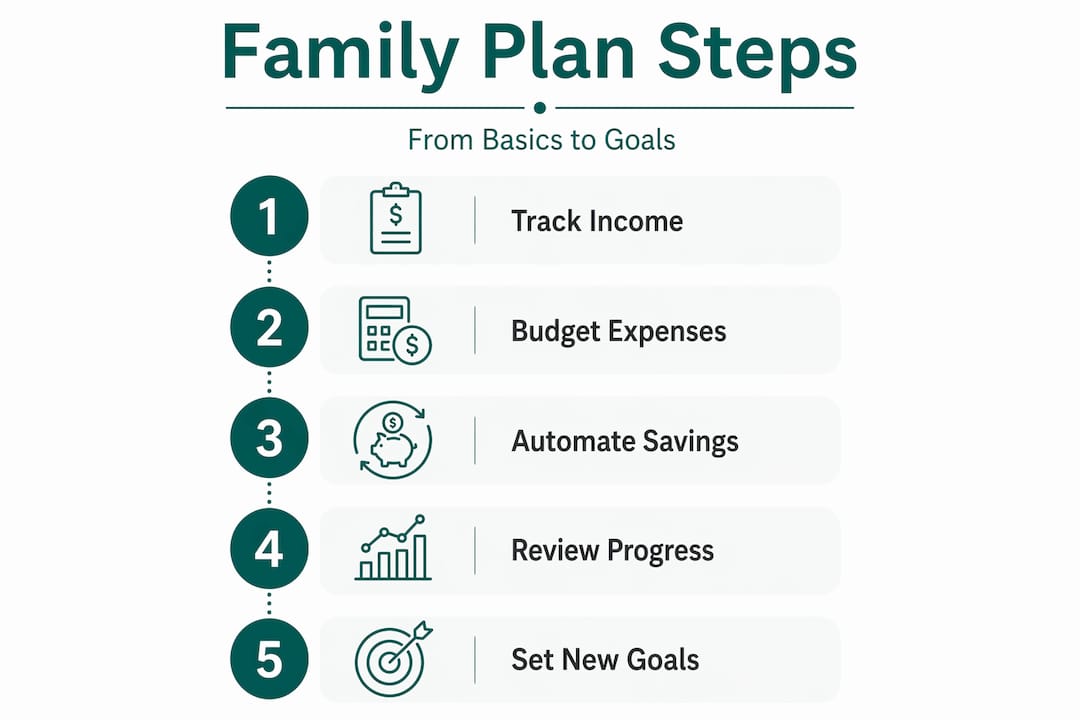
A genuine family financial plan creates a baseline snapshot of net worth and cash flow so you know exactly where you are before deciding where to go. From that starting point, you build outward into budgeting, saving, investing, protection, and planning for what you leave behind.
Budgeting and cash flow basics
A family budget is a plan that tracks all household income and expenses over a defined period, typically a month or a year. It is the operational engine that makes every other part of your financial plan possible. Without it, savings feel random and financial goals stay abstract.
A practical starting framework is the 50/30/20 budgeting rule, which divides your after-tax income this way:
- 50% for needs: Rent or mortgage, groceries, utilities, transportation, and insurance premiums.
- 30% for wants: Dining out, subscriptions, vacations, and entertainment.
- 20% for savings and debt repayment: Emergency fund contributions, retirement accounts, and paying down loans faster than minimum payments require.
This framework is a starting point, not a rigid rule. Families in high cost-of-living cities often need to shift the percentages. A family paying 40% of income in rent may need to compress the “wants” category significantly until their housing situation changes.
To maintain discipline, track your family spending habits consistently. Families who review their spending weekly catch drift early, rather than discovering a problem at the end of the month when it is harder to correct.
Pro Tip: Automate your savings the same day your paycheck clears. Treating savings as a fixed expense, like rent, removes the decision entirely and protects your goals from impulse spending.
Building your family emergency fund
An emergency fund is one of the few financial tools that serves every family regardless of income level. Its purpose is simple: cover unexpected costs or income disruption without forcing you to borrow money at high interest rates. Emergency funds prevent families from turning to high-cost borrowing during a crisis, which can set a household back by months or years.
Experts recommend building a fund that covers 3 to 6 months of essential household expenses, and Fidelity suggests starting with at least $1,000 as an immediately accessible buffer. Here is how to build your fund incrementally:
- Set a first milestone of $1,000. This small buffer handles most minor emergencies like a car repair or a medical copay without disrupting your regular budget.
- Identify a dedicated, accessible account. A high-yield savings account separate from your checking account works well. It earns modest interest without tempting you to spend the balance.
- Automate a fixed contribution each month. Even $100 a month builds to $1,200 in a year. Consistency matters more than the amount at this stage.
- Scale toward one month of expenses, then three, then six. Each milestone gives your family a measurably stronger safety net.
- Treat the fund as protected money. It is not for planned expenses like a vacation or a new appliance. It exists solely for genuine emergencies.
Pro Tip: When you receive a tax refund, bonus, or any unexpected income, deposit a portion directly into your emergency fund before it enters your regular checking account. This single habit accelerates progress faster than most monthly contributions.
Insurance, estate planning, and risk management
Comprehensive family financial planning includes insurance, estate planning, and risk management working together as a protection layer around everything else you build. Many families skip this layer because it feels distant or uncomfortable. The cost of skipping it, though, can be severe.
Here are the core protections every family should consider:
- Life insurance: Replaces income if a primary earner passes away. Term life insurance is straightforward and affordable for most families with dependents.
- Health insurance: Covers medical expenses and prevents a single hospitalization from wiping out savings.
- Disability insurance: Often overlooked, this replaces a portion of income if illness or injury prevents you from working. The Social Security Administration reports that one in four workers will experience a disability before retirement age.
- Homeowners or renters insurance: Protects physical assets and provides liability coverage.
Estate planning does not require significant wealth to be relevant. At minimum, a family needs:
- A will that specifies how assets are distributed and names a guardian for minor children.
- A power of attorney designating someone to manage finances if you become incapacitated.
- Properly designated beneficiaries on all accounts, including retirement accounts and life insurance policies.
For families looking deeper into legacy planning and how insurance fits into a long-term family security strategy, Premier 72 offers specialized guidance on business continuity and family legacy structures.
Annual financial checkups should include a review of insurance coverage amounts and estate documents to catch outdated beneficiaries or coverage gaps before they become problems.
Investment and tax planning for families
Building wealth for your family requires more than saving money in a checking account. Smart investment and tax planning strategies put your money to work over time and reduce what you give to the government unnecessarily.
Start with tax-advantaged accounts that directly benefit families:
- Roth IRA: Contributions grow tax-free, and withdrawals in retirement are tax-free. For families in lower income brackets today, this is particularly valuable.
- 529 education savings plan: Contributions grow tax-free when used for qualified education expenses. Starting early, even with small monthly contributions, creates a meaningful fund by college age.
- Employer 401(k) with matching: If your employer matches contributions, capturing the full match is an immediate 50% to 100% return on that portion of your savings.
Tax planning for families also means being aware of deductions and credits available to you, including the child tax credit, dependent care credit, and mortgage interest deduction. A common mistake is treating taxes as something you address in April rather than throughout the year. Families who manage tax anxiety proactively through year-round planning consistently pay less and experience less financial stress.
Review your investment portfolio at least once a year. As your children grow, your timeline for certain goals shortens, and your asset allocation should reflect that shift. A portfolio appropriate for a young family with a 20-year horizon looks very different from one suited for parents approaching retirement.

Pro Tip: If your family’s income or expenses changed significantly during the year, adjust your tax withholding or estimated payments accordingly. Waiting until tax season to make corrections creates preventable stress and can trigger underpayment penalties.
Reviewing and maintaining your financial plan
A family financial plan is not a document you create once and file away. Families should review and update their plans annually or after any major life change. Here is a structured approach to keeping your plan current:
- Schedule an annual family finance review. Pick a consistent date, perhaps each January or after you file taxes, and block time to assess every component of your plan.
- Check your budget against reality. Compare what you planned to spend with what you actually spent. Identify categories that consistently run over and adjust allocations honestly.
- Reassess your financial goals. Goals shift as families grow. A goal set three years ago may need to be reprioritized, extended, or replaced entirely.
- Review insurance coverage. A new baby, a home purchase, or a salary increase may all warrant coverage adjustments. Outdated coverage leaves gaps.
- Verify beneficiary designations. These are commonly overlooked after marriage, divorce, or the birth of a child, and they override what your will says.
- Evaluate investments relative to your timeline. If a major goal is three years away rather than ten, the investment strategy should become more conservative.
Building from financial basics reduces stress and creates forward momentum. Regular reviews are what transform a plan from a static document into a living tool your family actually uses.
My honest take on family financial planning
I have spent years watching families approach financial planning with the best intentions, only to stall because they expected to have everything figured out before they started. That is the most common and most costly misconception I see.
Family financial planning is not a privilege reserved for households with high incomes or large savings. It is a practice available to anyone willing to be honest about where they are and intentional about where they want to go. You do not need a financial advisor to start. You need a realistic budget, a small emergency fund, and a few protected conversations with your household about shared priorities.
The emotional dimension of family finance is real and often underestimated. Money conversations between spouses carry history, values, and sometimes fear. Framing those conversations around shared goals, rather than past spending decisions, changes the dynamic completely.
What I have found is that the families who make consistent progress are not the ones with the most sophisticated strategies. They are the ones who check in regularly, adjust honestly, and treat flexibility as a strength rather than a failure. Start where you are. Build incrementally. Review often.
— Imran
Start planning with Amanahfund
If you are ready to put these principles into practice, Amanah Budget was built specifically for families who want a budgeting tool that reflects their values.

With the Amanah Budget app, Muslim families can track spending with halal-aware categories, calculate zakat using their preferred madhab, and save intentionally toward goals like Hajj, Umrah, Ramadan, Eid, education, and emergencies. Shared household budgets let spouses and family members stay aligned without separate spreadsheets. AI-powered transaction categorization removes the manual work of tagging expenses, so your focus stays on decisions rather than data entry. For practical guidance on structuring your household finances, the best budgeting strategies guide on the Amanah Budget blog gives you a clear starting point grounded in real family needs.
FAQ
What does family financial planning include?
Family financial planning spans budgeting, saving, investing, insurance, tax, and estate planning to address a household’s current needs and long-term goals. It is a coordinated approach that covers every member of the family, not just the primary earner.
How much should a family keep in an emergency fund?
Most financial experts recommend saving 3 to 6 months of essential household expenses. Starting with a goal of $1,000 gives you an immediate buffer while you build toward a fuller fund over time.
When should we review our family financial plan?
Review your plan at least once a year and after any significant life event such as a new child, a job change, a home purchase, or a marriage. Annual reviews help you catch outdated coverage, missed goals, and shifting priorities before they create larger problems.
Is family financial planning only for high-income households?
No. Family financial planning is relevant at every income level. The goal is to manage what you have in a way that reduces stress, protects your household, and builds toward your family’s specific goals, regardless of how large or small your income is.
How is family financial planning different from personal financial planning?
Personal financial planning focuses on one individual’s income, expenses, and goals. Family financial planning must account for multiple people with different needs, shared expenses, combined income, and joint long-term goals like raising children or caring for aging parents.
Recommended
- What is a family financial council: A guide for Muslim families — Amanah Budget Blog
- What is a family financial council: A guide for Muslim families — Amanah Budget Blog
- Interfaith financial planning: a Muslim family’s guide — Amanah Budget Blog
- Interfaith financial planning: a Muslim family’s guide — Amanah Budget Blog
Ready to manage your amanah?
Track halal spending, calculate zakat, save for Hajj — all in one app. Free forever.
Create Free Account