What Is a Subscription Budgeting Model for Households

TL;DR:
- The subscription budgeting model categorizes all recurring expenses and establishes hard caps for better financial control. Regular monthly reviews help households track, cancel, or downgrade subscriptions, preventing surprises and duplicate charges. This intentional approach promotes disciplined spending aligned with values, especially for Muslim families practicing amanah.
The subscription budgeting model is defined as a household financial system that assigns all recurring subscription costs to specific spending categories or a hard cap, then reviews them regularly to decide what to keep, downgrade, or cancel. This approach covers every recurring charge you pay, from streaming services and software licenses to gym memberships and meal kits. The model works by converting scattered monthly and annual charges into a single, visible budget structure you actively manage. For Muslim families using tools like Amanahfund, this kind of intentional spending control aligns directly with the Islamic principle of amanah, or responsible stewardship of what you have been given.
What is the subscription budgeting model and how does it work?
The subscription budgeting model, sometimes called recurring expense budgeting in personal finance circles, works through four repeating steps: inventory, annualize, categorize, and review. Each step builds on the last to give you a clear, honest picture of what your household actually spends on subscriptions every month.
Here is how to put the model into practice:
- List every active subscription. Write down the service name, monthly or annual cost, billing date, and renewal type (auto-renew or manual). Include everything: Netflix, Spotify, Adobe Creative Cloud, Amazon Prime, iCloud storage, and any app subscriptions on your phone.
- Annualize and normalize costs. Annual subscriptions divided by 12 create a monthly equivalent that fits neatly into your budget. A $120 annual plan becomes $10 per month on paper, preventing the shock of a large charge hitting your account once a year.
- Assign each subscription to a category. Group services by type: entertainment, productivity, health, education, and household utilities. Each category gets its own spending envelope or sub-limit within your overall budget.
- Set a hard cap. Decide the maximum your household will spend on subscriptions in total, and set individual caps per category. Hard-cap budgeting requires proactive review of upcoming renewals so you can cancel or keep services before the charge posts.
- Schedule a monthly review. A 10-minute monthly check of your subscription tracker, upcoming renewals, and any price changes is strongly associated with controlled spending over time.
Pro Tip: Set a recurring calendar reminder on the first of each month labeled “Subscription Review.” Treat it like a bill payment appointment, not an optional task.
The model does not require expensive software. A simple spreadsheet with five columns covers the basics. What matters is the habit of reviewing, not the tool you use to track.

Which subscription budgeting method fits your household?
Three main approaches exist for managing subscription budgets, and each suits a different type of household. Choosing the right one depends on your income stability, household size, and how much structure you need.
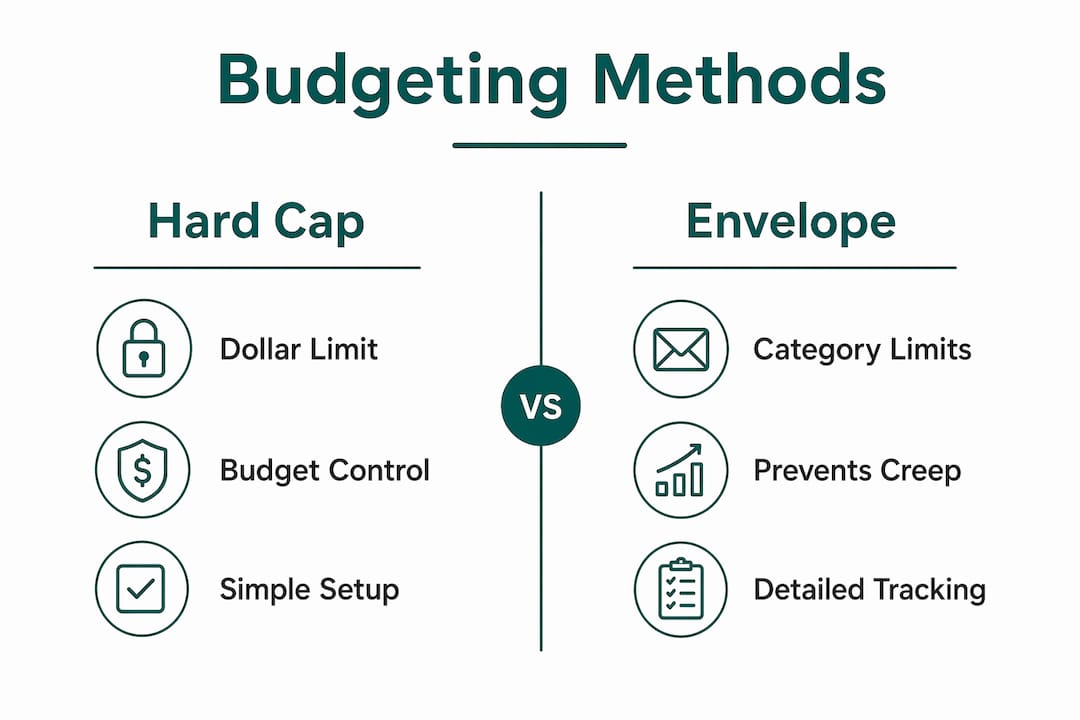
| Method | How it works | Best for | Main trade-off |
|---|---|---|---|
| Hard cap | Set a total dollar limit; cancel subscriptions when the limit is reached | Single earners, fixed incomes | Requires manual discipline at every renewal |
| Envelope budgeting | Assign a fixed amount per category; new subscriptions require removing an existing one | Families with multiple users | Less flexible when needs change quickly |
| Hybrid model | Combine category envelopes with an overall spending ceiling | Households with variable income | Slightly more complex to set up initially |
The envelope budgeting method assigns fixed spending limits by category and prevents subscription creep structurally rather than by transaction tracking. When the entertainment envelope is full, adding a new service means removing an existing one. This structural constraint removes the need to debate every small charge individually.
Hard-cap budgeting, by contrast, enforces a single ceiling across all subscriptions. It is simpler to manage but demands that you review your renewal calendar proactively. No app currently blocks charges automatically, so the control is entirely manual.
Key factors to consider when choosing your approach:
- Household size: Larger families benefit from envelope budgeting because multiple people use different services across different categories.
- Income variability: Freelancers or commission-based earners often prefer the hybrid model, which allows category flexibility while maintaining an overall ceiling.
- Tech comfort: If you prefer simplicity, the hard-cap method with a basic spreadsheet works well. If you want more granular visibility, envelope budgeting inside a dedicated app gives you that structure.
Common pitfalls in subscription budgeting and how to avoid them
Subscription budgeting fails in predictable ways. Knowing the traps in advance makes them much easier to sidestep.
Annual renewal shocks are the most common problem. A $99 annual charge for Amazon Prime or a $149 charge for an antivirus subscription hits your account without warning if you have not annualized it. Dividing annual costs by 12 and recording them as monthly equivalents solves this completely.
Duplicate subscriptions are a major unseen household expense. Household subscription duplication often goes unnoticed because different family members sign up for overlapping services independently. Two people in the same household might each pay for separate cloud storage plans, music services, or news subscriptions. A consolidated household inventory with one default service per category eliminates this overlap.
Subscription creep is the gradual accumulation of small charges that individually feel insignificant. A $3 app here, a $6 newsletter there. Over twelve months, these add up to hundreds of dollars. The psychological trap is that each charge feels too small to cancel but too small to notice. The envelope method counters this by making the category limit visible and non-negotiable.
- Review bank and credit card statements line by line at least once per quarter to catch charges you have forgotten about.
- Use a single payment method for all subscriptions so nothing slips through on a secondary card.
- Set calendar reminders three days before every annual renewal so you have time to cancel if needed.
- Apply a “one in, one out” rule within each spending category to prevent accumulation.
Pro Tip: When auditing your subscriptions, check your Apple App Store, Google Play, and PayPal recurring payments separately. Many forgotten subscriptions hide in these accounts rather than on your main credit card.
Benefits of adopting a subscription budgeting model
The subscription budgeting model delivers financial and behavioral benefits that go beyond simply spending less money.
“Subscription budgeting is less about eliminating subscriptions and more about creating intentional spending caps that enforce choices at signup and renewal, fostering financial discipline.” — TrackAllSubs
Predictability is the most immediate gain. Converting irregular subscription payments into predictable monthly amounts improves your ability to forecast expenses and protect savings goals. When you know exactly what leaves your account each month, you can plan around it with confidence.
Intentional spending is the behavioral shift the model creates. The model forces a conscious decision at every signup and renewal moment. You are no longer passively accumulating services. You are actively choosing what earns a place in your budget. This aligns well with the Islamic concept of avoiding israf, or wasteful spending, which Amanahfund builds into its halal-first budgeting framework.
Improved cash flow management follows naturally. Households that track family spending habits consistently report better awareness of where money goes and stronger ability to redirect funds toward savings goals like Hajj, Umrah, or an emergency fund.
Prevention of impulse subscriptions is a structural benefit. When you have a hard cap or a full envelope, signing up for a new service requires a deliberate trade-off. That friction alone stops many unnecessary subscriptions before they start.
Tools and digital strategies for managing your subscription budget
The right tools reduce the effort required to maintain a subscription budget and make the review process faster.
- Subscription tracking apps like SubRadar, Subtrakr, and Subnesio are built specifically for listing, categorizing, and monitoring recurring charges. They surface renewal dates and total monthly costs in one view.
- Spreadsheet templates in Google Sheets or Microsoft Excel work well for households that prefer full control. A five-column layout covering service name, monthly equivalent, category, renewal date, and status covers everything you need.
- Notion databases allow households to build a subscription inventory with filters, tags, and linked renewal reminders. This suits families who already use Notion for household organization.
- Calendar reminders in Google Calendar or Apple Calendar serve as a low-tech but reliable safety net. Set reminders three to five days before every annual renewal.
- Broader personal finance apps with expense tracking features can integrate subscription categories alongside your full household budget, giving you a single dashboard for all spending.
The goal of any tool is to make your subscription inventory visible. Digital visibility reinforces the manual discipline the model requires. Without visibility, even the best budgeting intentions break down within a few months.
Key takeaways
The subscription budgeting model works because it converts invisible recurring charges into a visible, capped, and regularly reviewed budget structure that forces intentional spending decisions.
| Point | Details |
|---|---|
| Annualize all subscriptions | Divide annual charges by 12 to normalize costs and prevent renewal shocks. |
| Choose the right method | Hard cap suits simple households; envelope budgeting suits families with multiple users. |
| Review monthly | A 10-minute monthly review prevents accumulation and keeps spending within limits. |
| Audit for duplicates | Consolidate household subscriptions to one default per category to eliminate overlap. |
| Intentional spending wins | The model creates friction at signup and renewal, not just a record of what you spent. |
Why subscription budgeting changed how I think about recurring expenses
Before I started applying a subscription budgeting model to my own household, I genuinely believed I had a handle on what we were spending. I was wrong. When I sat down and listed every active subscription across two adults, two phones, and a shared laptop, the total was nearly double what I had estimated. The individual charges were small enough that none of them felt significant. Together, they were a meaningful leak.
What surprised me most was not the total. It was how many services we had forgotten we were paying for. Two separate cloud storage plans. A news subscription nobody had opened in four months. A fitness app that had auto-renewed for the second year without anyone noticing.
The monthly review habit was the single most effective change. Not an annual audit, not a dramatic cancellation session, just ten minutes on the first of each month to check the list, confirm upcoming renewals, and make one or two decisions. That rhythm keeps the budget honest without requiring constant attention.
One misconception worth addressing directly: subscription budgeting is not about cutting everything down to zero. It is about intentional spending limits that make every service earn its place. Some subscriptions are worth every dollar. The model just makes sure you are choosing them consciously rather than accumulating them passively.
For families managing budgets together, the shared household budget approach makes this even more effective. When both spouses can see the subscription inventory, decisions become conversations rather than surprises.
Start simple. One list, one cap, one monthly review. Build from there.
— Imran
How Amanahfund supports your subscription budgeting goals

Amanahfund is built for Muslim families who want financial tools that reflect their values, and that includes managing recurring expenses with clarity and intention. The Amanah Budget app gives your household a single place to track spending across halal-aware categories, set savings goals for Hajj, Umrah, Ramadan, and Eid, and share budget visibility with your spouse or family members. AI-assisted transaction categorization means your subscription charges are automatically sorted, so your monthly review takes minutes rather than hours. No ads, no data selling, no interest-based products. Just a clean, values-aligned tool built to help you spend with purpose. Start managing your household budget with Amanahfund today.
FAQ
What is the subscription budgeting model?
The subscription budgeting model is a household financial system that assigns all recurring subscription costs to spending categories or a hard cap and reviews them regularly to decide what to keep or cancel. It converts scattered monthly and annual charges into a visible, manageable budget structure.
How does subscription budgeting work in practice?
Subscription budgeting works by listing all active subscriptions, dividing annual charges by 12 to create monthly equivalents, assigning each service to a spending category, setting a hard cap, and conducting a short monthly review of upcoming renewals.
What is the difference between hard-cap and envelope subscription budgeting?
Hard-cap budgeting sets one total spending ceiling across all subscriptions, while envelope budgeting assigns fixed limits per category and requires removing one subscription before adding another within that category.
What are the main benefits of subscription budgeting?
The main benefits include predictable monthly cash flow, prevention of impulse subscriptions, elimination of duplicate charges, and intentional spending decisions at every signup and renewal point.
How often should I review my subscription budget?
A monthly review of 10 minutes checking your tracker totals, upcoming renewals, and any price changes is the most effective frequency for keeping subscription spending under control.
Recommended
Ready to manage your amanah?
Track halal spending, calculate zakat, save for Hajj — all in one app. Free forever.
Create Free Account