What Is a Charitable Giving Budget? A 2026 Guide

Most people give to charity the same way they buy coffee. Something catches their attention, they feel a pull, and they give. A charitable giving budget changes that entirely. It transforms your philanthropy from a reaction into a plan, one that reflects your actual financial picture and your real values. This guide explains what a charitable giving budget is, how to build one that fits your life, and how the 2026 tax changes affect your strategy.
Table of Contents
- Key takeaways
- What is a charitable giving budget?
- Common methods for setting your giving amount
- How 2026 tax laws affect your giving strategy
- Balancing ongoing giving with emergency response
- Practical tips for sticking to your budget
- My take on intentional giving
- How Amanahfund supports your giving goals
- FAQ
Key takeaways
| Point | Details |
|---|---|
| Define your giving plan | A charitable giving budget specifies causes, amounts, frequency, and timing in writing. |
| Build from cash flow, not just income | Factor in debts, savings, and essentials before setting any giving target. |
| Use percentage-based methods | Giving 1% to 5% of gross income scales your donations sustainably as your finances change. |
| Know the 2026 tax rules | Non-itemizers can now deduct up to $2,000 in cash gifts, and bunching strategies matter more than ever. |
| Automate and review annually | Consistent giving protects your budget from accidental overspending or last-minute reactive donations. |
What is a charitable giving budget?
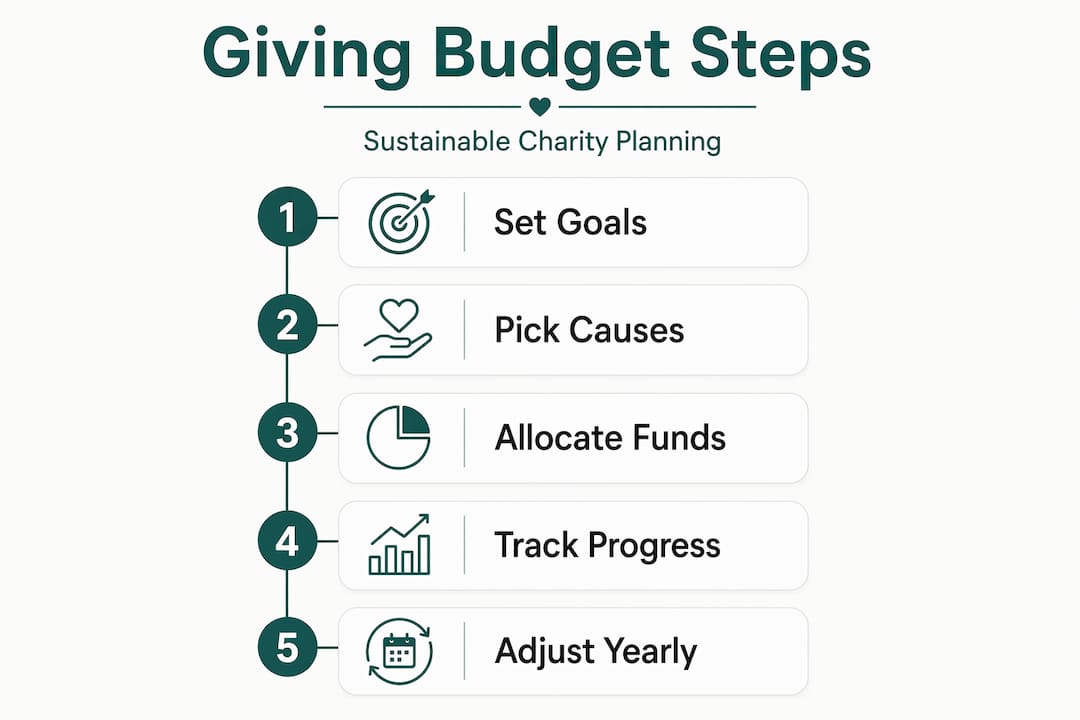
A charitable giving budget is a written plan specifying which causes you will support, how much you will give in any given year, and when and how those gifts will happen. Think of it as the philanthropy version of a savings goal. You are not waiting to see what is left over at year-end. You are deciding in advance.
It is worth clarifying what this is not. A charitable giving budget is distinct from a nonprofit operating budget, which is the financial plan a charity uses to manage its own income and expenses. Your personal giving budget focuses entirely on your role as a donor. What you give, to whom, and why.
The strongest giving budgets are built from a complete view of your finances, not just your income. A good charity spending plan starts with your monthly cash flow, accounts for fixed expenses, debt repayment, and emergency savings, and then identifies how much is genuinely available for giving. From there, you define two targets:
- Giving floor: The minimum you commit to giving, no matter what, in any given year
- Stretch goal: The higher amount you aim for in good financial years
This framework keeps your giving sustainable. You do not need to cut your charitable giving to zero during a tight month. You just hold to the floor.
Pro Tip: If you are unsure where to start, read this guide on the best budgeting strategy for families. It breaks down how to map your full financial picture before setting any giving targets.
Common methods for setting your giving amount
Once you understand what a charitable giving budget is, the next question is practical. How do you actually decide on a number? Several methods work well depending on your financial situation.
-
Percentage of gross income. Conservative households give around 1% of gross income annually, while growth-oriented donors aim for 3% to 5%, sometimes paired with a donor-advised fund for larger gifts. This method scales naturally as your income rises or falls, which makes it one of the most durable approaches.
-
Percentage of discretionary spending. Rather than tying giving to total income, some families allocate a share of their non-essential spending. A charitable donation budget built this way adapts quickly to life changes, since discretionary spending tends to shrink first in tight months.
-
Average of your past three years. Averaging your actual donations over the previous three years gives you a realistic baseline. It accounts for years when you gave more and years when you gave less, producing a number you can actually commit to.
-
Automated monthly donations. Setting up a recurring monthly donation treats giving like a bill. You decide the amount once, automate it, and the money goes to your chosen causes before you have a chance to spend it elsewhere.
-
Donor-advised funds for major gifts. If you expect a higher-income year due to a bonus, sale of assets, or inheritance, you can contribute a larger lump sum into a donor-advised fund. You receive the tax deduction immediately and distribute grants to charities over multiple years.
Pro Tip: Consider connecting your automated recurring donations to a dedicated giving account, separate from your main checking account. When the money moves automatically, you treat it as spent, which removes the temptation to redirect it.
How 2026 tax laws affect your giving strategy
Tax law changes in 2026 have shifted the math on charitable giving in ways that matter for every family, whether you itemize or not.
Here is a comparison of the key 2026 rules versus how most people have operated in recent years:
| Situation | Pre-2026 approach | 2026 rule |
|---|---|---|
| Itemizers | Deduct full charitable gifts above standard deduction | First 0.5% of AGI is excluded from the deduction |
| High earners | Full tax value on every dollar donated | Deduction value capped at 35 cents per dollar donated |
| Non-itemizers | No charitable deduction available | Can deduct up to $1,000 single / $2,000 joint in cash gifts |
| Age 70½ or older | Qualified Charitable Distributions allowed | QCDs remain a powerful, tax-efficient giving option |
The universal charitable deduction is genuinely good news for middle-income families who take the standard deduction. You no longer need to itemize to receive any tax benefit from your giving.
For higher earners, the picture is more complex. The 2026 deduction floor and cap make bunching strategies more valuable. Bunching means concentrating multiple years of charitable giving into a single high-income year using a donor-advised fund, then granting to charities over time. This approach preserves more of your tax benefit while keeping your actual giving consistent year to year.
Tax considerations should inform your giving plan, but they should not drive it. Tax-efficient strategies work best when they serve your values, not when your values serve the tax code.
Balancing ongoing giving with emergency response
One of the trickiest parts of setting a charity budget is deciding how to split your funds between causes you support consistently and situations that demand urgent help.

The most effective approach is to decide this split in advance, before a crisis happens. When a natural disaster, humanitarian emergency, or public health crisis captures your attention, having a pre-set allocation means you can respond with intention rather than panic.
A practical structure that works well for many families:
- 80% to core causes: These are the organizations and missions you support every year. Consistent funding matters enormously to nonprofits. It allows them to plan programs, pay staff, and operate without constant fundraising uncertainty.
- 20% to responsive giving: This reserve is specifically for unexpected needs. Natural disasters, refugee crises, or emergency relief funds. When something urgent arises, you have funds ready without breaking your main budget.
This structure also helps you avoid a common trap: over-giving during visible crises and then feeling stretched for the rest of the year. The financial uncertainty of any given year makes it even more important to have this allocation written down before emotions run high.
Pro Tip: Coordinate giving decisions with your household as a team. A shared family budget app keeps both spouses aligned on giving allocations, so neither partner makes a large donation without the other knowing.
Adjusting your allocation is always appropriate when your financial circumstances change significantly. Losing a job, paying off a large debt, or receiving an inheritance are all legitimate reasons to revisit your giving floor and stretch goal. The budget is a living document, not a rigid rule.
Practical tips for sticking to your budget
Knowing your giving amount is step one. Actually directing money to the right places, consistently and without stress, requires a few habits.
-
Automate first. Set up recurring monthly donations to your core causes at the start of the year. Treat this the same way you treat a utility bill. The money leaves your account on a schedule, and you never face the decision of whether to give this month.
-
Open a dedicated giving account. Moving your intended donation funds into a separate account removes the chance that the money gets absorbed into everyday spending. Even a simple savings account labeled “Giving” changes your behavior.
-
Track by organization, not just total. Review your giving at least once a year per organization. Are you still connected to this cause? Is the nonprofit still using funds well? A simple spreadsheet or an expense tracking app makes this review straightforward.
-
Adjust when life changes. A new baby, a job change, a medical expense. These moments are the right time to revisit your budget, not at year-end when you are scrambling. Build a short annual review into your calendar, perhaps in January or after Ramadan, so it becomes a habit.
-
Avoid last-minute, reactive giving. Year-end appeals and social media campaigns create emotional urgency. That urgency leads to unplanned gifts that can throw off your budget. If a cause moves you, note it and include it in next year’s plan instead.
My take on intentional giving
I have worked with enough families to notice a pattern. Most people who struggle with charitable giving do not lack generosity. They lack structure. They give impulsively to whatever appears in their feed, feel good for a moment, then wonder at year-end why their giving never felt consistent or meaningful.
What I have found is that separating annual gifts from major gifts, in writing, changes everything. When you know your recurring $50 a month goes to one cause and your major gift decisions get reviewed carefully at a specific time of year, you stop making giving decisions under pressure.
The 2026 tax changes reinforced something I already believed: you cannot afford to give without a plan anymore. The deduction floor, the cap for high earners, the value of bunching. These are not accounting details. They are real money that stays in or leaves your household. Families who take the time to model their giving strategy now will keep more of their wealth working for good causes.
My advice to anyone starting out is simple. Do not wait until you have the perfect system. Start with a giving floor you can commit to, automate it, and review it once a year. Small and consistent beats large and sporadic, every single time.
— Imran
How Amanahfund supports your giving goals

For Muslim families, charitable giving is not just a financial decision. It is an act of worship. Zakat, sadaqah, and support for the ummah are built into daily life, and your budgeting tools should reflect that.
Amanahfund is designed exactly for this. The app includes halal-aware spending categories, zakat calculation based on your preferred madhab, and shared household budgeting so the whole family stays aligned. You can set dedicated giving goals alongside your Hajj savings, Eid planning, and emergency fund in one place. Every category reflects your values, not just your balance sheet. Start your giving plan with Amanahfund at amanahfund.com and build a philanthropy budget that holds up through every season of life.
FAQ
What is a charitable giving budget?
A charitable giving budget is a written plan that specifies which causes you will support, how much you will give, and when donations will happen. It connects your giving directly to your overall financial picture, including income, expenses, and savings.
How much should I give to charity each year?
A common starting point is 1% to 5% of gross income, with conservative households giving around 1% and growth-focused donors targeting 3% to 5%. Your actual amount should be based on your full financial situation, not income alone.
Can I get a tax deduction if I don’t itemize in 2026?
Yes. Non-itemizers can deduct up to $1,000 in cash charitable gifts if filing single, or $2,000 if filing jointly, thanks to the universal charitable deduction that took effect in 2026.
What is bunching in charitable giving?
Bunching means concentrating multiple years of donations into one high-income tax year, often through a donor-advised fund. This strategy helps donors exceed the 2026 deduction floor and maximize their tax benefit while keeping actual giving consistent over time.
How do I keep from spending my giving budget by accident?
Open a dedicated giving account and move your budgeted donation funds there at the start of each month. Automating this transfer treats the money as already spent, which prevents it from getting absorbed into everyday expenses.
Recommended
Ready to manage your amanah?
Track halal spending, calculate zakat, save for Hajj — all in one app. Free forever.
Create Free Account