Spending Accountability in Islam: A 2026 Guide
TL;DR:
- Spending accountability in Islam requires managing wealth as a divine trust, ensuring earnings are halal and charitable duties are fulfilled. Every financial decision is viewed as a moral act, with principles like moderation, intention, and family obligation guiding responsible spending. Zakat is a mandatory annual obligation that should be prioritized before discretionary expenses, fostering social justice and personal discipline.
Spending accountability in Islam is defined as the obligation to manage all financial resources as a trust (amanah) from Allah, ensuring that earnings are halal, expenditures are balanced and purposeful, and charity obligations are fulfilled. This is not a peripheral concern. According to prophetic tradition, every Muslim will be questioned on the Day of Judgment about four things, two of which concern wealth directly: how it was earned and how it was spent. That framing transforms every financial decision into a moral one. Whether you are budgeting for groceries, planning for Hajj, or calculating zakat, the Islamic framework for financial responsibility treats money not as a personal possession but as a divine trust you are temporarily managing on behalf of Allah and your community.
What Islamic principles guide responsible earning and spending?
Wealth as amanah is the foundational concept: you are not an owner but a trustee, obliged to manage resources justly for the benefit of your family and society. This single shift in perspective changes how you approach every purchase, investment, and charitable act. It moves financial responsibility in Islam from a set of rules into a lived moral orientation.
The following principles shape how that trust is exercised in practice:
- Halal earnings: Income must come from lawful sources. Shariah-compliant financial dealings require distinguishing between lawful and unlawful wealth, which becomes increasingly complex in modern finance involving interest-based accounts, speculative investments, and supply chains with unclear ethical sourcing.
- Iqtisad (moderation): Iqtisad is the Islamic principle of balance in earning, spending, saving, and giving. It is not a call to poverty or frugality for its own sake. It promotes justice and prevents both reckless consumption and miserly hoarding.
- Avoiding israf: Extravagance, or israf, includes spending beyond your means, wasting money on pointless luxuries, or spending to impress others. Critically, israf applies even when the items purchased are halal. The problem is not always what you buy but how much and why.
- Niyyah (intention): The spiritual value of any financial act is determined by intention. Spending on your family with the intention of fulfilling your duty as a provider carries reward. The same spending done to show off carries accountability.
Pro Tip: Before any significant purchase, pause and ask: Is this a need, a want, or a display? That single question aligns your spending with Iqtisad and protects you from israf.
Iqtisad connects material life with moral responsibility. It is not about living minimally. It is about spending justly and using resources in ways that serve a genuine purpose without compromising your religious or social duties.

How does zakat and charitable giving fit into spending accountability?
Zakat is the most concrete financial obligation in Islam. It is a mandatory 2.5% annual giving on qualifying wealth that has been held for one lunar year (hawl) and exceeds the nisab threshold. In 2026, the nisab based on gold is approximately equivalent to the value of 85 grams of gold, and the silver nisab is based on 595 grams of silver. Because gold and silver prices fluctuate, you should verify current nisab values before calculating your obligation each year.
Zakat is not optional charity. It is one of the Five Pillars of Islam and functions as a mechanism for wealth redistribution and social justice. Paying it is an act of worship, not generosity. That distinction matters for how you budget: zakat belongs in your financial plan before discretionary spending, not after.
Here is a practical sequence for integrating zakat and sadaqah into your monthly financial planning:
- Calculate your zakatable assets. Include savings, gold, silver, business inventory, and investment holdings. Subtract eligible debts. Use a reliable zakat calculation guide to apply your preferred madhab’s methodology.
- Determine your annual zakat amount. Multiply your net zakatable wealth by 2.5%. Divide by 12 to set aside a monthly reserve if you prefer to pay incrementally.
- Identify your sadaqah capacity. Voluntary sadaqah is recommended at 1 to 10% of monthly income depending on your circumstances. Start with what you can sustain consistently.
- Allocate before spending on wants. Place zakat and sadaqah allocations at the top of your monthly budget, alongside essential needs like housing and food.
- Review annually. Wealth changes. Recalculate your nisab eligibility and zakat amount every lunar year.
| Giving type | Obligation level | Recommended amount | Primary purpose |
|---|---|---|---|
| Zakat | Mandatory (Fard) | 2.5% of net zakatable wealth | Purification and redistribution |
| Sadaqah | Voluntary (Mustahabb) | 1–10% of monthly income | Ongoing charity and community support |
| Sadaqah Jariyah | Voluntary | Variable | Enduring benefit beyond one’s lifetime |
Pro Tip: Many Muslims pay zakat in Ramadan for the added spiritual reward, but your hawl (holding period) is calculated from the date your wealth first reached nisab. Aligning payment with Ramadan is fine as long as you are not delaying an obligation that fell due earlier.
What are the common pitfalls in spending that violate accountability in Islam?
The most widespread violations of Islamic spending accountability are not dramatic. They are ordinary habits that accumulate quietly over time. Recognizing them is the first step toward correcting them.
- Living beyond your means. Spending more than you earn, even on halal goods, is israf. Debt-funded consumption for lifestyle upgrades is a direct violation of the amanah principle. You are spending resources you do not yet possess.
- Spending for social status. Lifestyle creep and social vanity push many Muslims toward excessive spending that violates accountability. Buying a more expensive car because your neighbor did, or upgrading your home to impress guests, is riya’ (showing off) in financial form.
- Confusing enjoyment with waste. Lawful enjoyment is permitted in Islam. Spending on halal pleasures is not israf when done with sound intention, within your means, and without neglecting your obligations. The confusion arises when Muslims either over-restrict themselves unnecessarily or use this permission to justify excess.
- Neglecting family financial duties. Financial management in Islam prioritizes household solidarity and mutual support over individual accumulation. Ignoring the financial needs of your spouse, children, or parents while accumulating personal savings or spending on personal wants is a breach of Islamic financial responsibility.
- Skipping planning and budgeting. Accountability requires intentionality. Spending without a budget is not neutral. It is a passive form of negligence that makes israf and missed zakat obligations far more likely.
A common misconception worth addressing directly: many Muslims believe that paying zakat grants them freedom to spend however they wish afterward. Paying zakat does not exempt you from avoiding israf or maintaining financial discipline in all other areas of life.
How can Muslims apply spending accountability in everyday budgeting?
Practical budgeting according to Islam starts with one clear distinction: needs versus wants, filtered through an Islamic ethical lens. Needs include food, shelter, clothing, healthcare, and education. Wants include upgrades, luxuries, and status-driven purchases. The Islamic framework does not prohibit wants. It requires that you meet your needs, fulfill your obligations (including zakat), and then spend on wants within your remaining means.
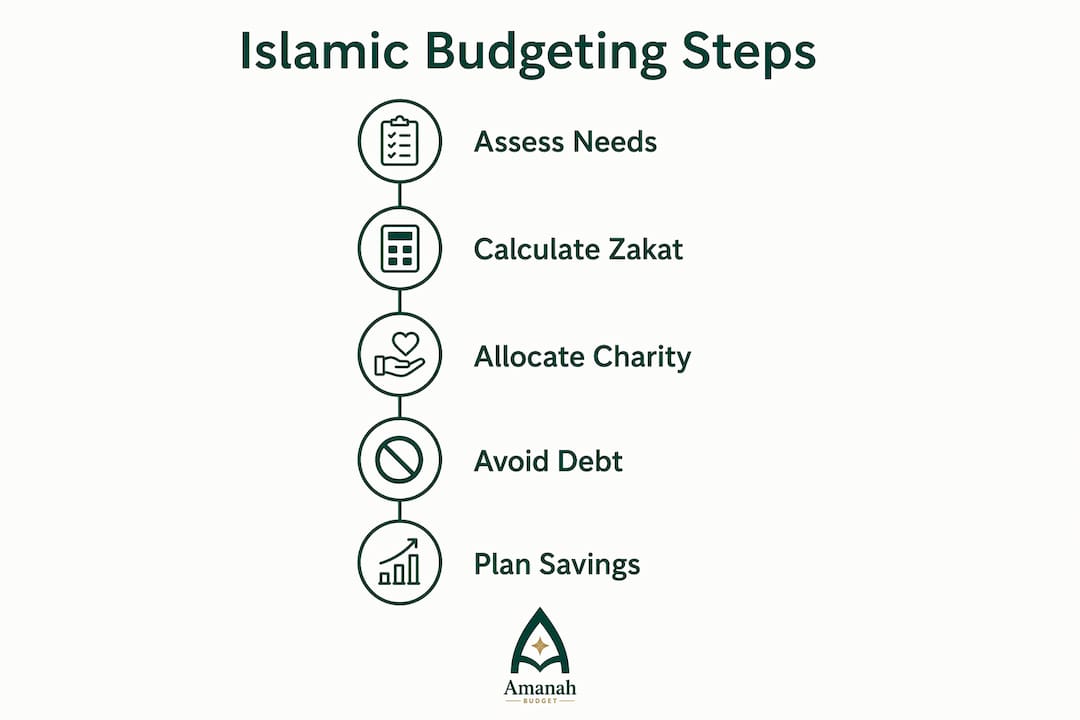
| Spending category | Islamic priority level | Practical guidance |
|---|---|---|
| Basic needs (food, shelter, clothing) | Obligatory | Fund first, before any discretionary spending |
| Zakat and sadaqah | Obligatory / Recommended | Allocate before wants; treat as a fixed budget line |
| Family obligations | Obligatory | Spouse, children, and dependent parents come before personal wants |
| Savings and emergency fund | Strongly recommended | Protects against debt and maintains household stability |
| Permissible enjoyment | Allowed within means | Fund last, with clear intention and no excess |
Debt avoidance is a core principle of accountability in financial dealings. Islamic law discourages unnecessary borrowing, and interest-bearing debt (riba) is prohibited outright. Building an emergency fund is therefore not just good financial practice. It is a form of ibadah (worship) that protects your household from being forced into haram financial arrangements during a crisis.
For family budgeting, shared household financial planning reduces conflict and reinforces the Islamic principle of collective responsibility. When spouses align on spending priorities and both understand the household’s zakat obligations, financial decisions become a shared act of worship rather than a source of tension.
Pro Tip: Use halal-aware budgeting tools that include dedicated categories for zakat, sadaqah, Hajj savings, and Ramadan expenses. Generic budgeting apps treat all spending as morally equivalent. A halal-first app reflects the actual hierarchy of your financial obligations.
Exploring halal fintech options is worth your time. Tools built specifically for Muslim households can automate zakat calculations, flag spending categories that may conflict with Islamic values, and help families save intentionally for religious milestones.
Key takeaways
Spending accountability in Islam requires treating wealth as a divine trust, fulfilling zakat before discretionary spending, and applying the principle of Iqtisad to every financial decision.
| Point | Details |
|---|---|
| Wealth is amanah | Every financial decision carries moral weight because wealth belongs to Allah, not to you. |
| Zakat comes first | Calculate and allocate your 2.5% zakat obligation before budgeting for wants or luxuries. |
| Israf is not just excess | Spending to show off or beyond your means is israf, even when the items purchased are halal. |
| Family duties are financial duties | Islamic financial responsibility includes providing for dependents before personal accumulation. |
| Budgeting is an act of worship | Intentional planning prevents negligence and aligns your spending with your values and obligations. |
Why financial accountability changed how I think about money
I used to treat my finances as a personal matter, something between me and my bank account. What shifted my thinking was not a financial crisis or a lecture. It was sitting with the hadith about the five questions on Judgment Day and realizing that two of them were about money. That is not a minor detail. That is a signal that how we earn and spend is woven into the fabric of our accountability before Allah.
The hardest part is not calculating zakat or avoiding haram income. Those have clear rules. The harder challenge is the gray zone: the lifestyle upgrade that feels justified, the social event that costs more than it should, the subscription you keep because canceling feels inconvenient. Lifestyle creep is real, and it does not announce itself. It arrives slowly, dressed as comfort and normalcy.
What I have found genuinely useful is treating my budget as a reflection of my priorities, not just my income. When zakat and sadaqah sit at the top of the budget, every other spending decision falls into its proper place. The family vacation, the new phone, the home renovation: none of these are wrong. They are just lower on the hierarchy. Keeping that hierarchy visible, in writing, in a budget you actually review, is what makes the difference between intention and practice.
Modern tools built around Islamic values make this easier than it has ever been. You do not have to choose between good financial software and your deen. The two can work together.
— Imran
Start budgeting with your values built in
Amanahfund built Amanah Budget specifically for Muslim families who want their financial tools to reflect their faith. The app includes halal-aware spending categories, zakat calculation using your preferred madhab, and dedicated savings goals for Hajj, Umrah, Ramadan, and Eid. You can share your household budget with your spouse, connect your bank accounts securely through Plaid, and receive AI-assisted transaction categorization that understands the difference between a sadaqah payment and a subscription fee. No ads. No interest-based products. No selling your data. If you are ready to align your daily financial decisions with your Islamic values, start with Amanah Budget today.
FAQ
What is spending accountability in Islam?
Spending accountability in Islam is the obligation to manage wealth as a trust from Allah, ensuring all earnings are halal, expenditures are balanced and purposeful, and charity duties like zakat are fulfilled. Every Muslim will be questioned about how they earned and spent their wealth on the Day of Judgment.
How much zakat do I need to pay in 2026?
Zakat is 2.5% of your net zakatable wealth, calculated annually after your holdings have exceeded the nisab threshold for one full lunar year (hawl). Use a current 2026 zakat guide to verify the nisab value based on gold or silver prices at the time of your calculation.
Is spending on halal enjoyment considered israf?
Spending on lawful enjoyment is not israf when done with sound intention, within your means, and without neglecting your obligations. The issue arises when spending is motivated by showing off, exceeds your financial capacity, or crowds out your zakat and family duties.
What is Iqtisad and why does it matter for budgeting?
Iqtisad is the Islamic principle of moderation in earning, spending, saving, and giving. It matters for budgeting because it provides the ethical framework for distinguishing between justified spending and waste, preventing both extravagance and harmful miserliness.
Does paying zakat mean I can spend freely on everything else?
No. Paying zakat does not exempt you from maintaining financial discipline or avoiding israf in other areas of your life. Zakat purifies your wealth and fulfills a pillar of Islam, but accountability in financial dealings continues across every spending decision you make.
Recommended
- The Best Budgeting Strategy for Muslim Families: A Practical Guide — Amanah Budget Blog
- The Best Budgeting Strategy for Muslim Families: A Practical Guide — Amanah Budget Blog
- Household halal spending: a guide for Muslim families — Amanah Budget Blog
- Household halal spending: a guide for Muslim families — Amanah Budget Blog
Ready to manage your amanah?
Track halal spending, calculate zakat, save for Hajj — all in one app. Free forever.
Create Free Account