Share Budget with Your Spouse App: 2026 Guide

Money is one of the most intimate things two people share, and also one of the most contentious. 56% of couples cite money as their top argument source, not because they disagree on values, but because they lack shared visibility. The right share budget with spouse app changes that dynamic directly. Instead of monthly surprises and defensive conversations, you get a living picture of your household finances that both partners can see, contribute to, and trust. This guide covers everything you need to choose and use the right one in 2026.
Table of Contents
- Key Takeaways
- What couples need to know before choosing a share budget with spouse app
- How to set up a shared budget with your spouse step by step
- Common mistakes couples make with shared budgeting apps
- Comparing popular budgeting apps for couples in 2026
- Tips for making your shared app work long-term
- My honest take on shared budgeting apps for couples
- Amanah Budget: built for how Muslim households actually manage money
- FAQ
Key Takeaways
| Point | Details |
|---|---|
| Shared visibility reduces conflict | Couples who use a joint budget tracker app report fewer money arguments due to greater transparency. |
| Setup requires upfront effort | Spend time cleaning 30 to 60 days of transaction history before treating app data as reliable. |
| Privacy matters inside a shared budget | Selective account syncing protects personal spending while keeping household finances transparent. |
| Financial check-ins are non-negotiable | Apps provide data, but scheduled monthly reviews produce better communication outcomes than notifications alone. |
| App choice should match your values | The best budgeting app for couples is the one that fits how you both think about money, not the one with the most features. |
What couples need to know before choosing a share budget with spouse app
Before you download anything, get clear on how your household actually handles money. Are you fully joint, fully separate, or somewhere in between? Each setup calls for a different type of couples budgeting software, and choosing the wrong one creates friction before you even start.
Account structure comes first
Most couples over 25 fall into one of three patterns: joint accounts for everything, separate accounts for everything, or a hybrid where shared bills come from a joint account while each partner keeps personal spending money separate. Your app needs to reflect that structure. If you try to force a fully joint app onto a hybrid household, one partner will feel surveilled. If you use a privacy-first app for a fully shared household, you lose the visibility you need.
Here are the questions worth answering before you search for an app:
- What expenses are truly shared (rent, groceries, utilities, childcare)?
- What spending do you each want to keep private?
- Do you split expenses 50/50 or proportionally based on income?
- Are you tracking to reduce spending, pay off debt, or build savings?
- Does one partner manage finances more actively than the other?
Proportional expense splitting based on income ratios (60/40, 70/30) is becoming a standard feature in modern apps. If one spouse earns significantly more, a rigid 50/50 split often creates resentment. Look for apps that support flexible splitting.
On cost: premium couples apps typically run $7.99 to $17.99 per month, with annual plans between $80 and $110 and free trials ranging from 7 to 34 days. Always use the trial period to test with your partner before committing.

Pro Tip: Before picking an app, write down your top three financial goals as a couple and share them with each other. Goals reveal values. If your goals don’t align, no app will fix that. If they do, you have a filter for every feature decision.
How to set up a shared budget with your spouse step by step
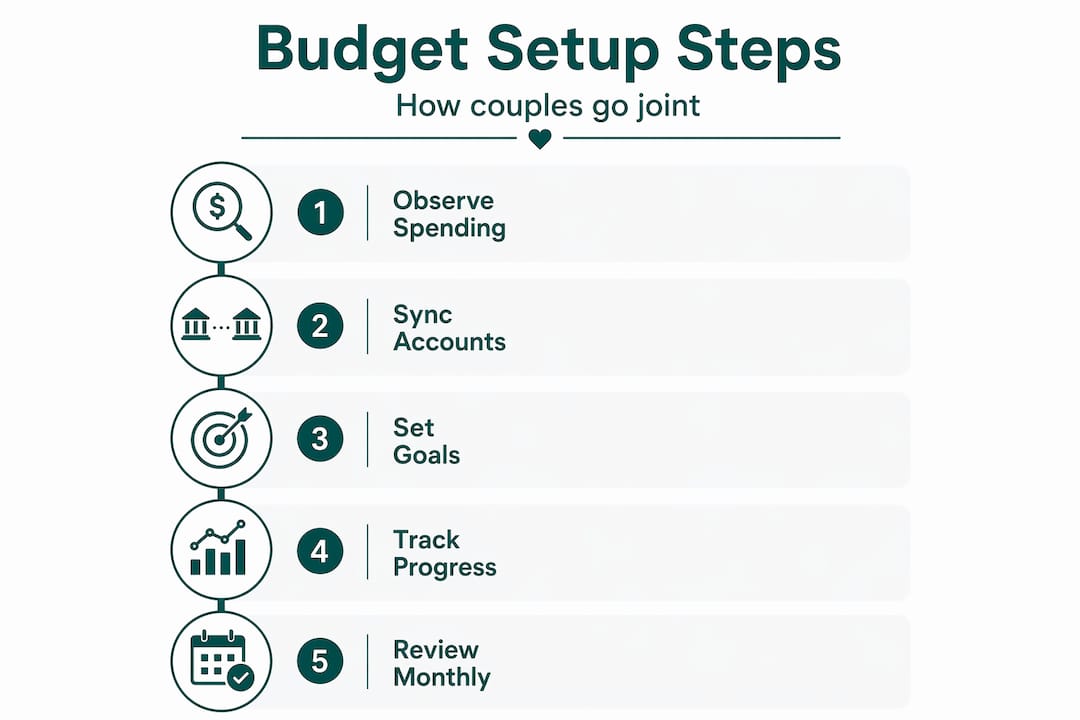
Once you know what you need, setting up your shared budget is a process. Rushing it creates inaccurate data and abandoned apps. Here is a step-by-step approach that works.
-
Choose your app. Match the app to your budgeting style. Zero-based budgeting requires every dollar to have a job and works well for couples paying down debt. Envelope budgeting caps spending by category and suits couples who overspend in specific areas. Flexible tracking works better for households that want visibility without rigid limits. Monarch Money handles shared dashboards and long-term goal tracking well, while Honeydue suits couples who want selective sharing with a partner across mixed-account setups.
-
Connect your accounts. Add joint accounts first, then decide together which personal accounts to include. Most apps connect through Plaid. Agree upfront on what stays private. This conversation alone is worth having.
-
Clean your transaction history. Spend 1 to 2 hours reviewing and categorizing the last 30 to 60 days of transactions. Auto-categorization is rarely perfect out of the box. A restaurant charge might land in “Entertainment” when it belongs in “Dining.” Fixing this upfront makes your budget meaningful instead of misleading.
-
Set your categories and budgets. Build spending categories that reflect your real life. Generic defaults rarely fit. If your household observes Ramadan or saves for Eid, those categories belong in your budget. Set monthly limits based on what you actually spend, then adjust over 1 to 2 months as you calibrate.
-
Define shared savings goals. Add at least one shared goal. Emergency fund, home down payment, Hajj savings, education fund — whatever is real for you. Shared goals give the budget a purpose beyond restriction.
-
Schedule your first financial check-in. Put a recurring monthly calendar event on both your calendars before you leave the setup session. The app surfaces data. The check-in is where you actually talk about it.
Pro Tip: Use the first two weeks purely for observation. Don’t try to change behavior yet. Just let the app show you how you both actually spend. The data will tell you more than any assumptions either of you brought in.
| Feature | What to look for | Why it matters |
|---|---|---|
| Account syncing | Plaid or similar bank integration | Eliminates manual entry errors |
| Shared goals | Both partners can contribute | Builds joint ownership of outcomes |
| Privacy controls | Per-account visibility settings | Reduces surveillance tension |
| Spending categories | Customizable labels | Reflects your real household |
| Proportional splits | Adjustable income-based ratios | Removes 50/50 resentment |
Common mistakes couples make with shared budgeting apps
Even well-intentioned couples make the same mistakes. Knowing them in advance saves real relationship friction.
The most damaging mistake is treating the app as a surveillance tool. Sharing all accounts without discretion can harm trust. When one partner sees every coffee purchase and questions it, the app stops feeling like collaboration and starts feeling like judgment. Selective syncing of joint versus individual accounts is usually the right architecture, not an avoidance tactic.
A second common mistake is choosing an app that is too complex for one partner. If one spouse is a spreadsheet person and the other avoids looking at finances entirely, picking the most feature-rich app on the market will lose the reluctant partner within a week. The best app is the one both people will actually open.
Here are the most frequent pitfalls and how to avoid them:
- Skipping data cleaning: Inaccurate categories produce misleading reports. Fix categorization issues early before the bad data shapes your habits.
- No agreed-upon privacy boundaries: Decide together what each partner can see. Document it. This prevents assumptions from becoming arguments.
- Using notifications as judgment: App alerts for overspending work best when framed as information, not accusation. Agree in advance that a notification is a conversation starter, not a criticism.
- Abandoning the app after the first month: Most couples who quit do so because they skipped check-ins. The app alone does not maintain the habit.
- Ignoring values in app selection: If your household has specific financial values, whether religious, ethical, or philosophical, a generic app will require constant workarounds that add friction over time.
“The app gives you a shared language about money. But the conversation still has to happen between two people.” This is the most important thing to hold onto as you build the habit.
You can find practical frameworks for resolving budgeting conflicts that go beyond the app itself and address the communication patterns underneath.
Comparing popular budgeting apps for couples in 2026
Choosing between apps comes down to which features actually matter for your household. Here is a grounded comparison of the leading options.
| App | Best for | Budgeting style | Price/month | Privacy controls | Shared goals |
|---|---|---|---|---|---|
| Monarch Money | Long-term planning, full household visibility | Flexible, goal-based | ~$14.99 | Moderate | Yes |
| Honeydue | Mixed-account couples wanting selective sharing | Flexible tracking | Free (with tips) | Strong | Basic |
| YNAB | Debt payoff, zero-based discipline | Zero-based | ~$14.99 | Limited | Yes |
| Goodbudget | Envelope method devotees | Envelope | Free / $10 | Limited | Yes |
| Amanah Budget | Muslim families with halal-first values | Flexible, values-based | Accessible | Yes | Yes (Hajj, Eid, Zakat) |
Monarch Money stands out for detailed dashboards and unlimited household members on a single subscription, which matters for couples who manage finances alongside family commitments. Honeydue earns its place for couples where financial independence is important but shared visibility on household bills is needed.
For Muslim couples specifically, generic apps require constant workarounds: manually excluding interest income, building custom categories for Zakat and Ramadan spending, and ignoring features designed for interest-based savings products. That friction adds up over time and makes the app harder to sustain.
Pro Tip: Take advantage of free trials from two or three apps simultaneously. Run the same month of data through each one and compare how the interface presents your spending. The app that makes your financial picture clearest to both partners is the right choice, regardless of what any review says.
New AI-driven financial tools now allow couples to ask plain-English questions about their combined finances, such as “How much did we spend on dining last quarter compared to this one?” This is a meaningful upgrade for couples who find charts and graphs less intuitive than conversational queries. Look for apps adding this capability in 2026.
Tips for making your shared app work long-term
The app is only as useful as the habits you build around it. Here is what actually sustains the practice:
- Monthly check-ins on the calendar. Not optional, not ad hoc. Regular scheduled reviews produce better financial communication than any notification system. Keep them to 30 minutes with a simple agenda: review last month, adjust upcoming month, revisit one shared goal.
- Separate spending money within the shared budget. Give each partner a personal spending category with no questions asked. This small act of autonomy removes the biggest source of surveillance tension.
- Celebrate goal progress, not just restraint. When you hit a savings milestone, acknowledge it together. The app should generate positive shared experiences, not only accountability.
- Connect the budget to your broader values. If your household values generosity, build a sadaqah or giving category. If education is a priority, make it a visible goal. Money managed in alignment with your values is money that feels meaningful, not restrictive.
- Review the benefits of shared household budgets periodically to remind yourselves why you started. The case for shared financial visibility compounds over time.
My honest take on shared budgeting apps for couples
I’ve worked with a lot of couples who came to shared budgeting expecting an app to fix their money problems. What I’ve found, consistently, is that the app does not fix anything on its own. It just removes the excuse that you didn’t have the information.
What I’ve seen actually work is this: couples who treat the app as a shared language, not a scorecard, build better financial communication within a few months. The ones who use it to track who spent what and interrogate each other about it usually abandon the tool within 90 days. The tool reflects the relationship. If the relationship has trust, the app amplifies collaboration. If it lacks trust, the app amplifies surveillance.
In my experience, the privacy controls inside these apps are underused. Most couples default to sharing everything because it feels more accountable. But allowing personal spending money without visibility does more for long-term adoption than any tracking feature. When both partners feel respected, they both stay engaged.
The other thing I’ve learned is that the initial setup conversation, the one where you decide what to share, how to split, and what you’re saving for, is often the most valuable financial conversation a couple has all year. The app is just the reason to have it. Do not rush that part.
— Imran
Amanah Budget: built for how Muslim households actually manage money
If you are a Muslim couple looking for a share budget with spouse app that does not require you to work around interest-based features or build custom categories for Zakat and Ramadan, Amanah Budget was designed with exactly your household in mind. It brings halal-aware spending categories, Zakat calculation, and dedicated savings goals for Hajj, Umrah, Eid, and education into a single app both spouses can use together.
Shared household budgets, privacy controls, and secure bank connections through Plaid are built in from the start. No ads, no data selling, and no interest-based products anywhere in the experience. Explore Amanah Budget and see how household financial management built around your values actually feels in practice. To understand more about how shared budgeting supports family financial wellbeing, read about shared family budgets on the Amanah Budget blog.
FAQ
What is the best budgeting app for couples in 2026?
The best budgeting app for couples depends on your financial setup and values. Monarch Money leads for full household visibility, Honeydue suits mixed-account couples, and Amanah Budget is purpose-built for Muslim families who want halal-first money management.
How do I share a budget with my spouse without losing privacy?
Use an app with selective account syncing so joint accounts are shared and personal accounts remain private. Selective syncing prevents trust breakdowns while keeping household finances transparent for both partners.
How often should couples review their shared budget together?
Once a month is the standard recommendation. Monthly financial check-ins using app data produce better couple communication outcomes than relying on in-app notifications alone.
Do couples need a joint bank account to use a shared budgeting app?
No. Most modern couples budgeting software connects to separate accounts and displays them in a shared view. You can manage finances with your partner without merging accounts, as long as the app supports multi-account visibility with customizable sharing settings.
Are there budgeting apps designed specifically for Muslim couples?
Yes. Amanah Budget is a halal-first app built for Muslim families. It includes Zakat calculation, Hajj and Umrah savings goals, halal-aware spending categories, and shared household budgeting. It is the only app that aligns Islamic financial values with day-to-day household money management.
Recommended
Ready to manage your amanah?
Track halal spending, calculate zakat, save for Hajj — all in one app. Free forever.
Create Free Account