Role of Accountability Partner in Finance: 2026 Guide
TL;DR:
- A financial accountability partner is someone trusted to review your financial decisions, give honest feedback, and help you meet your money goals. Combining a partner with automation tools significantly improves the likelihood of financial success, reaching up to 89%. Effective partnerships require clear boundaries, reliability, honesty, and regular, structured check-ins focused on behavior and progress.
A financial accountability partner is defined as a trusted person who regularly reviews your financial decisions, provides honest feedback, and holds you to the money goals you have set. This is sometimes called a “money accountability partner” in personal finance circles, though the practice draws on the same behavioral science behind workplace accountability systems. Research shows that working alone gives you only an 8% chance of hitting a financial goal. Add a partner with regular check-ins, and that rate climbs to 73%. Pair that partner with automated tracking tools like YNAB or real-time bank alerts, and success reaches 89%. The role of accountability partner in finance is not a soft motivational concept. It is a proven system for closing the gap between what you intend to do with money and what you actually do.
What does a financial accountability partner actually do?
The role of a financial accountability partner centers on three core activities: reviewing, reflecting, and redirecting. These are not passive tasks. They require commitment from both people in the partnership.

Regular check-ins are the foundation. Effective partnerships run on 10–20 minute weekly sessions or 30-minute monthly reviews. Weekly sessions work best when you are actively paying down debt or building an emergency fund. Monthly check-ins suit longer-term goals like saving for Hajj or growing an investment account.
During each session, a partner typically covers:
- Spending review: Did you stay within your budget categories this week?
- Savings progress: Did the automatic transfer to your goal account go through?
- Debt tracking: Did you make the extra payment you committed to?
- Milestone celebration: Did you hit a target worth acknowledging?
Partners verify transfers, review progress, and celebrate milestones together. That last point matters more than most people expect. Positive reinforcement builds the habit loop that keeps you consistent.
A financial accountability partner is not a financial advisor. A financial advisor gives licensed investment or tax guidance. A financial accountability partner holds you to the plan you have already made. They do not manage your money or tell you where to invest. They ask whether you did what you said you would do.
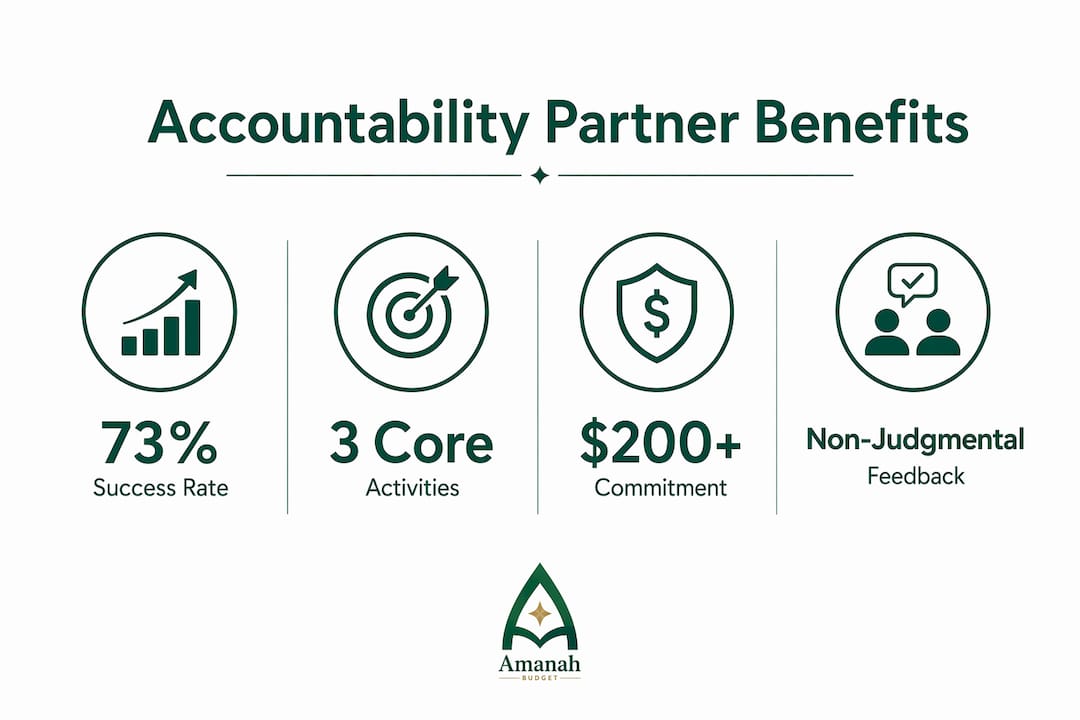
Pro Tip: Write down one specific commitment at the end of every check-in session. “I will transfer $200 to my Eid savings account by Thursday” is far more effective than “I will try to save more this week.”
Honest but non-judgmental feedback is what separates a good partner from a great one. External accountability acts as a behavioral regulation system when your own willpower runs low. Knowing someone will review your spending on Friday changes how you behave on Wednesday night.
How to choose the right financial accountability partner
Choosing the wrong partner is worse than having no partner at all. A partner who enables poor decisions or shames you for mistakes will either keep you stuck or push you away from the process entirely.
Five traits to screen for when selecting a partner:
- Reliability: They show up consistently, not just when it is convenient.
- Honesty: They tell you the truth, even when it is uncomfortable.
- Non-judgment: They separate your financial behavior from your worth as a person.
- Financial responsibility: They practice reasonable money habits themselves.
- Availability: They can commit to the agreed check-in schedule.
Common pitfalls include choosing partners who are too emotionally involved, unreliable, or carry poor financial habits of their own. A spouse can be an excellent partner, but only if both of you can discuss money without it becoming a conflict about the relationship.
Here is a comparison of the most common partner types:
| Partner Type | Strengths | Weaknesses |
|---|---|---|
| Spouse or partner | High trust, shared financial goals | Risk of emotional conflict |
| Close friend | Comfortable, accessible | May enable or avoid hard conversations |
| Financial coach | Professional, structured | Costs money, less personal connection |
| Accountability group | Community support, diverse perspectives | Less individual focus, scheduling complexity |
Setting explicit rules of engagement before you start is non-negotiable. Clear agreements on what data you share, how often you meet, and what topics are in or out of scope prevent the partnership from feeling like surveillance. Decide upfront whether your partner sees actual account balances or just progress toward goals. That boundary protects privacy and keeps the relationship healthy.
Does automation make accountability partnerships more effective?
Automation does not replace a financial accountability partner. It makes the partnership significantly more productive. Combined accountability plus automation raises goal success to 89%, compared to 73% with a partner alone. That 16-point gap represents real money and real progress.
Here is how automation supports the partnership:
- Real-time spending alerts from your bank or a budgeting app notify you the moment you approach a category limit. You do not wait until Friday’s check-in to discover you overspent on dining out.
- Automatic savings transfers remove the decision from your hands entirely. The money moves on payday before you can spend it.
- Shared budgeting apps give both you and your partner a live view of progress without requiring you to manually compile reports before every meeting.
Automation tools transform check-ins from administrative reporting into strategic conversations. Instead of spending 15 minutes reviewing what happened, you spend 15 minutes deciding what to do next. That shift in focus is where real financial growth happens.
For Muslim families, expense tracking apps that include halal-aware categories add another layer of intentionality. When your spending categories reflect your values, the data your partner reviews is more meaningful.
Pro Tip: Set spending alert thresholds at 80% of your category budget, not 100%. This gives you and your partner a warning window before you actually overspend, rather than a notification that the damage is already done.
Privacy matters in any accountability partnership. You do not need to give your partner full access to every account. Notification-based sharing, where your partner receives a summary alert rather than live account access, keeps the relationship focused on behavior rather than surveillance.
How do you maintain a healthy accountability partnership long-term?
Most accountability partnerships fail not because of bad intentions but because of poor structure. Consistency and clear communication are what keep them working over months and years.
Follow these practices to sustain a productive partnership:
- Document every action item. At the end of each check-in, write down what each person committed to before the next session. Verbal agreements fade. Written ones hold.
- Keep sessions time-bound. Meetings capped at 10–20 minutes stay focused and prevent burnout. Longer sessions drift into general conversation and lose their purpose.
- Address conflict directly and early. If a check-in feels judgmental or one-sided, name it in the moment. Letting resentment build ends partnerships faster than any financial setback.
- Revisit your agreement every 90 days. Goals change. Life changes. Your partnership structure should reflect where you are now, not where you were when you started.
- Plan for the partnership to evolve. The goal of external accountability is to build internal discipline over time. Partnerships focused on identifying blind spots help you develop self-directed habits that eventually reduce your dependence on external support.
Accountability fatigue is real. It happens when check-ins feel like performance reviews rather than collaborative conversations. Rotating the format, celebrating wins more deliberately, or temporarily shifting to monthly check-ins during stable financial periods can restore energy to the partnership.
Knowing when to end or restructure a partnership is a sign of maturity, not failure. If you have internalized the habits your partner helped you build, that is the outcome the process was designed to produce. For many Muslim families, spending accountability rooted in Islamic values provides a framework that makes this transition feel natural rather than abrupt.
Key takeaways
A financial accountability partner raises your goal success rate from 8% to 73%, and combining that partnership with automation pushes it to 89%.
| Point | Details |
|---|---|
| Define the role clearly | A financial accountability partner reviews behavior and holds you to commitments, not a financial advisor. |
| Screen partners carefully | Reliability, honesty, and non-judgment are the three traits that matter most in a long-term partner. |
| Use automation strategically | Automated alerts and shared budgeting apps shift check-ins from reporting to planning. |
| Set explicit agreements | Define data sharing, meeting frequency, and topic boundaries before the first session. |
| Build toward independence | The goal is internal discipline, not permanent reliance on external accountability. |
Why most people choose the wrong accountability partner
I have seen this pattern more times than I can count. Someone decides they want a financial accountability partner, and the first person they ask is their closest friend or their spouse. That instinct makes sense. Trust matters. But closeness and effectiveness are not the same thing.
The most common mistake is choosing someone who cares too much about your feelings in the short term. A good friend who hates conflict will let a missed savings transfer slide. A spouse who is also stressed about money may turn a check-in into an argument about something unrelated. Neither outcome serves you.
Accountability bridges the gap between financial knowledge and real-life execution. Most people already know what they should do with money. The problem is doing it consistently when life gets busy or stressful. A partner who can give you honest feedback without making you feel ashamed is genuinely rare. When you find one, treat that relationship with care.
The other mistake I see is treating the partnership as a permanent crutch. The real measure of success is not how long you keep the partnership. It is whether you eventually need it less. The ultimate goal is to build internal self-discipline through consistent feedback and reflection, not to outsource your financial willpower forever.
Start with structure. Be honest about what you need. And choose a partner who respects both your goals and your values.
— Imran
How Amanahfund supports your financial accountability

Amanahfund builds tools designed for Muslim families who want their financial habits to reflect their values. The Amanah Budget app includes shared household budgets, halal-aware spending categories, and AI-powered transaction categorization. These features make it easier for spouses or family members to serve as each other’s financial accountability partners without needing a separate system. Zakat calculation, Hajj and Umrah savings goals, and Ramadan and Eid planning are built directly into the experience. If you are looking for a budgeting tool that supports both your dunya and your deen, Amanahfund is built for exactly that.
FAQ
What is the role of an accountability partner in finance?
A financial accountability partner reviews your spending and savings progress, provides honest feedback, and holds you to the financial commitments you have made. They are not a financial advisor. They are a relational check on your behavior.
How often should you meet with a financial accountability partner?
Weekly check-ins run 10–20 minutes and work best for active debt payoff or savings goals. Monthly sessions of 30 minutes suit longer-term planning and more stable financial periods.
Can a spouse be a financial accountability partner?
A spouse can be an effective partner if both people can discuss money without it triggering unrelated relationship conflict. Setting clear rules of engagement and keeping sessions structured helps prevent check-ins from becoming arguments.
What is the difference between a financial accountability partner and a financial coach?
A financial coach provides professional guidance, structured programs, and often charges a fee. A financial accountability partner is typically a peer who holds you to goals you have already set, without offering licensed financial advice.
Does automation replace the need for an accountability partner?
Automation does not replace a partner. Combined partner and automation raises success rates to 89%, compared to 73% with a partner alone. Automation handles the data so the partner can focus on strategy and motivation.
Recommended
- Spending Accountability in Islam: A 2026 Guide — Amanah Budget Blog
- Examples of Family Financial Transparency That Build Trust — Amanah Budget Blog
- Examples of Family Financial Transparency That Build Trust — Amanah Budget Blog
- Connect Bank Account to a Budgeting App: 2026 Guide — Amanah Budget Blog
Ready to manage your amanah?
Track halal spending, calculate zakat, save for Hajj — all in one app. Free forever.
Create Free Account