Muslim Family Financial Goals Setup: 2026 Guide
TL;DR:
- Muslim family financial goals should be specific, Sharia-compliant, and reviewed regularly to ensure spiritual and material stability.
- Implementing a structured approach like SMART goals and halal budgeting helps families manage wealth according to Islamic principles effectively.
Muslim family financial goals setup is the process of defining, planning, and managing your household finances in a way that aligns with Islamic values and Sharia compliance, producing both material stability and spiritual barakah. The standard industry term for this practice is Islamic financial planning, and it covers six core steps: earning halal income, budgeting, paying zakat, building an emergency fund, investing in Sharia-compliant vehicles, and reviewing goals regularly. Frameworks like SMART goal-setting, the Logistics of Faith budgeting model, and tools like Amanah Budget give Muslim families a structured path to follow. This guide walks through each step with the specificity your family needs to act today.
How do you set muslim family financial goals using the SMART framework?
The SMART framework is the most reliable method for setting financial goals with built-in Sharia compliance. SMART stands for Specific, Measurable, Achievable, Relevant, and Time-bound. Applied to Islamic financial planning, each goal must also pass a halal filter before it is finalized.
Here is how to apply SMART to three common Muslim family financial goals examples:
- Home purchase. Instead of “buy a house someday,” write: “Save $60,000 for a down payment on a home purchased through an Ijara or Musharakah contract within four years.” The Sharia-compliant contract type is built into the goal itself, removing ambiguity later.
- Education funding. A SMART version reads: “Contribute $2,500 annually to a self-directed halal investment account for each child’s post-secondary education, reaching $30,000 per child by age 18.” Canadian families can use RESPs with halal-screened ETFs to capture the 20% Canada Education Savings Grant, worth up to $500 per child per year.
- Charity endowment. “Donate 5% of net monthly income to a waqf or sadaqah jariyah fund, beginning this month and reviewed annually.” Writing this down transforms a vague intention into a trackable commitment.
Write every goal on paper or in a shared digital document your spouse can access. Goals that exist only in your head rarely survive the first financial pressure of the year.
Pro Tip: Schedule a 30-minute family financial review every three months. Goals that felt achievable in January may need adjustment by April. Reviewing quarterly keeps your plan alive and your family aligned.

What are the essential steps for halal budgeting and money management?
Halal budgeting is not just about avoiding haram spending. It is a complete system for managing family finances with religious obligations treated as fixed, non-negotiable expenses. The Logistics of Faith budgeting model places zakat, sadaqah, and Hajj savings in the same category as rent and utilities. That single shift changes how Muslim families prioritize every dollar.
Follow these steps in order:
- Audit your income. Confirm every income source is halal. Employment income from a company with significant interest-based or haram revenue streams requires careful review. Freelance, rental, and business income each carry their own halal considerations.
- Track all expenses for 30 days. You cannot budget what you have not measured. Use halal-aware spending categories that separate permissible from impermissible expenditures.
- Assign religious obligations first. Zakat, monthly sadaqah, and a Hajj savings contribution come before discretionary spending. This is the core principle of the Logistics of Faith model.
- Identify and cut haram expenditures. Common examples include interest charges on credit cards, streaming subscriptions with predominantly haram content, and lottery or gambling-adjacent apps.
- Build your halal monthly budget. Allocate remaining income across housing, food, education, savings, and personal spending in proportions your family agrees on.
One practical challenge Muslim families face is the digital-sharia dilemma: auto-pay systems and subscription defaults can silently fund haram services. Many families discover they are paying for interest-bearing financial products or impermissible content simply because they never manually reviewed their recurring charges.
Pro Tip: Once a month, open your bank statement and review every recurring charge manually. Cancel any subscription that does not align with your values. Manual review is the only reliable defense against digital spending drift.
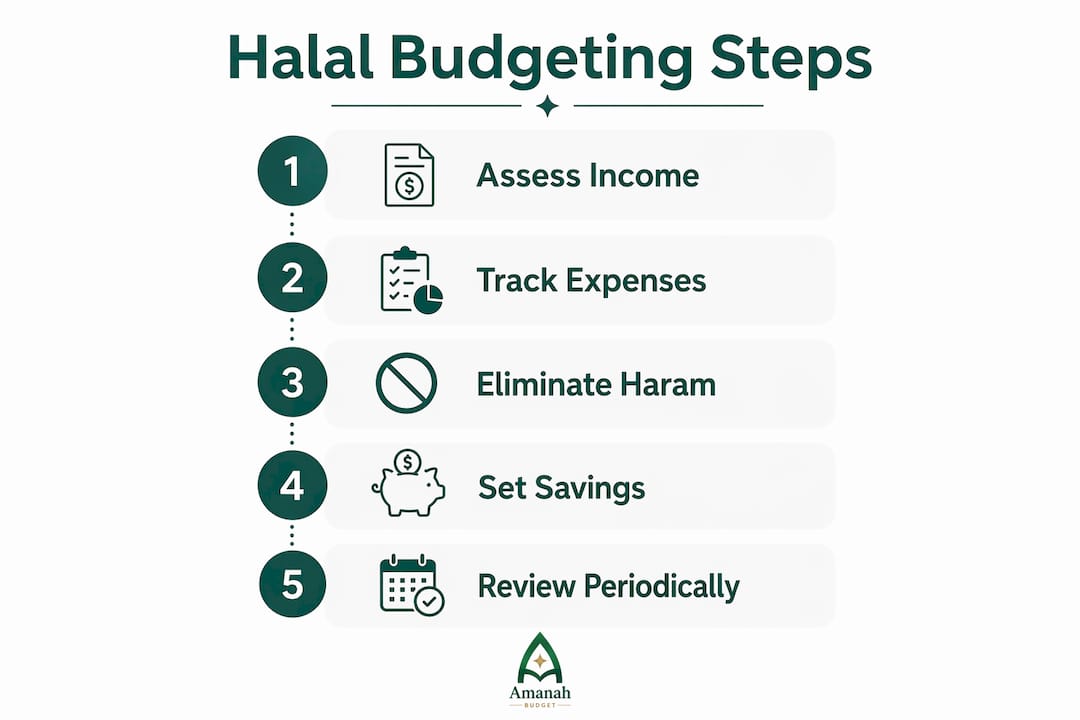
For a detailed walkthrough of building your first halal budget, the halal budget setup guide from Amanah Budget covers the full process step by step.
How to calculate, manage, and pay zakat within your financial plan
Zakat is a mandatory annual payment and a pillar of Islam. It is also one of the most underused tools in Muslim family financial wellbeing explained correctly. When you treat zakat as a fixed budget line rather than an afterthought, it protects your wealth spiritually and keeps your financial plan honest.
Key facts every Muslim family needs to know:
- Nisab threshold. Zakat is due when your net zakatable wealth exceeds the value of approximately 85 grams of gold, held for a full lunar year. In 2026, that threshold fluctuates with gold prices, so check a current nisab calculator before your annual calculation.
- Zakat rate. The zakat rate is 2.5% of all zakatable wealth above the nisab threshold.
- Zakatable assets. Cash savings, gold and silver, business inventory, receivables, and investment holdings all count. Your primary home, personal vehicle, and household items do not.
- Timing. Calculate zakat on the same date each lunar year. Many families tie it to Ramadan for ease, but any consistent annual date works.
Integrating zakat into your budget means setting aside roughly 2.5% of your projected zakatable wealth each month into a dedicated account. When your zakat date arrives, the funds are ready. This approach removes the stress of a large lump-sum payment and reinforces the habit of giving as a financial discipline.
Pro Tip: Use a madhab-specific zakat calculator rather than a generic one. Different schools of thought treat certain assets differently. Amanah Budget’s zakat tool lets you select your preferred madhab before calculating, which produces a more accurate and spiritually grounded result.
What steps should muslim families follow to build a halal emergency fund?
An emergency fund is the financial foundation that protects every other goal your family sets. Without it, a single unexpected expense forces you into debt, often interest-bearing debt, which undermines your entire halal financial plan.
The recommended target is 3–6 months of essential living expenses, held in a halal account. That means no interest-bearing savings accounts. Acceptable options include:
- Profit-sharing deposit accounts offered by Islamic banks or credit unions
- Non-interest-bearing checking accounts with a separate savings bucket
- Halal money market funds that invest in Sharia-screened short-term instruments
Building this fund alongside other goals requires a sequenced approach. Start with one month of expenses as your first milestone. Pause non-urgent discretionary spending until you reach it. Then continue building while simultaneously contributing to zakat savings and investment accounts.
Common pitfalls to avoid:
- Treating the emergency fund as a general savings pool and withdrawing from it for non-emergencies
- Keeping the fund in an account that earns interest by default
- Combining emergency savings with your Hajj or education fund, which creates confusion when either goal needs attention
Pro Tip: Label your emergency fund account clearly, whether in a spreadsheet or a budgeting app, as “Emergency Only.” The psychological barrier of a named account reduces impulsive withdrawals significantly.
The role of deen in family finances shapes how you think about security. An emergency fund is not a lack of tawakkul. It is responsible stewardship of the resources Allah has entrusted to you.
How can muslim families invest according to sharia compliance?
Sharia-compliant investing is the stage of Islamic financial planning most families delay too long. The most common reason is analysis paralysis over which halal investment is “perfect.” That hesitation is costly. Income generation is the biggest lever in Islamic wealth building, especially for households earning under $150,000 annually. Grow your income first, then direct that income into compliant investments.
Compliant investment vehicles available to Muslim families in 2026 include:
- Halal equity ETFs. Funds like those screened by Wahed Invest or Saturna Capital exclude companies with significant revenue from alcohol, tobacco, weapons, interest-based finance, and other prohibited sectors.
- Sukuk. Islamic bonds that represent ownership in a tangible asset rather than a debt obligation. They provide fixed-income-style returns without interest.
- Screened equity funds. Actively managed funds that apply AAOIFI or MSCI Islamic screening criteria to stock selection.
- RRSPs and TFSAs (Canada). These registered accounts can hold halal equity funds and sukuk, making them tax-efficient vehicles for Sharia-compliant retirement and savings goals.
For families just starting to invest, follow this sequence:
- Confirm your income is halal and your budget is stable.
- Fund your emergency account to the 3-month minimum.
- Open a self-directed brokerage account that allows halal fund selection.
- Start with a single diversified halal ETF and contribute consistently each month.
- Add sukuk or screened equity funds as your knowledge and capital grow.
One common misconception is that wealth accumulation conflicts with Islamic values. It does not. The Quran and Sunnah encourage responsible stewardship of wealth. The restriction is on how wealth is earned and used, not on the act of building it.
Key takeaways
Effective Muslim family financial planning requires treating religious obligations as fixed budget items, not optional additions, while building income, savings, and compliant investments in a deliberate sequence.
| Point | Details |
|---|---|
| Use SMART goals with halal filters | Write specific, time-bound goals that name the Sharia-compliant contract or account type from the start. |
| Treat zakat as a fixed expense | Set aside 2.5% of zakatable wealth monthly so your annual zakat payment is always funded and on time. |
| Build a halal emergency fund first | Target 3–6 months of expenses in a profit-sharing or non-interest account before scaling investments. |
| Grow income before chasing investments | Increasing halal income streams produces more wealth than optimizing investment selection at lower income levels. |
| Review goals every quarter | Family circumstances change; a quarterly review keeps your financial plan aligned with your current reality. |
Why i think most muslim families start financial planning backwards
After years of working with Muslim households on financial literacy, I have noticed a consistent pattern. Families spend enormous energy researching the “perfect” halal investment while their emergency fund sits at zero and their zakat calculation has not been done in two years. The sequence is backwards, and it costs them.
Maqasid al-Shariah teaches that financial management is a spiritual ecosystem. Preserving property, intellect, and lineage are not abstract ideals. They are practical obligations that require a funded emergency account, a debt-free household, and a clear income strategy. The families I have seen thrive financially are not the ones with the most sophisticated investment portfolios. They are the ones who paid their zakat on time, kept three months of expenses in a halal account, and grew their income deliberately before worrying about fund selection.
The other thing most articles miss is the income conversation. Building income streams through halal side work, freelancing, or a small business produces far more wealth than the difference between two halal ETFs. If your household earns $80,000 a year and you grow that to $110,000 through a halal side venture, you have created more financial capacity than any investment optimization could deliver at that income level.
Islamic financial planning is not a limitation. It is protection. It keeps your wealth pure, your family stable, and your intentions clear. Start with the basics, do them consistently, and the rest follows.
— Imran
Start managing your family’s finances the halal way
Knowing the steps is one thing. Having a tool built around those steps is another.
Amanah Budget is a halal-first budgeting app built specifically for Muslim families. It includes halal-aware spending categories, a madhab-specific zakat calculator, dedicated savings goals for Hajj, Umrah, Ramadan, and education, and shared household budgeting for spouses. Bank accounts connect securely through Plaid, and AI-assisted categorization keeps your spending organized without you doing it manually. No ads, no interest-based products, and no selling your data. If you are ready to put your family’s financial goals on a halal foundation, Amanah Budget is where to start.
FAQ
What is a muslim family financial goal?
A Muslim family financial goal is a specific, Sharia-compliant financial target that aligns with Islamic values, such as saving for Hajj, funding education through halal accounts, or building an interest-free emergency fund.
How do you calculate zakat for family financial planning?
Zakat is calculated at 2.5% of all zakatable wealth held above the nisab threshold (approximately 85 grams of gold) for a full lunar year, covering cash, gold, business assets, and investments.
What is the recommended emergency fund size for muslim families?
The recommended target is 3–6 months of essential living expenses, held in a halal account such as a profit-sharing deposit or non-interest-bearing savings vehicle.
Can muslim families use registered accounts like rrsps or tfsas for halal investing?
Yes. RRSPs and TFSAs can hold halal equity funds and sukuk, making them tax-efficient options for Sharia-compliant retirement and education savings goals.
How does the SMART framework apply to islamic financial planning?
The SMART framework applies by adding a Sharia compliance filter to each goal, specifying the halal contract type, account, or investment vehicle alongside the financial target and timeline.
Recommended
- Interfaith financial planning: a Muslim family’s guide — Amanah Budget Blog
- Interfaith financial planning: a Muslim family’s guide — Amanah Budget Blog
- The Best Budgeting Strategy for Muslim Families: A Practical Guide — Amanah Budget Blog
- The Best Budgeting Strategy for Muslim Families: A Practical Guide — Amanah Budget Blog
Ready to manage your amanah?
Track halal spending, calculate zakat, save for Hajj — all in one app. Free forever.
Create Free Account