Islamic Perspective on Saving Explained for Muslims
TL;DR:
- Islamic savings must be halal and free from interest, focusing on ethical, risk-sharing growth methods.
- Strictly avoiding interest, Muslims should transition to Shariah-compliant accounts, pay zakat, and practice proper deduction.
The Islamic perspective on saving is defined by one foundational rule: all financial growth must come through halal means, free from interest (riba) and aligned with Shariah law. Islamic financial planning requires earning halal income, avoiding interest, paying zakat, and investing only in Shariah-compliant vehicles. This is not simply a religious preference. It is a complete financial framework that shapes how Muslims earn, spend, protect, and grow their wealth. Understanding saving in Islam means understanding why riba is forbidden, how zakat purifies wealth, and which practical tools help you build financial security without compromising your faith.

What is the Islamic perspective on saving explained?
Saving in Islam is permissible and encouraged. The Prophet Muhammad (peace be upon him) taught moderation in spending and the importance of providing for one’s family. What Islam prohibits is not saving itself but the method by which savings grow. Conventional savings accounts pay interest, and that interest is classified as riba by the majority of Islamic scholars. The Quran explicitly forbids riba in multiple verses, including Surah Al-Baqarah (2:275), which states that Allah has permitted trade and forbidden interest.
The Islamic view on savings draws a clear line between two types of financial return. A return earned through trade, risk-sharing, or productive effort is halal. A return guaranteed by a contract regardless of outcome, such as bank interest, is riba and therefore haram. This distinction shapes every decision a Muslim makes about where to keep money and how to grow it.
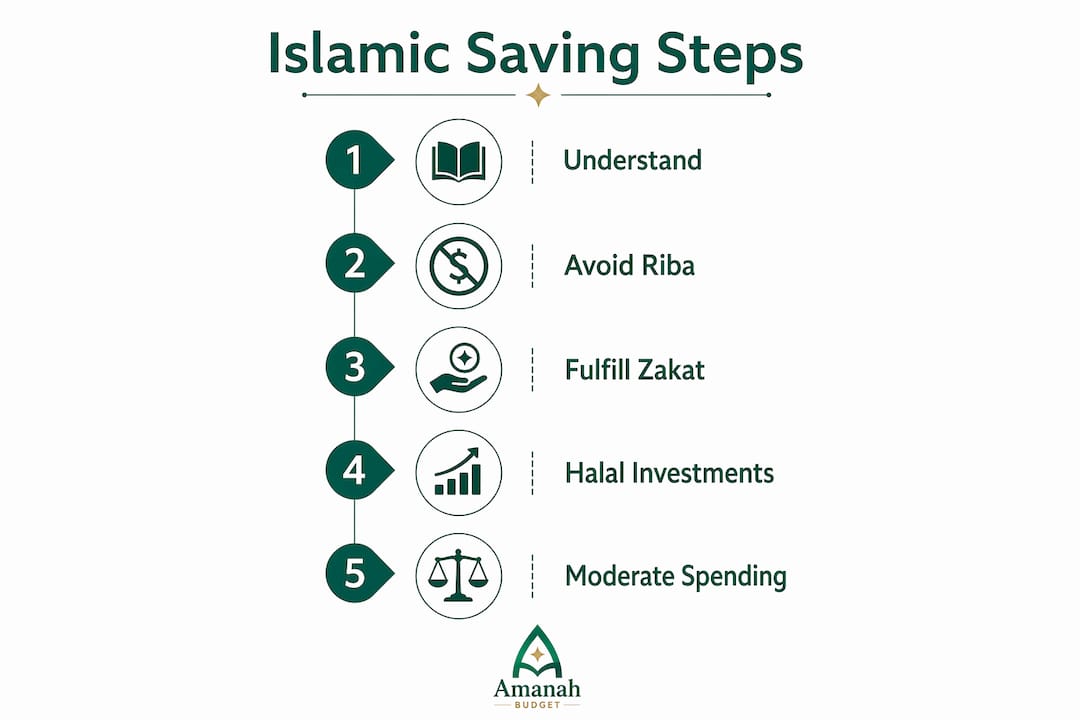
Shariah-compliant saving also connects to broader ethical goals. The concept of maqasid al-Shariah, the higher objectives of Islamic law, holds that financial products must promote human welfare and avoid harm. Saving money in ways that fund exploitative lending or generate passive income without productive effort conflicts with these objectives directly.
Why is interest on savings accounts forbidden in Islam?
Interest on savings accounts is considered riba because it guarantees a fixed return without any risk sharing between the depositor and the bank. That guaranteed return, disconnected from real economic activity, is precisely what Islamic law prohibits. The bank profits from lending your money at higher rates, and you receive a cut of that profit chain. Every link in that chain involves riba.
A common misconception is that simply ignoring the interest credited to your account makes it permissible. Scholars are clear that structural riba remains problematic regardless of your intention. The contract itself is the issue, not just the act of spending the interest. Holding funds in an interest-bearing account, even passively, participates in a riba-based system.
Here is what Islamic scholars recommend for Muslims currently holding interest-bearing accounts:
- Do not spend the interest on yourself. It is not considered halal wealth.
- Remove the interest and donate it to charity. Scholars agree that interest should be donated without the intention of receiving reward for the act.
- Transition to a non-interest-bearing account as soon as practically possible.
- Seek Shariah-compliant alternatives such as profit-sharing accounts offered by Islamic banks.
Pro Tip: When donating accumulated interest, give it to a general charity rather than a religious cause. Scholars advise against using haram funds to fund acts of worship.
The prohibition of riba is not a minor technicality. It is one of the most strongly worded prohibitions in the Quran, placing those who deal in riba in a state of war with Allah and His Messenger (2:279). Muslims who understand this take the search for halal savings options seriously.
How does zakat apply to savings and what are the key obligations?
Zakat is the third pillar of Islam and one of the most direct financial obligations tied to saving. It applies to savings that meet two conditions: the amount must exceed the nisab threshold, and it must have been held for a full lunar year (hawl).
The nisab threshold is approximately 85 grams of gold, which translates to a cash equivalent that changes with gold prices. In 2026, this figure sits roughly between $5,000 and $6,000 depending on the current gold rate. Any savings above that threshold, held continuously for one lunar year, are subject to zakat at a rate of 2.5%.
How zakat calculation works on savings
| Savings Amount | Nisab Met? | Zakat Due (2.5%) |
|---|---|---|
| $3,000 | No | $0 |
| $6,000 | Yes | $150 |
| $20,000 | Yes | $500 |
| $50,000 | Yes | $1,250 |
The spiritual purpose of zakat goes beyond the financial transfer. Zakat purifies wealth by acknowledging that a portion belongs to those in need. It prevents hoarding, redistributes resources within the Muslim community, and keeps the saver connected to the broader social responsibility that Islam places on those with means.
Practically, the best approach is to calculate zakat on your savings on the same date each lunar year, ideally your zakat anniversary. Set aside the 2.5% in a separate account so it does not get mixed with your regular spending funds. This separation keeps your financial picture clean and your obligation clear.
- Determine your zakat anniversary date (the date your savings first exceeded nisab).
- Calculate total qualifying assets: cash, gold, silver, and business inventory.
- Subtract any immediate debts or liabilities due within the year.
- Apply the 2.5% rate to the net amount above nisab.
- Pay zakat before your next anniversary date.
What are the recommended Islamic saving practices?
Saving money according to Islamic teachings follows a clear structure: protect what you have, grow it through halal means, and fulfill your obligations before accumulating more. The starting point is an emergency fund.
Muslims should keep 3–6 months of essential expenses in liquid, non-interest-bearing accounts. This fund covers job loss, medical emergencies, or unexpected family needs without forcing you into debt or haram borrowing. Liquid means accessible within days, not locked in an investment. Non-interest-bearing means held in a current account, a Shariah-compliant savings account, or a profit-sharing account at an Islamic bank.
Beyond the emergency fund, Islamic savings should be divided between liquid capital for near-term needs and Shariah-compliant investments for long-term growth. This two-bucket approach mirrors conventional financial planning but replaces interest-based products with halal alternatives.
Pro Tip: Automate your savings on the day your salary arrives. Set up an automatic transfer to your halal savings account before any discretionary spending happens. This single habit removes the temptation to spend first and save what remains.
Halal long-term saving options include:
- Musharakah accounts: Profit-and-loss sharing arrangements where your funds are invested in real business activity.
- Mudarabah accounts: You provide capital; the bank or fund manager provides expertise. Profits are shared; losses are borne by the capital provider.
- Halal equity funds: Shariah-screened stock funds that exclude companies involved in alcohol, tobacco, weapons, conventional finance, and other prohibited industries.
- Sukuk (Islamic bonds): Asset-backed certificates that generate returns from real assets rather than interest payments.
The principles of Islamic finance require that every investment be tied to a real asset or productive activity. This is not a limitation. It is a protection against speculative bubbles and exploitative financial instruments that have caused repeated economic crises in conventional markets.
How do Islamic financial principles compare to conventional saving methods?
The core difference between Islamic and conventional saving is not just about interest. It is about who bears the risk and who benefits from the outcome.
| Feature | Islamic Saving | Conventional Saving |
|---|---|---|
| Return type | Profit-sharing, asset-backed | Fixed interest |
| Risk distribution | Shared between parties | Borne by borrower |
| Ethical screening | Required (halal assets only) | Not required |
| Zakat obligation | Yes, on qualifying savings | No religious obligation |
| Speculative instruments | Prohibited | Permitted |
Islamic finance principles include the prohibition of riba, the requirement for risk-sharing, and the insistence that financial contracts be backed by real assets. These principles create a system where returns reflect genuine economic activity rather than the passage of time. A conventional savings account pays you simply for depositing money. A Shariah-compliant profit-sharing account pays you because your funds were used in a real, productive transaction.
This distinction matters for how Muslims should think about Islamic views on savings and long-term wealth building. Conventional high-yield savings accounts may offer attractive rates, but those rates are funded by lending at higher rates to borrowers. The entire model depends on riba at every level. Shariah-compliant alternatives may offer lower or variable returns, but they align with the ethical and spiritual framework that maqasid al-Shariah demands.
The family halal budget setup also plays a role here. Keeping halal and haram funds separate, tracking spending against Islamic categories, and planning for faith-based goals like Hajj, Umrah, and Ramadan all require a financial system built around Islamic values, not adapted from a conventional one.
Key Takeaways
Saving in Islam requires avoiding interest at every level, fulfilling zakat obligations on qualifying wealth, and growing capital only through Shariah-compliant, risk-sharing methods.
| Point | Details |
|---|---|
| Riba prohibition is absolute | Interest from savings accounts is haram regardless of whether you spend it or ignore it. |
| Zakat applies to savings above nisab | Pay 2.5% annually on savings held above approximately 85 grams of gold equivalent for one lunar year. |
| Emergency fund comes first | Keep 3–6 months of expenses in a liquid, non-interest-bearing account before investing. |
| Halal growth requires risk-sharing | Use Musharakah, Mudarabah, or halal equity funds instead of interest-based products. |
| Automate savings on payday | Transfer to your halal savings account on salary day to prioritize saving before spending. |
Saving with intention: a personal reflection
I have spent years watching Muslims struggle with a specific tension: they know interest is haram, but they do not know what to do instead. The conventional financial world is built almost entirely on interest-based products. Banks, savings accounts, mortgages, credit cards. It can feel like there is no clean path forward.
What I have found is that the path forward starts with intention and then builds incrementally. You do not have to overhaul your entire financial life in a week. Start by opening a non-interest-bearing current account and moving your emergency fund there. Then calculate your zakat properly, even if it is the first time you have done it accurately. These two steps alone bring your financial life significantly closer to Shariah compliance.
The spiritual dimension of this is real and worth naming. When you save with the awareness that your wealth is an amanah, a trust from Allah, the act of saving changes. It is no longer just about security or retirement. It becomes an act of stewardship. You are managing something that was never fully yours to begin with. That mindset shift changes how you spend, how you give, and how you plan.
The community dimension matters too. When Muslims collectively move toward halal financial products, we create demand for better Shariah-compliant options. Islamic banks grow. Halal investment funds expand. The ecosystem improves for everyone. Individual choices have collective consequences in this space.
— Imran
How Amanahfund helps you save the halal way
Managing your savings according to Islamic principles requires tools that understand those principles from the start, not apps that treat zakat as an afterthought.
Amanahfund is a halal-first budgeting app built specifically for Muslim families. It includes built-in zakat calculation using your preferred madhab, halal-aware spending categories, and dedicated savings goals for Hajj, Umrah, Ramadan, Eid, education, and emergencies. You can share your household budget with your spouse, connect your bank accounts securely through Plaid, and receive AI-assisted transaction categorization that reflects your values. No ads. No interest-based products. No selling your data. If you are ready to manage your halal financial goals with a tool built around your deen, Amanahfund is where to start.
FAQ
What is riba and why does it apply to savings accounts?
Riba is any guaranteed fixed return on money that is disconnected from real economic risk or trade. Savings account interest qualifies as riba because the bank guarantees a return regardless of how it uses your funds.
How much zakat do I owe on my savings?
Zakat on savings is 2.5% of any amount above the nisab threshold (approximately 85 grams of gold equivalent) that you have held for a full lunar year. Use a complete zakat guide to calculate your exact obligation based on current gold prices.
Can I keep money in a conventional bank account?
You can use a conventional bank account for transactions, but you should avoid interest-bearing savings products. If interest accumulates, scholars advise donating it to charity without claiming any spiritual reward for the donation.
What is the best halal alternative to a high-yield savings account?
The best halal alternatives include Mudarabah profit-sharing accounts at Islamic banks, Shariah-screened equity funds, and Sukuk. These instruments generate returns from real assets and productive activity rather than interest.
Does saving money conflict with trusting in Allah (tawakkul)?
No. Islamic teaching encourages both tawakkul and practical preparation. The Prophet Muhammad (peace be upon him) instructed believers to tie their camel and then trust in Allah. Saving responsibly is an act of stewardship, not a lack of faith.
Recommended
Ready to manage your amanah?
Track halal spending, calculate zakat, save for Hajj — all in one app. Free forever.
Create Free Account