How to Review Your Monthly Budget Islamically

TL;DR:
- Reviewing your monthly budget Islamically involves ensuring income is halal, categorizing expenses to prevent wastefulness, and allocating funds for Zakat and Sadaqah as planned commitments. It emphasizes starting with verified income, dividing spending into needs, wants, savings, and charitable obligations, and treating Zakat as an annual duty saved monthly. This spiritual approach promotes moderation, gratitude, and alignment with Islamic ethics, fostering both financial discipline and Taqwa.
Reviewing your monthly budget Islamically means structuring your income, expenses, and charitable giving around halal principles, moderation, and your annual Zakat obligation. This practice goes beyond standard personal finance. It treats every dollar earned and spent as an act of stewardship (amanah) before Allah. The framework covers three core areas: verifying that your income sources are halal, categorizing your spending to avoid wastefulness (israf), and setting aside Zakat and Sadaqah as planned allocations rather than afterthoughts. Tools like Islamic budget planners, spreadsheets, and halal-first apps such as Amanah Budget make this process concrete and repeatable each month.
How to review your monthly budget Islamically
A halal budget review starts with your income, not your expenses. Before categorizing a single purchase, identify income sources that are not 100% halal and create a plan to phase them out gradually. Ignoring doubtful income while budgeting carefully elsewhere creates a contradiction that undermines the entire exercise.
Once your income is verified, divide your expenses into four clear buckets:
- Needs (Daruriyyat): Rent or mortgage, utilities, groceries, transportation, and healthcare. Target roughly 50% of net income.
- Wants (Hajiyyat): Dining out, entertainment, clothing beyond necessity, and subscriptions. Cap this at 20 to 30%.
- Savings and investments: Emergency fund, Hajj or Umrah fund, education, and retirement in Sharia-compliant vehicles. Aim for 10 to 20%.
- Zakat and Sadaqah: A dedicated allocation that is never treated as leftover money. A practical family framework suggests 20 to 30% combined for savings and Zakat, though your exact split depends on your wealth level.
This four-bucket structure mirrors the Islamic financial planning principle that budgeting is an act of worship, moving from halal income through disciplined spending to consistent giving and saving.
Pro Tip: Open a separate bank account or label a dedicated envelope specifically for Zakat funds. Transfer a fixed amount into it the moment income arrives each month. This prevents accidental spending of Zakat money and removes the stress of finding a lump sum at your hawl date.
What to check during your monthly spending review
The Quran explicitly prohibits both extravagance and stinginess. Surah Al-Furqan (25:67) describes the servants of the Most Merciful as those who, when they spend, are neither wasteful nor miserly. A monthly budget review grounded in Islamic ethics asks a harder question than “Did I stay within budget?” It asks, “Was this spending necessary and moderate?”

Quranic principles on spending stress that living within a budget cultivates gratitude and protects against the spiritual harm of overconsumption. This means your review should flag not just overspending, but the type of overspending.
Look for these specific patterns in your monthly transactions:
- Israf (wastefulness): Duplicate subscriptions, food waste, impulse purchases that went unused, and premium upgrades with no functional benefit.
- Shahawat-driven spending: Purchases driven purely by desire rather than need. Ask whether each non-essential expense brought lasting benefit or momentary satisfaction.
- Riba exposure: Any interest charges on credit cards or loans. These require immediate attention and a plan to eliminate them.
- Missed Sadaqah: Months where charitable giving was skipped entirely because funds ran out. This signals that Sadaqah was treated as optional rather than planned.
Pro Tip: After your monthly review, identify one recurring expense to cut and redirect that exact dollar amount to Sadaqah or your Hajj savings goal. The discipline of replacing a want with a giving act reinforces both financial and spiritual priorities simultaneously.
How to prepare monthly allocations for annual Zakat
Zakat is an annual obligation, not a monthly one. This distinction matters enormously for budgeting. Zakat is calculated once per lunar year on your hawl date, applied at 2.5% to net zakatable wealth that exceeds the nisab threshold. Many Muslims misunderstand this as a monthly payment, which creates unnecessary complexity and potential errors in calculation.
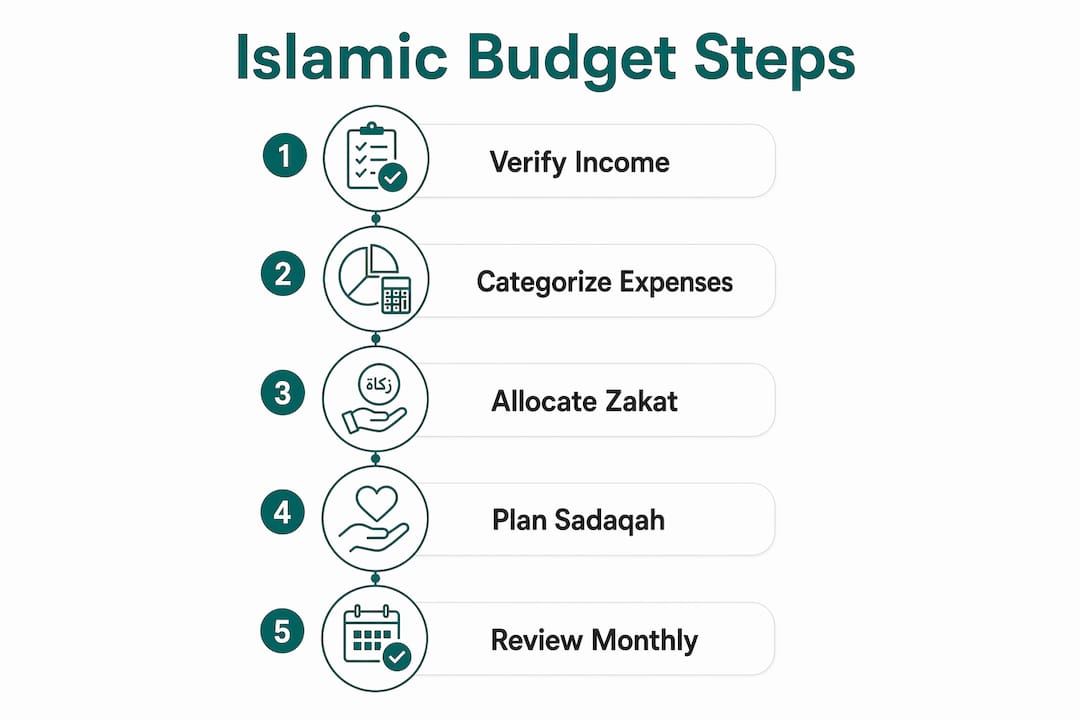
The correct approach is to save toward your annual Zakat obligation each month, then pay it in full on your hawl date. Here is how the calculation works:
| Step | Action |
|---|---|
| 1. List zakatable assets | Cash, gold, silver, trade goods, investments, and receivables |
| 2. Subtract short-term liabilities | Only debts due within the next 12 months are deductible |
| 3. Check nisab | Net wealth must exceed the nisab (value of 85g of gold or 595g of silver) |
| 4. Multiply by 2.5% | This is your annual Zakat due |
| 5. Divide by 12 | Set this amount aside monthly into your Zakat holding account |
Deducting only short-term liabilities before calculating Zakat reflects scholarly consensus and gives you an accurate picture of the wealth truly subject to Zakat.
Zakat al-Fitr is a separate, smaller obligation due before Eid al-Fitr prayer. It is calculated per household member, not on total wealth, and is typically a fixed food staple amount or its cash equivalent. Budget for it separately from Zakat al-Mal.
Monthly Sadaqah operates on a different logic entirely. It is voluntary, spiritually significant, and should be budgeted as a fixed line item rather than a variable one. Even a consistent small amount given monthly carries more spiritual weight than irregular large donations, because it builds the habit of generosity as a character trait.
Pro Tip: Many families find it helpful to pay Zakat during Ramadan for the spiritual reward multiplied in that month, even if their hawl date falls at a different time. If you choose this approach, confirm with a scholar whether early payment is valid for your specific situation.
Ramadan and Eid budgeting within your monthly review
Ramadan requires a separate budget layer, not just an adjustment to your regular monthly plan. Ramadan household budgets typically increase by 20 to 40% for food and hosting alone. A U.S. family of four can expect Ramadan-specific food and hospitality costs in the range of $600 to $1,400, before accounting for Zakat al-Fitr, nightly Sadaqah, and Eid gifts.
The families who handle Ramadan finances best are those who start saving months in advance using dedicated sinking funds. Starting monthly Ramadan savings well before the month begins treats the spending increase as a planned variance rather than a financial emergency.
Your Ramadan budget should include five distinct allocations:
- Food and hosting: Iftar meals, suhoor groceries, and guests. This is typically the largest line item.
- Zakat al-Fitr: Calculate per household member and set aside before the last day of Ramadan.
- Sadaqah for the last 10 nights: The most spiritually significant nights of the year deserve a pre-committed giving amount, not a spontaneous one.
- Eid clothing and gifts: Often underestimated. Include children’s outfits, family gifts, and any Eid celebrations.
- Eid al-Adha preparation: If applicable, budget for Udhiyah (Qurbani) contributions well in advance.
For a deeper look at managing Eid-related costs across the year, the Eid savings strategy guide from Amanah Budget walks through how to build these sinking funds month by month.
Coordinate your Ramadan budget review with your regular monthly review by treating Ramadan as a separate budget category that runs parallel to your normal spending plan. Do not absorb Ramadan costs into your regular grocery or entertainment budgets. The overlap creates confusion and makes it nearly impossible to track whether your regular spending stayed on track.
Key takeaways
Reviewing your monthly budget Islamically requires verifying halal income, categorizing expenses with dedicated Zakat and Sadaqah allocations, and applying the Islamic principle of moderation to every spending decision.
| Point | Details |
|---|---|
| Verify income first | Identify and plan to phase out any doubtful or haram income sources before categorizing expenses. |
| Use four spending buckets | Divide spending into needs, wants, savings, and a fixed Zakat/Sadaqah allocation every month. |
| Save toward annual Zakat | Set aside 1/12 of your estimated Zakat monthly; pay the full amount on your hawl date. |
| Budget Ramadan separately | Treat Ramadan as a parallel budget layer with its own sinking funds started months in advance. |
| Apply israf checks | Flag wasteful spending patterns monthly, not just overspending totals, to stay aligned with Islamic ethics. |
Why I think most Muslims are budgeting backwards
After years of working in Islamic financial planning and talking with hundreds of Muslim families, I have noticed a consistent pattern: most people start their monthly review by looking at what they spent, then try to figure out where Zakat fits in at the end. That sequence is backwards, and it explains why so many families feel financially stretched despite decent incomes.
The correct sequence starts with your obligations. Zakat is not a deduction from surplus. It is a right of the poor in your wealth, as the Quran states plainly. When you treat it as a planned allocation from the first dirham of income, your entire relationship with money shifts. You spend differently because you have already acknowledged that a portion of what you earned was never fully yours to begin with.
The spiritual dimension of this is real and practical. Families who budget with taqwa (God-consciousness) as the organizing principle tend to make fewer impulsive purchases, carry less consumer debt, and report higher satisfaction with their financial lives. Not because they earn more, but because their spending reflects their values. That alignment between deen and dunya is what Islamic financial planning is actually trying to achieve.
The hardest part is not the math. It is the honesty required to look at your transactions and ask whether they reflect the person you want to be. That question is uncomfortable. It is also the most valuable thing a monthly budget review can do for you.
— Imran
Start your halal budget review with Amanah Budget

Amanah Budget is a halal-first budgeting app built specifically for Muslim families who want their financial tools to reflect their values. The app includes halal-aware spending categories, built-in Zakat calculation across different madhabs, dedicated savings goals for Hajj, Umrah, Ramadan, and Eid, and AI-assisted transaction categorization. There are no ads, no interest-based products, and no selling of user data. If you are ready to put the principles in this article into practice, start budgeting with Amanah Budget today and build a monthly review process that honors both your finances and your faith.
FAQ
What does it mean to review a monthly budget Islamically?
Reviewing a monthly budget Islamically means evaluating your income for halal compliance, categorizing expenses to avoid wastefulness (israf), and confirming that Zakat and Sadaqah are funded as planned allocations rather than afterthoughts.
Is Zakat paid monthly or annually?
Zakat is an annual obligation paid once per lunar year on your hawl date, calculated at 2.5% of net zakatable wealth exceeding the nisab. Monthly budgeting should focus on setting aside funds progressively toward that annual payment.
How much should a Muslim family budget for Ramadan?
A U.S. family of four should budget between $600 and $1,400 for Ramadan food and hosting costs alone, plus separate amounts for Zakat al-Fitr and Sadaqah during the last 10 nights and Eid gifts.
What is the difference between Zakat al-Mal and Zakat al-Fitr?
Zakat al-Mal is the annual 2.5% wealth tax on net zakatable assets exceeding nisab. Zakat al-Fitr is a smaller, fixed per-person food charity due before Eid al-Fitr prayer, obligatory on every Muslim who can afford it.
What budgeting ratio works best for Islamic financial planning?
A practical framework for families allocates approximately 50% of net income to needs, 20 to 30% to wants, and 20 to 30% combined to savings and Zakat, with Sadaqah treated as a fixed line item within that final bucket.
Recommended
- The Best Budgeting Strategy for Muslim Families: A Practical Guide — Amanah Budget Blog
- The Best Budgeting Strategy for Muslim Families: A Practical Guide — Amanah Budget Blog
- How Muslim couples can resolve budgeting disagreements — Amanah Budget Blog
- How Muslim couples can resolve budgeting disagreements — Amanah Budget Blog
Ready to manage your amanah?
Track halal spending, calculate zakat, save for Hajj — all in one app. Free forever.
Create Free Account