Top 3 halalwallet.us Alternatives 2026

Finding an Islamic budgeting app that combines halal transaction screening, accurate zakat calculation, and personal or family workflow support is harder than it should be for Muslim households in North America. Many options skip madhab-specific zakat rules, limit account integrations, or gate key features like family sharing and compliance reports behind expensive or unclear pricing tiers. This comparison covers faith-aligned budgeting, investment compliance, and multi-asset support so you can choose the app that matches your needs without paying for extra workarounds.
Table of Contents
Amanah Budget
At a Glance
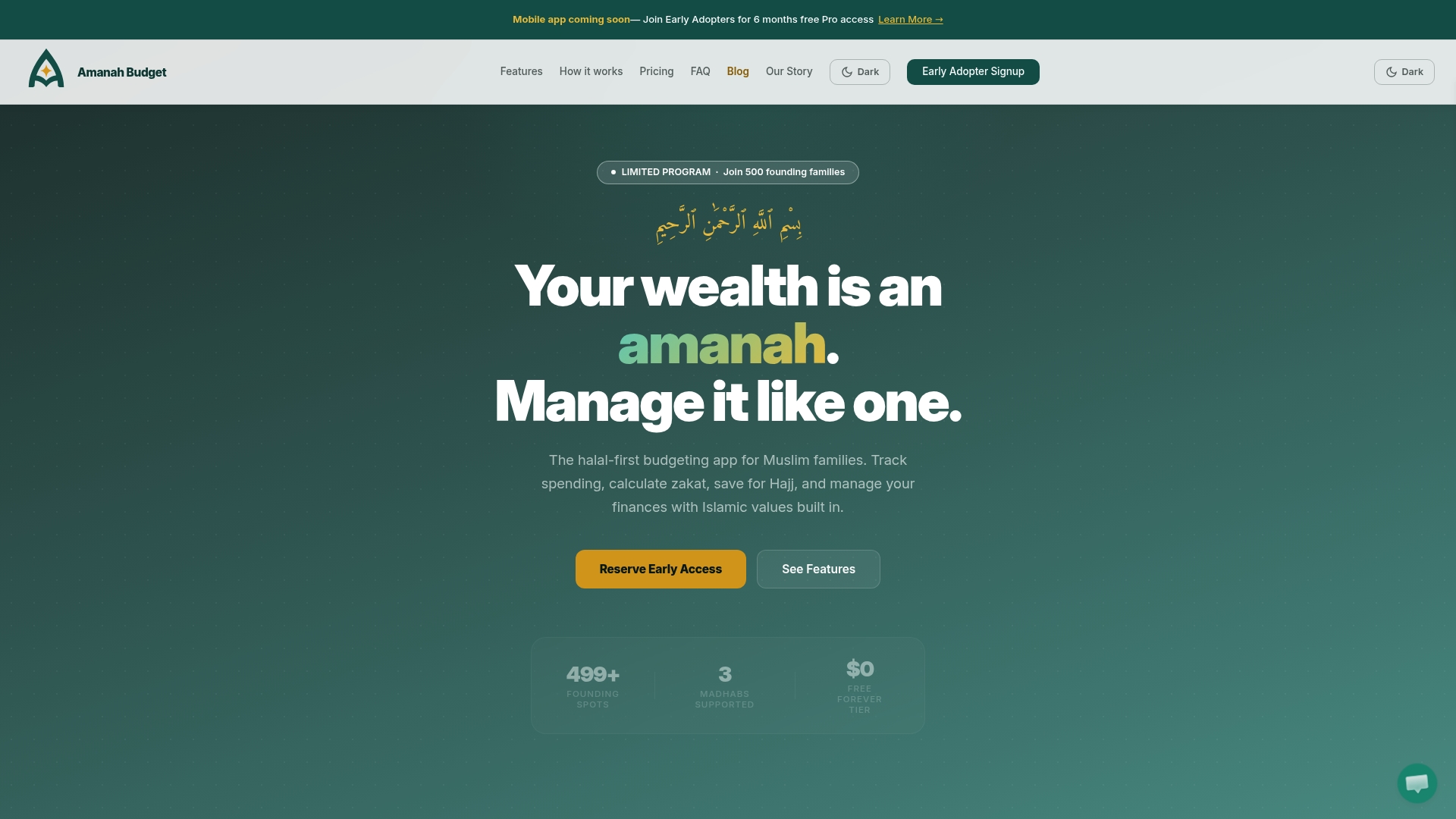
Amanah Budget advertises an early access program limited to the first 500 families and includes a free six-month Pro trial for early adopters. The app pairs halal-aware budgeting with bank sync via Plaid and family sharing, aimed at North American households.
Core Features
- Halal-aware categories with AI flagging for transactions so you can spot nonhalal spending quickly.
- Zakat calculator that supports all four Madhabs and produces a yearly figure tied to your accounts.
- Ramadan planner, charitable goals, and purpose-built savings targets for Hajj, Umrah, and education.
- Bank sync via Plaid for automatic transaction import and AI-assisted categorization with editable suggestions.
- Family sharing with multiple user profiles, goal health scores, and secure encryption with no ads or data selling.
Key Differentiator
Amanah Budget places Islamic finance mechanics inside everyday budgeting. Zakat calculation, halal transaction flagging, and faith-aligned savings goals are native features rather than add-ons, so religious obligations and household budgeting live in the same workflow.
Pros
- Built for Muslim families: the feature set maps directly to household needs like zakat, Hajj savings, and Ramadan planning.
- Family sharing lets spouses and household members view combined budgets and contribute to shared goals without separate accounts.
- Privacy-first approach: the vendor states no ads and no selling of user data, which matters for household trust.
- Educational content on Islamic finance helps families understand how to calculate zakat and prioritize charitable giving.
- Early adopter benefits include the trial period and lock-in pricing for Pro features.
Cons
- Limited availability and mobile limitations: the early access cap above and the lack of a full mobile app yet mean some families will face a waitlist or need to use desktop tools for now.
Notable Integrations
Amanah Budget connects to banks through Plaid for secure transaction import. Bank sync is currently available in the US, UK, and Canada, which lets families in those markets automate most of their expense tracking while users elsewhere must rely on manual entry.
Who It’s For
Muslim families in North America who want budgeting that respects their madhab and religious obligations. It fits couples sharing household finances, parents saving for religious travel or education, and households that prefer privacy and no ad trackers.
Unique Value Proposition
The Zakat calculator supports all four Madhabs, so your annual calculation can match your chosen school of thought rather than forcing a generic rule. That alignment removes a frequent source of uncertainty for families who must reconcile religious practice with automated finance tools.
Real World Use Case
A married couple links their joint checking via Plaid, tags daily groceries and zakat-eligible savings, and sets a Hajj goal with weekly contributions. AI flags unclear transactions, they correct a few categories, and the app shows progress toward the Hajj fund and the next zakat due date.
Pricing
Free tier with core features. Amanah Pro is $7.99 per month or $76.70 per year and adds bank sync and unlimited categories. Family+ is $14.99 per month or $143.90 per year and supports multiple users with combined budgets.
Website: https://amanahfund.com
Rafiq
At a Glance
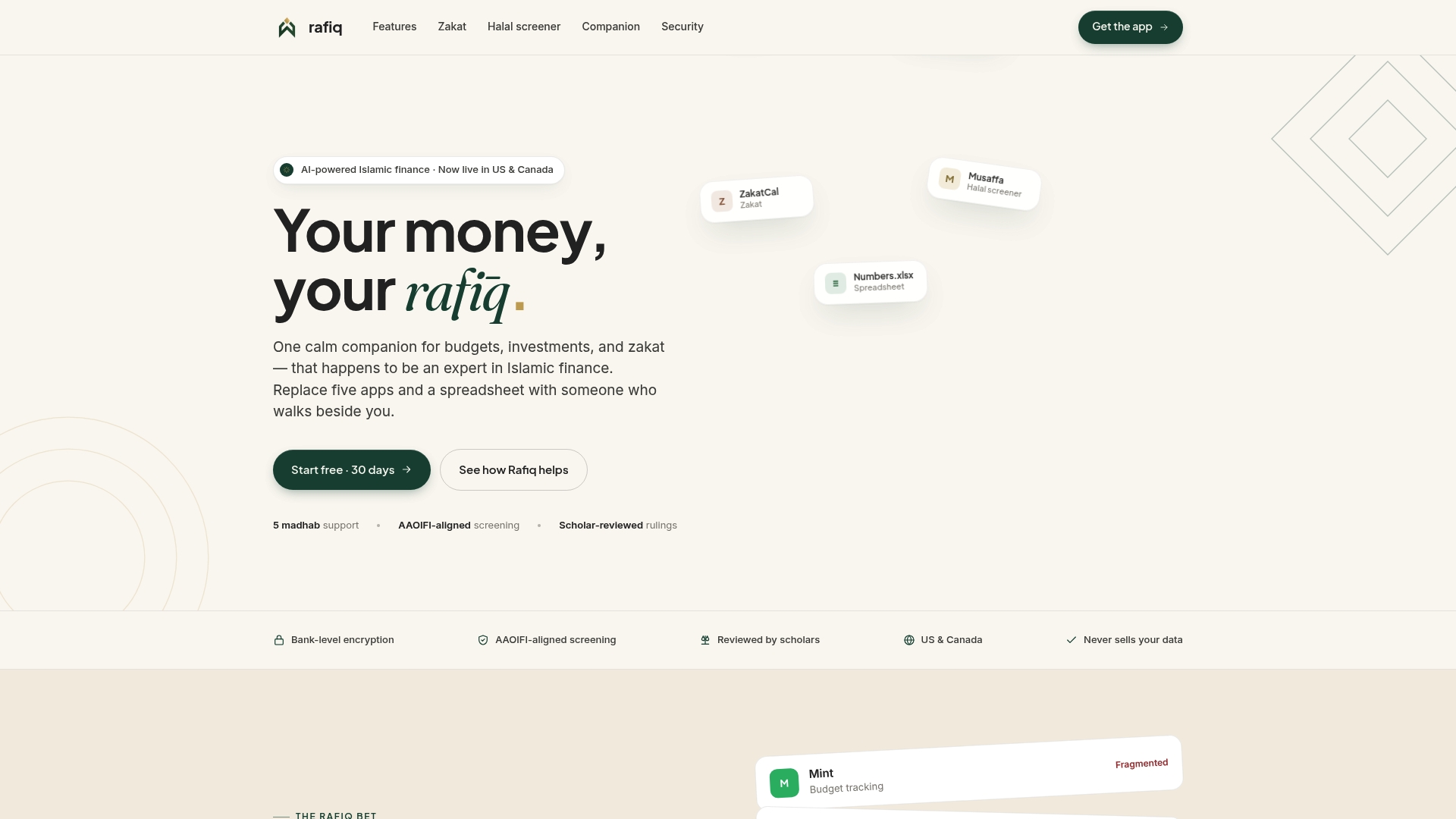
Rafiq’s marketing materials claim support for all five major Islamic madhabs with real-time, citation-backed calculations across crypto, retirement accounts, and rental property. That combination aims to replace juggling separate zakat calculators, portfolio screeners, and spreadsheets.
Core Features
- Auto-categorized transactions and recurring expense detection for cleaner budgets.
- Linking multiple account types including bank, crypto, investment, and rental property for consolidated net worth tracking.
- Portfolio screening with live updates and AAOIFI-aligned screening mentioned in the product data.
- Zakat and khums calculators with madhab-specific rules and progress reports for giving and Hajj savings.
- An AI-guided fiqh companion for clarifying fiqh questions and showing rule citations.
Key Differentiator
The product positions itself around madhab-aware calculations that apply live to diverse asset classes. That claim makes Rafiq narrower in focus than general budgeting apps because it couples scholarly citations with automated screening across assets that other apps often ignore.
Pros
-
Supports a full set of madhab options, which helps you follow your preferred fiqh without switching tools.
-
Transparent calculations with line-item citations and stated assumptions reduce guesswork when you compute zakat or khums.
-
Handles unusual asset mixes. The app claims it covers crypto, retirement accounts, stocks, and real estate in one place, which simplifies net worth and zakat work.
-
AI-driven fiqh questions give quick, referenced answers that are useful before you consult a scholar in complex cases.
-
The vendor emphasizes data privacy and scholar review, an appealing stance for users wary of data harvesting.
Cons
-
No independent third-party reviews are available in the product data, so real user experience and edge-case behavior are not documented.
-
Availability is limited to the US and Canada for now, which rules out users outside North America.
-
The app depends on data aggregation partners for account linking, so coverage and updates depend on those third parties.
-
Pricing details are not published on the website. You must download the app to see subscription tiers beyond the trial.
When It May Not Fit
If you live outside the US or Canada you cannot use it yet. If you prefer fully open pricing before committing, Rafiq’s in-app only pricing model will feel restrictive. If your workflow requires enterprise integrations or multiuser finance teams, this consumer-focused app may lack the necessary controls.
Who It’s For
Muslim individuals in the US or Canada who hold mixed asset portfolios and want scholar-reviewed, madhab-specific guidance for zakat, khums, and halal screening. It fits professionals juggling crypto, retirement accounts, and rental income who want a single place to calculate obligations.
Real World Use Case
A Muslim professional links bank, brokerage, and crypto accounts, then runs a portfolio screen and zakat calculation in one session. They check the AI fiqh companion for a question about qualifying dividends, note the citation, and schedule charitable transfers against a tracked Hajj fund.
Pricing
Rafiq advertises a 30-day free trial, after which access requires a paid subscription. The vendor states that exact subscription details are available only inside the app, so you see tiers and billing once you install and sign up.
Website: https://rafiq.money
Zoya
At a Glance
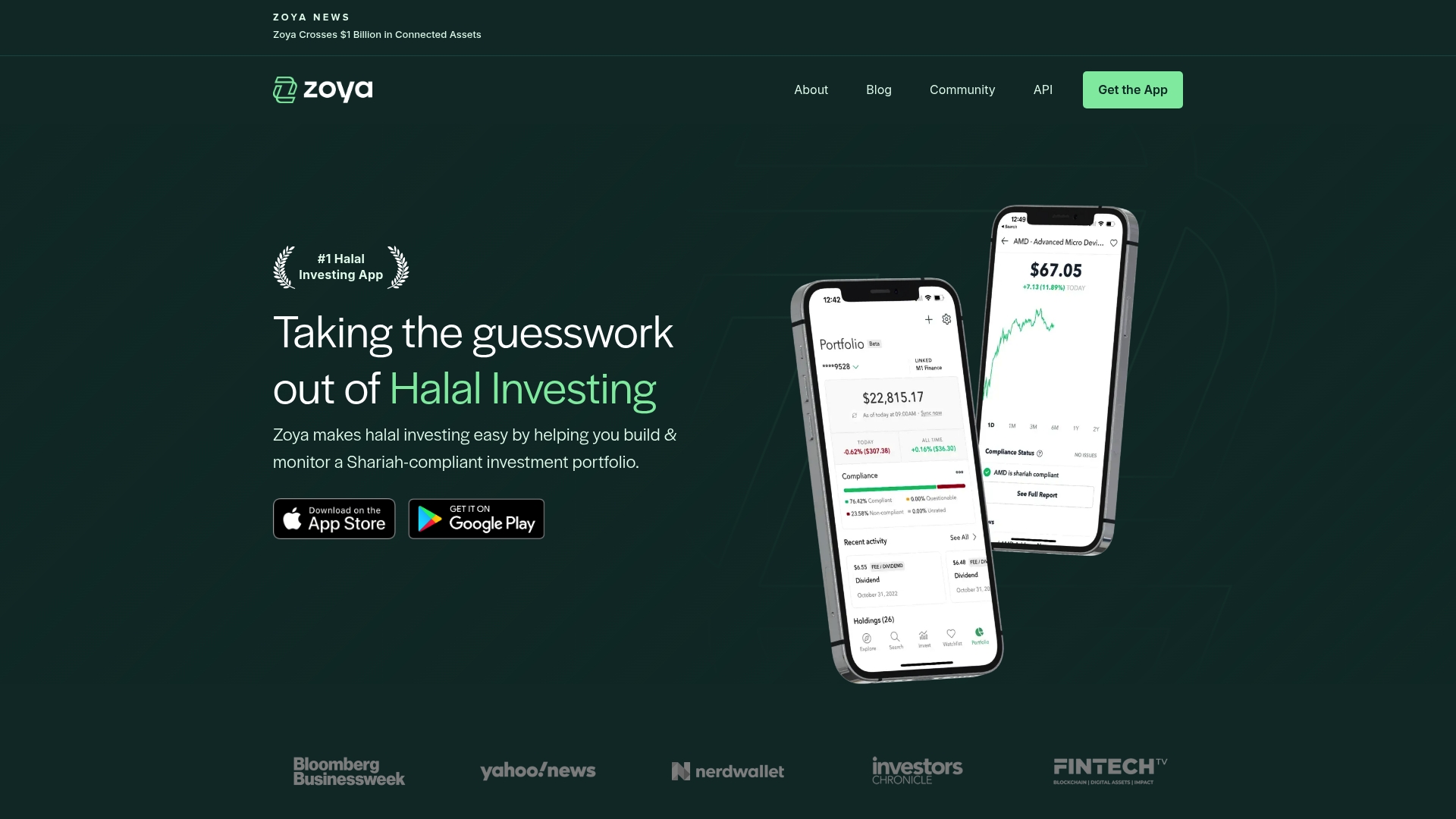
Zoya’s marketing materials state its Shariah compliance database covers more than 30,000 stocks. That breadth, combined with in-app trade execution and a built-in zakat calculator, positions Zoya as a single mobile hub for halal investing rather than a general budgeting tool.
Core Features
- Portfolio tracker that connects and syncs your brokerage accounts for continuous monitoring.
- Buy and sell stocks directly within the app through supported brokers, reducing steps between screening and execution.
- Access to up-to-date Shariah compliance reports for thousands of equities; the coverage above is vendor-reported.
- ETF and mutual fund screening based on Shariah rules and a vendor-advertised 4.8 App Store rating.
- Smart alerts for compliance changes, a zakat calculator, and donation tools.
- Industry-standard AAOIFI-based screening methodology and support across multiple global markets.
Key Differentiator
Zoya combines industry-standard Shariah compliance screening with trading and zakat workflows in one mobile experience. Where Amanah Budget centers household budgeting and zakat planning, Zoya narrows its focus to portfolio-level compliance, alerts, and trade execution for investors who want investment purity alongside action.
Pros
- Comprehensive halal investing toolkit that covers screening, monitoring, and calculation in a single app. This reduces the need to cross-check multiple sources.
- Portfolio sync lets you see live exposure and compliance without manual CSV imports, saving time during rebalances.
- In-app trade execution moves users from research to action in fewer taps, which helps when compliance status changes unexpectedly.
- Regularly updated compliance reports reduce guesswork; the vendor advertises broad coverage and frequent refreshes.
- Active community and educational resources help investors new to Shariah screens learn practical rules and edge cases.
Cons
- Mobile-first design: there is no dedicated desktop or web interface, which frustrates users who prefer large screens for portfolio work.
- Feature access depends on supported brokers and markets; if your broker is unsupported, trading and sync functions are limited.
- The premium subscription tier is expensive for casual users who only want occasional stock checks or a simple compliance lookup.
When It May Not Fit
If you run portfolio analysis on a desktop or need browser-based dashboards, Zoya’s mobile-only approach will slow you down. If you use a broker that Zoya doesn’t support or you want a free occasional compliance lookup, the paid plans may not justify the cost.
Who It’s For
Active Muslim investors and Islamic finance professionals who want rigorous Shariah screening tied directly to trading and monitoring. Also useful for advisors running halal portfolios who need compliance reports and zakat calculations on client accounts.
Real World Use Case
An investor links a brokerage account, screens a watchlist for AAOIFI-based compliance, receives an alert when a holding moves into noncompliant territory, and executes a replacement trade through a supported broker. Zakat is calculated from the synced portfolio and exported for donation.
Pricing
Subscription plans start at $32/month for a personal basic plan and scale up to $1,165/month for enterprise-level advanced plans. Plans are billed annually for savings and specific features vary by tier.
Website: https://zoya.finance
Best Islamic Finance Apps for Your Needs
Discovering the right Islamic finance tool often entails balancing specificity of features, cost-effectiveness, accessibility, and relevance to individual financial priorities. Here’s how the featured applications—Amanah Budget, Rafiq, and Zoya—compare across key dimensions.
Feature Specialization: Meeting Diverse Needs
Each app is specialized for distinct financial scenarios, and their features reflect these focuses:
-
Amanah Budget caters to families aiming to integrate Islamic principles into household budgeting and zakat obligations. With functionality like a Ramadan planner, halal-aware categorization, and family sharing, it’s uniquely equipped for full-scope support.
-
Rafiq excels in accommodating diverse portfolios, offering reconciliation services for crypto, real estate, and modern investment portfolios with citation-backed madhab-specific zakat calculations and asset screenings.
-
Zoya concentrates on investment compliance, providing detailed AAOIFI-based Shariah assessments, enabling Islamic investors to make timely decisions with integrated execution features.
Accessibility and Pricing Transparency
While the apps emphasize privacy and data security, their accessibility and pricing approaches differ substantially:
-
Amanah Budget maintains transparent tiered pricing, catering to varying levels of user needs from free limited access to advanced multi-user subscriptions.
-
Rafiq limits clear pricing disclosure to in-app visibility, which may restrict users preferring upfront external information.
-
Zoya spans a broad range of users, offering enterprise and personal-level plans, but its exclusively higher pricing may deter casual investors.
Best Fit for Specific Scenarios
- For collaborative family-focused financial planning combined with faith-oriented features, Amanah Budget excels.
- Rafiq suits individuals with intricate portfolios who value automated, citational, and madhab-aligned management tools.
- Zoya is for active investors requiring on-the-go mechanisms for Shariah-screened stock and asset transactions.
Our Pick: Amanah Budget
Amanah Budget distinguishes itself by integrating Islamic financial principles into everyday planning for North American families. By encompassing not just individual zakat calculations but a family-wide scope with teachable insights, it’s a distinct choice for users aligning their entire household’s finances with their faith. However, professionals managing mixed portfolios might find Rafiq a more specialized option for their investing workflow.
Islamic Budgeting App Comparisons
Explore how these Islamic budgeting apps differ in their features, applicability, and user focus to select the best option for your personal or family planning needs.
| Product | Core Feature | Key Differentiator | Best For | Pricing | Notable Limitation |
|---|---|---|---|---|---|
| Amanah Budget | Halal-aware budgeting functionality | Integrated religious finance workflows | North American Muslim families | Free basic; Pro: $7.99/month; Family+: $14.99/month | Limited mobile app functionality |
| Rafiq | Asset-integrated zakat calculator | Madhab-specific financial guidance | US/Canadian Muslims with mixed portfolios | Not disclosed | Limited to the US and Canada |
| Zoya | Shariah-screened investment tools | Portfolio Shariah compliance and trading | Active investors requiring compliance tracking | Starts at $32/month | Mobile-exclusive user interface |
Discover Amanahfund as a Thoughtful Alternative to halalwallet.us
If you feel overwhelmed by apps that try to blend Islamic finance with budgeting but miss key religious nuances Amanahfund offers a halal-first budgeting experience built specifically for Muslim families. With features like halal-aware spending categories, zakat calculations aligned with your preferred madhab, and savings goals catering to Hajj, Umrah, and family needs Amanah Budget bridges the gap between faith and finances.

Choose Amanahfund to take control of your household finances without compromising your values. Join hundreds of families who securely connect bank accounts through Plaid and enjoy AI-powered transaction categorization designed around your deen and dunya. Visit Amanahfund now to start calculating zakat and tracking halal spending with confidence.
Frequently Asked Questions
What features make Amanahfund suitable for Muslim families?
Amanahfund includes halal-aware categories, a zakat calculator supporting all four Madhabs, and purpose-built savings targets for religious objectives. These features are tailored to meet the budgeting needs of Muslim households, making it simpler to manage finances while fulfilling religious obligations. Families can prioritize their budgeting around zakat and other Islamic duties effectively.
How does Rafiq compare to Amanahfund for zakat calculation?
Rafiq excels with its real-time, citation-backed zakat calculations across various asset types like crypto and real estate. While Amanahfund also offers a zakat calculator, it primarily focuses on household budgeting and savings goals. Users with diverse asset portfolios may find Rafiq more beneficial for asset-specific zakat management.
Can I use Amanahfund if I want to share budgeting tasks with family?
Amanahfund supports family sharing with multiple user profiles, allowing household members to view combined budgets and contribute to shared financial goals. This feature enhances collaborative financial management in families, which is important for achieving common savings goals. It’s convenient for couples looking to manage finances together while ensuring individual contributions are recognized.
What is the price range for Amanahfund compared to Zoya?
Amanahfund offers a Pro subscription for $7.99 per month or $76.70 annually, while Zoya’s subscription plans start at $32 per month. This makes Amanahfund a more affordable option for budget-conscious families while still providing essential features for halal budgeting and zakat planning. Users seeking cost-effective Islamic budgeting solutions may prefer Amanahfund for its pricing structure.
Does Amanahfund provide resources for understanding Islamic finance?
Yes, Amanahfund includes educational content on Islamic finance, helping families understand zakat calculations and charitable giving priorities. This feature supports users in navigating their financial responsibilities according to Islamic principles, promoting a better understanding of their obligations. Individuals new to these concepts can benefit from these resources when using the app.
Recommended
Ready to manage your amanah?
Track halal spending, calculate zakat, save for Hajj — all in one app. Free forever.
Create Free Account