Halal Fintech Apps Explained for Muslim Adults

Halal fintech apps are defined as digital financial platforms built to help Muslims manage money in full compliance with Islamic law, covering investing, budgeting, banking, and charitable giving within a single ecosystem. The term “halal fintech” is the widely used shorthand, but the recognized industry category is Islamic finance technology, a field that has produced regulated products from apps like Musaffa, HalalWallet, Zakat+, and Amanah Pro. Understanding what these platforms actually do, and how they maintain Shariah compliance, is the first step toward making genuinely ethical financial decisions. This article breaks down halal fintech apps explained in full, so you can choose tools that reflect both your financial goals and your values.
What features do halal fintech apps typically offer?
Halal fintech apps cover a wider range of financial services than most people expect. The category goes well beyond stock screening and includes budgeting, zakat automation, pilgrimage savings, and charity discovery.
Investment research and Shariah screening is the most recognized feature. Musaffa, for example, provides halal stock screening for over 11,000 US stocks and ETFs across 60+ global markets, with real-time compliance reports, zakat calculators, and earnings purification tools built in. Crucially, Musaffa separates research from execution, meaning it provides decision support without acting as a broker. This design reduces compliance risk for the user.

Holistic financial scoring and budgeting is where apps like HalalWallet stand apart. HalalWallet’s Halal Finance Score evaluates housing, banking, investments, retirement, debt, zakat, and estate planning in under two minutes, producing a weighted score from 0 to 100. That score then generates personalized recommendations for halal providers in each category. No conventional budgeting app comes close to this level of Islamic financial self-assessment.
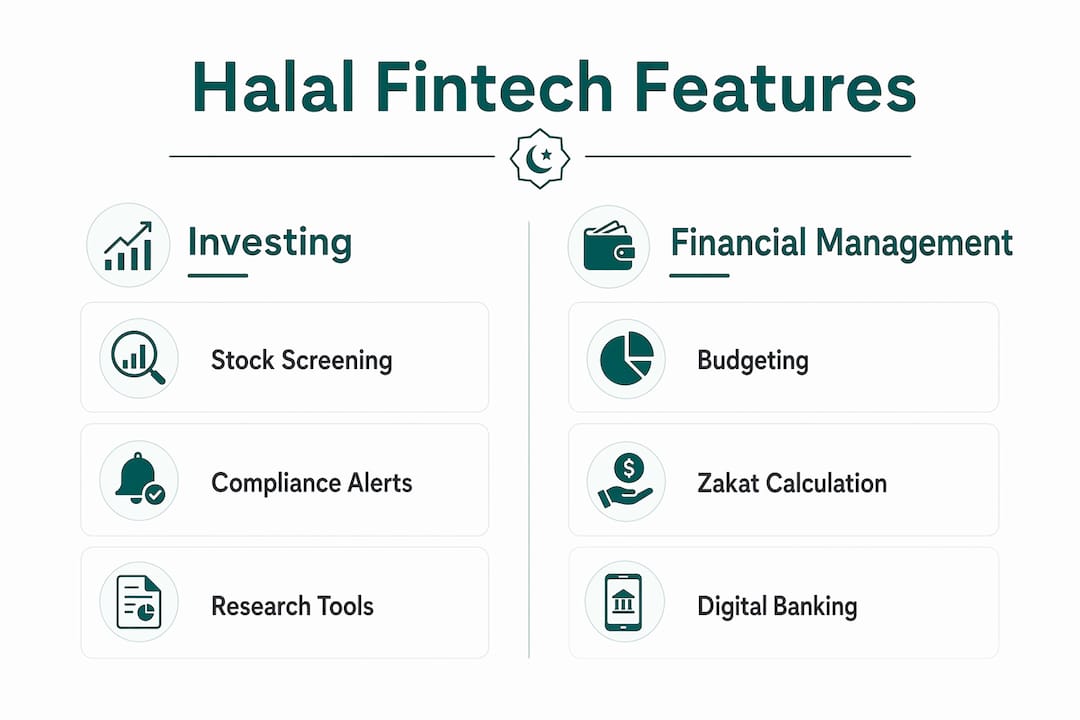
Zakat calculation and charity integration is handled by dedicated apps like Zakat+, which provides real-time nisab rates for gold and silver alongside screening of over 400 charities on Shariah compliance, financial transparency, impact, and efficiency. This means you are not just calculating what you owe. You are also directing it to verified recipients.
Shariah-compliant digital banking has arrived through embedded finance partnerships. Muslim Pro launched Amanah Pro in May 2026 in Jakarta, allowing users to open savings accounts remotely through the Muslim Pro app, with Maybank Indonesia providing the regulated banking infrastructure. This model lets a lifestyle app offer genuine banking without holding a banking license itself.
Pro Tip: Before downloading any halal fintech app, check whether it lists a named Shariah Supervisory Board and publishes audit summaries. An app that cannot name its scholars is not a verified Islamic finance product.
How do halal fintech apps maintain Shariah compliance?
Compliance in Islamic finance technology is not a label applied after a product is built. It is an architectural requirement embedded from the first line of product design. Here is how credible platforms maintain it.
-
Shariah Supervisory Board oversight. Every legitimate halal fintech platform operates under a board of qualified Islamic scholars who review product structures, contracts, and features before launch. These scholars certify that underlying contracts, whether Murabaha, Mudarabah, or Ijara, are structured on Islamic risk-sharing principles from inception.
-
Internal and external audits. AAOIFI governance standards require an internal Shariah audit annually and an independent external audit every three years. This is not optional for institutions claiming compliance. It is the minimum standard for institutional credibility.
-
Purification of impure income (tathir). When a halal investment portfolio contains a company that earns a small percentage of revenue from prohibited activities, the app calculates the proportional impure income and directs the user to donate that amount to charity. Musaffa’s earnings purification feature automates this process entirely.
-
Dynamic compliance, not static certification. Authentic platforms maintain versioned fatwas and ongoing audits rather than a one-time certification. A fatwa issued in 2020 may not account for a new financial instrument introduced in 2024. Credible apps update their compliance logic as markets evolve.
-
Audit-ready reporting systems. Compliance logic is embedded in workflows and purification engines, with reporting systems that can demonstrate adherence to regulators and scholars at any point. This level of accountability separates genuine Islamic fintech from apps that simply remove interest-based products without deeper structural compliance.
“Halal compliance must be integrated from product design, not as an afterthought, ensuring contracts are based on Islamic finance principles with scholar certification.” — Islamic Fintech Is Having Its Moment
Comparing popular halal fintech apps and their offerings
The best halal fintech apps each serve a distinct financial need. Understanding their differences helps you build a stack that covers your full financial life.
| App | Primary focus | Key feature | Availability |
|---|---|---|---|
| Musaffa | Halal investing | Screening for 11,000+ US stocks and ETFs | Global (60+ markets) |
| HalalWallet | Holistic financial health | Halal Finance Score across 7 categories | United States |
| Amanah Pro (Muslim Pro) | Pilgrimage savings and banking | Embedded savings accounts via Maybank Indonesia | Indonesia (launched May 2026) |
| Zakat+ | Zakat and charity | Real-time nisab rates, 400+ charity screening | iOS (App Store) |
A few distinctions worth noting beyond the table:
- Musaffa functions as a research and monitoring tool, not a brokerage. You screen investments through Musaffa, then execute trades through a separate halal broker. This is by design.
- HalalWallet’s scoring system is particularly useful for Muslims who want a structured audit of their entire financial life, not just their investment portfolio. The seven-category framework covers areas most people have never evaluated through an Islamic lens, including retirement and estate planning.
- Amanah Pro represents a new model in Islamic finance technology. Embedded banking-as-a-service through Audax and Maybank Indonesia means Muslim Pro users get a regulated savings product without Muslim Pro needing a banking license. This model is likely to expand to other Muslim lifestyle apps globally.
- Zakat+ addresses a gap that most budgeting apps ignore entirely. Knowing your nisab threshold is one thing. Knowing which charities actually meet Shariah compliance and operational efficiency standards is another. Zakat+ handles both.
For Muslims interested in how halal investment screening compares to broader ethical investing frameworks, ESG strategies share some structural similarities but do not apply Islamic jurisprudence to contract design or purification.
Practical ways to use halal fintech apps every day
Knowing which apps exist is only useful if you know how to integrate them into your actual financial life. Here is how to use Islamic finance technology for real, day-to-day money management.
Set goals that reflect Islamic priorities. Halal budgeting tools work best when your savings goals are named and specific. Hajj, Umrah, Ramadan preparation, Eid gifts, and emergency funds are all distinct categories that deserve dedicated savings buckets. Apps that allow you to label goals by Islamic occasion make it far easier to stay consistent and intentional.
Monitor your investment portfolio with compliance alerts. Shariah compliance is not a one-time check. A company that was halal-screened in January may cross a financial ratio threshold by July. Musaffa’s portfolio monitoring feature sends alerts when a holding’s compliance status changes, so you are not relying on annual reviews to catch problems.
Automate your zakat calculation. Manual zakat calculation is prone to error, especially when your wealth spans bank accounts, investment portfolios, gold holdings, and business assets. Apps like Zakat+ pull real-time nisab values and walk you through each asset category systematically. Pairing a zakat calculation guide with a dedicated app removes the guesswork entirely.
Use family budgeting features for household accountability. Halal financial management is often a household responsibility, not an individual one. Apps that allow spouses to share budgets and track spending together reinforce the concept of shared financial amanah within a family.
Pro Tip: Before committing to any halal fintech app, verify three things: the name of the Shariah board, the date of the most recent audit, and whether the app discloses how it handles purification of impure income. These three data points reveal whether compliance is genuine or cosmetic.
Key takeaways
Halal fintech apps are most effective when they cover investing, budgeting, zakat, and banking together, because Islamic financial management is a whole-life practice, not a single product category.
| Point | Details |
|---|---|
| Definition is specific | Halal fintech apps apply Islamic jurisprudence to product design, contracts, and ongoing compliance, not just branding. |
| Compliance requires governance | AAOIFI standards mandate annual internal audits and external audits every three years to maintain credibility. |
| Apps serve distinct needs | Musaffa covers investing, HalalWallet covers financial health scoring, Zakat+ covers charitable giving, and Amanah Pro covers savings. |
| Embedded finance is expanding | Non-bank apps like Muslim Pro now offer regulated banking through partnerships, making halal banking more accessible. |
| Verification is your responsibility | Confirm each app’s Shariah board, audit history, and purification process before trusting it with your financial data. |
Why the compliance question matters more than the feature list
I have spent time reviewing halal fintech apps across investing, budgeting, and banking categories, and the single most consistent mistake I see Muslim adults make is choosing an app based on its feature list rather than its compliance architecture. An app can have a beautiful zakat calculator and still be routing your deposits through interest-bearing accounts in the background. The feature is halal. The infrastructure is not.
The apps that earn genuine trust, Musaffa, HalalWallet, Zakat+, and Amanah Pro, are transparent about who their scholars are, when their last audit occurred, and how they handle edge cases like purification. That transparency is not a marketing detail. It is the product.
I also think the industry is underestimating how much Muslims want integrated financial tools that cover budgeting, investments, zakat, and retirement in one place. Most people are currently stitching together three or four separate apps to manage what a single well-designed platform could handle. That fragmentation creates gaps, and gaps in halal compliance are not trivial.
The next frontier is blockchain-based smart contracts that enforce Shariah compliance at the transaction level, removing human error from purification calculations entirely. That technology exists in prototype form today. Within five years, it will likely be standard in premium Islamic finance apps.
My honest recommendation: start with your budgeting and zakat obligations before you touch investment screening. Getting your household finances aligned with Islamic principles is the foundation. Investment compliance built on a shaky financial base does not serve your deen or your dunya.
— Imran
Manage your finances the halal-first way with Amanahfund
If this article clarified what halal fintech apps can do, the next step is putting those principles into practice with a tool built specifically for Muslim families.
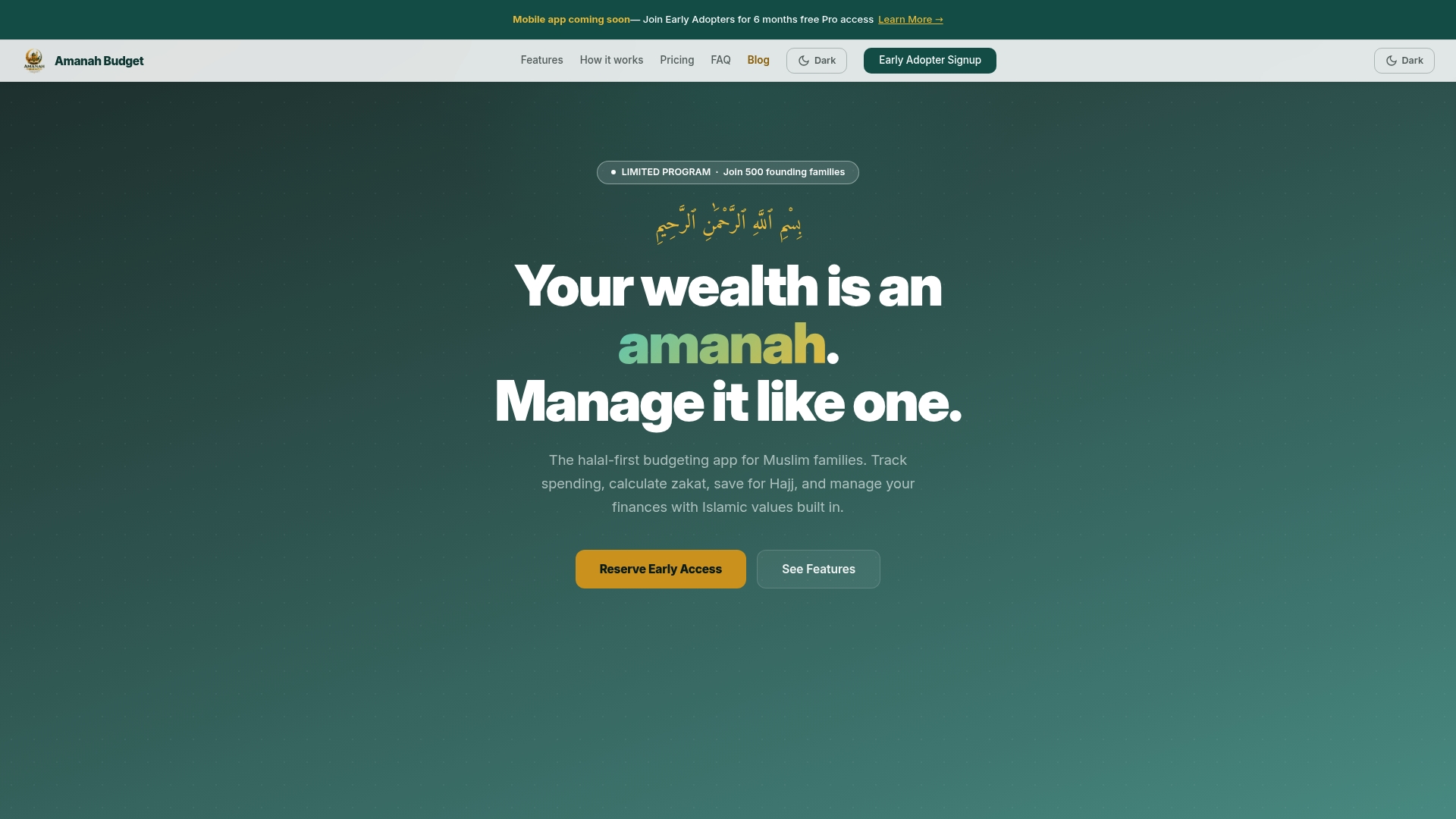
Amanahfund’s halal budgeting app is designed around both your dunya and your deen. Amanah Budget includes halal-aware spending categories, a zakat calculator that supports multiple madhabs, dedicated savings goals for Hajj, Umrah, Ramadan, and Eid, and AI-powered transaction categorization through a secure Plaid connection. Spouses and family members can share a single household budget. There are no ads, no data selling, and no interest-based products. For families ready to align their daily financial habits with Islamic values, the Amanahfund blog also offers practical guides on halal budgeting strategies and zakat planning to support every step of the process.
FAQ
What are halal fintech apps?
Halal fintech apps are digital financial platforms that apply Islamic law to investing, budgeting, banking, and charitable giving, ensuring all features and underlying contracts are free from riba (interest), gharar (excessive uncertainty), and prohibited industries.
How do I know if a fintech app is genuinely Shariah-compliant?
Look for a named Shariah Supervisory Board, published audit dates, and a disclosed purification process. AAOIFI-aligned platforms conduct internal audits annually and independent external audits every three years.
What is the difference between Musaffa and HalalWallet?
Musaffa focuses on halal investment research and stock screening across 11,000+ US stocks, while HalalWallet provides a holistic Halal Finance Score covering seven financial categories including housing, retirement, and zakat for US-based users.
Can halal fintech apps calculate zakat automatically?
Yes. Apps like Zakat+ use real-time gold and silver nisab rates to calculate zakat obligations across asset categories, and Musaffa includes a built-in zakat calculator for investment portfolios specifically.
What is embedded finance in Islamic fintech?
Embedded finance allows non-bank apps to offer regulated banking products by partnering with licensed institutions. Muslim Pro’s Amanah Pro uses this model, partnering with Maybank Indonesia to offer Shariah-compliant savings accounts directly inside the Muslim Pro app.
Recommended
Ready to manage your amanah?
Track halal spending, calculate zakat, save for Hajj — all in one app. Free forever.
Create Free Account