Hajj Savings Strategies List: Your 2026 Planning Guide
TL;DR:
- Hajj savings strategies are interest-free plans that help Muslims fund their pilgrimage in accordance with Islamic principles.
- A realistic plan involves setting a target, a timeline of 3–5 years, and using Shariah-compliant financial products.
Hajj savings strategies are structured, interest-free financial plans that help Muslim individuals and families fund their pilgrimage while staying fully compliant with Islamic principles. Standard Hajj packages range between $9,500 and $15,500 per person in 2026, with an additional $1,500 recommended for hady, gifts, and incidentals. That puts your total funding target between $11,000 and $17,000 per pilgrim. Reaching that number requires a multi-year plan built on halal savings accounts, Shariah-compliant investments, and disciplined automation. This guide gives you a complete hajj savings strategies list, step by step, tailored for Muslim families and individuals in the United States.
1. What are the key components of a Hajj savings plan?
A reliable Hajj savings plan has three core elements: a realistic target, a clear timeline, and Shariah-compliant financial vehicles. Without all three, most pilgrims either fall short or dip into funds meant for other needs.

Start by setting your total savings goal. Take the package cost, add the $1,500 incidentals buffer, and then add a 15% inflation cushion on top. That buffer accounts for rising costs, currency shifts, and personal travel expenses. Skipping it is the single most common reason pilgrims face a shortfall in their final year.
Choose your timeline next. A 3–5 year horizon is the most practical for most American Muslim families. Divide your total goal by the number of months in your plan to get your monthly savings target. Then open a dedicated account labeled specifically for Hajj. Keeping it separate from your daily checking account is not optional. It is the foundation of the entire plan.
- Set a total goal: package cost plus $1,500 incidentals plus 15% inflation buffer
- Choose a 3–5 year timeline and calculate your monthly target
- Open a dedicated, clearly labeled Hajj savings account
- Use Shariah-compliant financial products that offer profit-sharing instead of interest
- Never mix Hajj funds with emergency savings or daily spending
Pro Tip: Open your Hajj account at a different bank than your main checking account. The extra friction of a separate login reduces the temptation to transfer funds out.
2. Which halal savings and investing options work best?
The right financial vehicle depends on your timeline and risk tolerance. For a 3–5 year horizon, a split of 30% liquid and 70% invested in Shariah-screened assets balances accessibility with inflation protection.
The liquid 30% belongs in a halal savings account that uses profit-sharing rather than interest. Institutions like Amana Mutual Funds, University Islamic Financial (UIF), and LARIBA offer Shariah-compliant deposit products in the United States. These accounts grow your money without riba and keep funds accessible when you need them.
The invested 70% can go into Shariah-screened ETFs or mutual funds. Wahed Invest’s HLAL ETF and SP Funds’ SPUS ETF are two widely used options for medium-term growth and inflation protection. Both are screened against interest-based businesses, weapons, and other prohibited sectors. For pilgrims who prefer a hands-off approach, managed halal portfolios through platforms like Wahed Invest handle diversification automatically.
| Vehicle | Best For | Liquidity | Riba Risk |
|---|---|---|---|
| Halal savings account (UIF, LARIBA) | Short-term and emergency buffer | High | None |
| Shariah-screened ETF (HLAL, SPUS) | Medium-term growth | Medium | None |
| Managed halal portfolio (Wahed Invest) | Hands-off diversification | Medium | None |
| Wakala fixed-term deposit | 1–5 year locked savings | Low | None |
- Amana Mutual Funds and UIF are established US-based halal savings options
- HLAL and SPUS provide screened equity exposure without interest
- Wakala deposits lock funds for a fixed term and pay a predetermined profit rate
- Managed portfolios suit families who want diversification without active management
Pro Tip: Check that any ETF or mutual fund you choose carries a current Shariah certification from a recognized board, not just a marketing claim. HLAL and SPUS both publish their screening criteria publicly.
3. How automation improves your savings discipline
Automation is the most reliable tool for consistent Hajj saving. Standing instructions and automated micro-deposits remove the decision from your hands every month. When the transfer happens automatically on payday, you never have a chance to spend the money first.
Set up a recurring transfer from your paycheck directly to your dedicated Hajj account. Schedule it for the same day your salary arrives. This “pay yourself first” approach treats your Hajj fund like a fixed bill, not an optional contribution. Apps that support bank account linking make this setup straightforward and secure.
Micro-saving strategies add meaningful amounts over time without feeling painful. Rounding up purchases to the nearest dollar and directing the difference to your Hajj fund is one method. Cutting dining expenses by half can redirect $125 per month to your Hajj fund. That is $1,500 per year from one habit change alone.
- Schedule an automatic transfer on payday to your Hajj account
- Enable round-up savings if your bank or app supports it
- Audit subscriptions quarterly and cancel unused ones
- Redirect any windfalls (tax refunds, bonuses) directly to the Hajj fund
- Review your dining budget and set a firm weekly limit
Pro Tip: Use Amanahfund’s Hajj savings goal feature to track your progress visually. Seeing the balance grow toward a labeled goal keeps motivation high between milestones.
4. What is the right savings timeline and risk approach?
The hajj savings timeline for US pilgrims typically runs 3–5 years. Your monthly target depends entirely on your start date. A family targeting a $14,000 total goal over four years needs to save roughly $292 per month. Starting one year later raises that to $389 per month.
Risk management changes as your Hajj date gets closer. In the early years, Shariah-screened equities can carry the bulk of your portfolio because you have time to recover from market dips. As you enter the final 12–24 months, that changes completely. Savings plans should shift 100% into liquid, low-risk instruments within 1–2 years of Hajj to eliminate market timing risk before payment deadlines.
Planning your booking timeline matters just as much as your savings timeline. Most Hajj operators in the United States require deposits approximately 12 months before departure. That means your funds need to be fully liquid and accessible well before your travel date.
- Years 1–2: 70% in Shariah-screened ETFs, 30% in halal savings accounts
- Years 3–4: Begin shifting invested assets to liquid accounts
- Final 12 months: 100% liquid in a halal savings or profit-sharing account
- Book your Hajj package approximately 12 months before departure
- Keep a separate contingency budget for hady, gifts, and incidentals
A currency transfer calculator helps you track exchange rate movements if you are sending funds internationally or paying a non-US operator. Locking in a favorable rate early can protect your budget from currency fluctuations.
5. What are the most common mistakes in Hajj financial preparation?
The most damaging mistake in Hajj financial preparation is starting without an emergency fund. An emergency fund covering at least one month of expenses should be in place before you begin aggressive Hajj saving. Without it, a car repair or medical bill forces you to raid your Hajj fund and restart from zero.
Interest-bearing debt is the second major obstacle. Carrying credit card balances while trying to save for Hajj creates a direct contradiction with Islamic finance principles. Pay off existing interest-bearing debt before directing significant funds toward Hajj. The math also works in your favor: eliminating a 20% APR credit card balance is a better return than almost any halal investment.
Keeping Hajj savings in a separate account with a transfer delay significantly reduces impulse withdrawals. The barrier of a separate institution, a different login, and a 1–3 day transfer window is enough to stop most unplanned spending decisions. Booking group packages through local mosques can also reduce costs and provide spiritual guidance throughout the journey.
- Build a one-month emergency fund before starting Hajj saving
- Clear interest-bearing debt before aggressive saving begins
- Keep Hajj savings at a separate institution with a transfer delay
- Conduct a monthly spending audit to find and redirect wasted funds
- Book through a mosque-affiliated group operator for better rates and community
Key takeaways
A complete Hajj savings plan combines a realistic total target, a 3–5 year timeline, Shariah-compliant financial vehicles, and automated contributions that protect your fund from impulse spending.
| Point | Details |
|---|---|
| Set a total savings target | Include package cost, $1,500 incidentals, and a 15% inflation buffer. |
| Split liquid and invested funds | Keep 30% liquid in halal savings and 70% in Shariah-screened investments. |
| Automate every contribution | Schedule transfers on payday to remove the decision and prevent missed payments. |
| Shift to liquid assets early | Move all funds to low-risk accounts 12–24 months before your Hajj date. |
| Eliminate debt first | Clear interest-bearing balances before starting aggressive Hajj saving. |
My honest take on saving for Hajj
I have seen many families approach Hajj savings the same way they approach a New Year’s resolution. They start strong in january, hit a financial bump in march, and quietly abandon the plan by june. The problem is almost never income. It is structure.
The families who actually make it to Hajj on their intended date share one habit: they treat the monthly contribution as non-negotiable. Not a goal. Not a wish. A fixed expense. That mental shift, more than any specific financial product, is what separates those who go from those who keep saying “next year.”
The Islamic perspective on saving reinforces this beautifully. Saving with intention, for a purpose that pleases Allah, is itself an act of worship. That framing makes it easier to say no to a restaurant dinner or an impulse purchase. You are not depriving yourself. You are protecting something sacred.
My practical advice: start now, even if the amount feels small. A family saving $150 per month today is building a habit and a balance. Waiting until you can save $500 per month means losing years of compounding and, more importantly, losing the discipline that comes from consistent practice. The family budgeting strategies that work for Eid and Ramadan savings work just as well for Hajj. The goal is bigger, but the method is the same.
— Imran
How Amanahfund supports your Hajj savings goal
Amanahfund is a halal-first budgeting app built specifically for Muslim families, with dedicated Hajj and Umrah savings goals built directly into the experience. You can set your total Hajj target, track monthly progress, and connect your bank accounts securely through Plaid. AI-powered transaction categorization helps you find spending to redirect toward your fund.
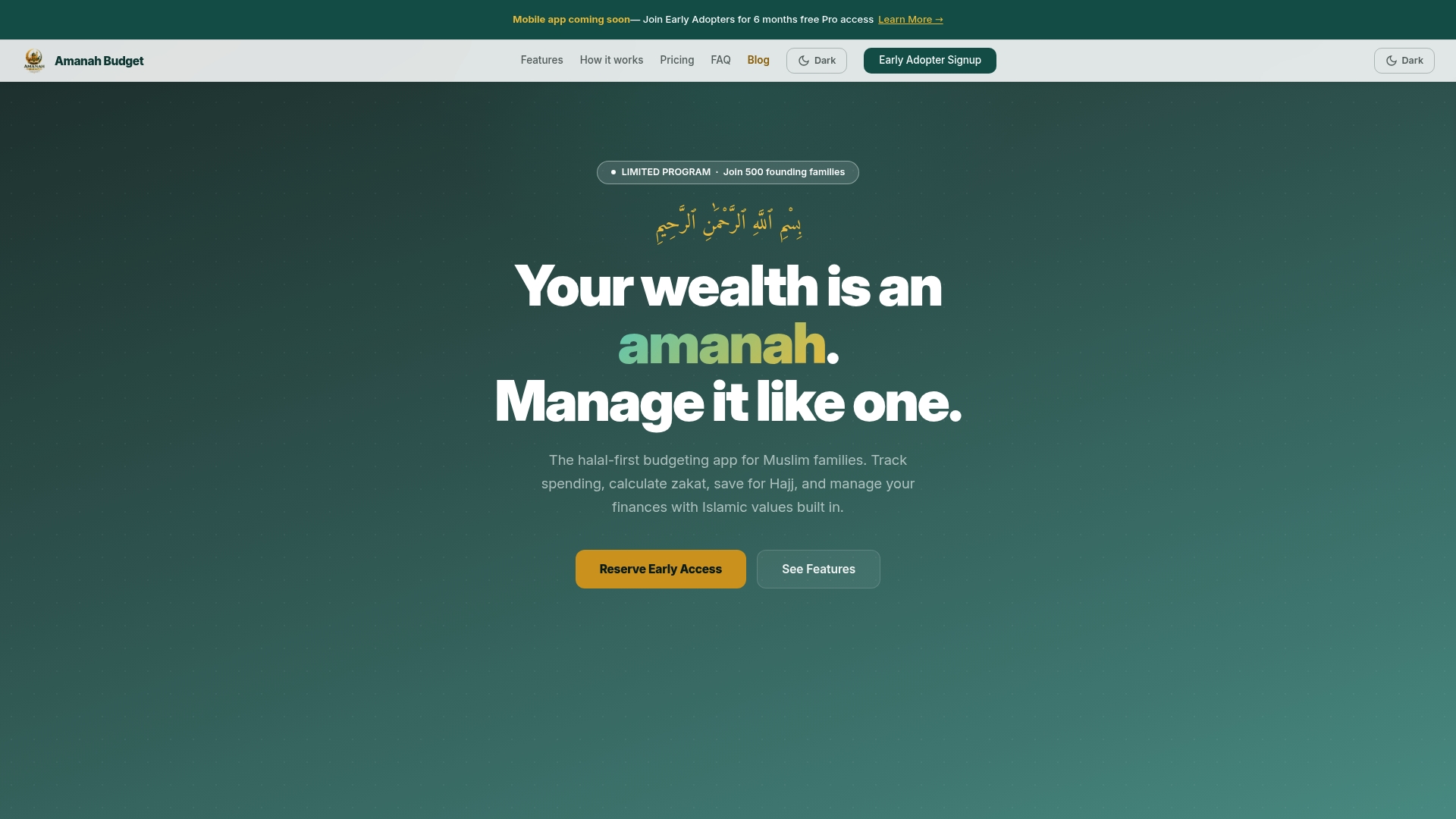
Amanahfund includes zakat calculation, halal-aware spending categories, and family budget sharing so your entire household stays aligned on the goal. There are no ads, no data selling, and no interest-based products. Start your Hajj savings plan with a tool built around your values, not just your balance.
FAQ
How much should I save each month for Hajj?
Divide your total Hajj goal (package cost plus $1,500 incidentals plus a 15% inflation buffer) by the number of months until your intended departure. For a $14,000 target over four years, that is roughly $292 per month.
What is the best halal savings account for Hajj in the US?
University Islamic Financial (UIF), LARIBA, and Amana Mutual Funds all offer Shariah-compliant, profit-sharing deposit products in the United States. Choose based on your state’s availability and the profit rate offered.
When should I stop investing and move funds to savings?
Move all Hajj funds into liquid, low-risk accounts 12–24 months before your travel date. This protects against market volatility and keeps funds accessible for operator deposits and booking deadlines.
Can a family save for Hajj together?
Yes. A family Hajj fund contribution plan works best when all household members contribute to a single dedicated account with a shared monthly target. Apps like Amanahfund support shared household budgets for exactly this purpose.
Does riba in my savings account affect my Hajj?
Shariah scholars widely advise that funds earned through interest compromise the spiritual integrity of Hajj. Use only profit-sharing accounts and Shariah-screened investments to keep your savings fully halal from start to finish.
Recommended
- How Much Does Hajj Cost and How to Save for It: A Practical Guide — Amanah Budget Blog
- How Much Does Hajj Cost and How to Save for It: A Practical Guide — Amanah Budget Blog
- Amanah Budget Blog — Islamic Finance, Zakat, and Halal Budgeting Guides
- Eid Savings Strategy Explained for Muslim Families — Amanah Budget Blog
Ready to manage your amanah?
Track halal spending, calculate zakat, save for Hajj — all in one app. Free forever.
Create Free Account