Family Halal Budget Setup Guide for Muslim Families
TL;DR:
- A halal family budget aligns household spending, saving, and giving with Islamic principles, prioritizing religious obligations and long-term goals. Implementing structured frameworks like the 50/30/20 split and treating zakat as fixed expenses ensures consistency and barakah in family finances. Bulk purchasing, meal planning, and sharia-compliant savings strategies help families manage halal grocery costs and safeguard their financial stability.
A family halal budget is a structured financial plan that aligns every spending and saving decision with Islamic values, covering needs, religious obligations, and long-term goals under one framework. Most Muslim families in the US manage their finances with tools built for a secular worldview, which means zakat, Hajj savings, and halal grocery costs get treated as afterthoughts rather than priorities. This guide gives you a practical, step-by-step approach to setting up halal family finances from scratch, using real strategies for grocery budgeting, religious obligations, and sharia-compliant savings that actually work for everyday households.
What is the recommended family halal budget setup framework?
The most widely recommended structure for halal family budgeting is a modified 50/30/20 split: 50% of net income toward needs, 20 to 30% toward wants, and 20 to 30% toward savings, investments, and zakat. This framework, adapted from conventional personal finance, works for Muslim families because it creates a dedicated space for religious obligations rather than treating them as optional extras.
The three categories break down like this:
- Needs (50%): Rent or mortgage, utilities, halal groceries, transportation, school fees, and basic clothing.
- Wants (20 to 30%): Dining out at halal restaurants, family entertainment, travel, and discretionary purchases.
- Savings, investments, and zakat (20 to 30%): Emergency fund contributions, Hajj and Umrah savings, halal investment accounts, and zakat payments.
The most important shift this framework requires is treating religious obligations as fixed expenses, not flexible ones. Zakat belongs in the same mental category as your rent payment. If you wait until the end of the month to see what is left over, it rarely gets paid consistently.
Transparency within the household is equally critical. Both spouses should have full visibility into income, spending, and savings goals. Families who budget together are far less likely to experience financial conflict and far more likely to reach shared goals like Hajj or debt-free living.

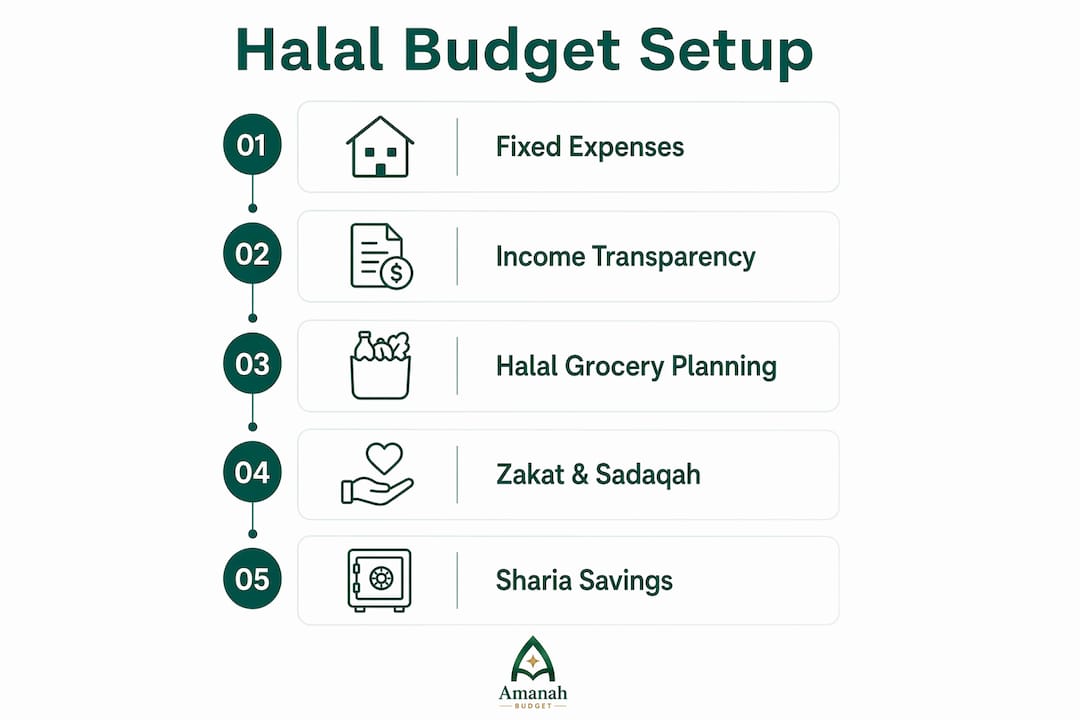
Pro Tip: Start your halal food budget tracking guide by listing every fixed expense first, including zakat and any regular sadaqah. What remains is your true discretionary income.
How to plan halal grocery and meat budgeting effectively
Halal grocery costs run higher than conventional alternatives in the US, primarily because certified halal meat commands a premium and is available from fewer suppliers. The most effective counter-strategy is bulk purchasing. Buying halal meat in bulk lowers the cost per pound by 30 to 50%, saving families between $500 and $1,000 annually. That is a meaningful number for any household budget.
Here is a practical four-step approach to halal grocery budgeting:
- Audit your current spending. Pull three months of grocery receipts and identify your top 10 to 15 staple items. Tracking a focused list of staple prices, rather than every single receipt, helps you spot price fluctuations and time your purchases wisely.
- Identify your halal meat sources. Find two or three trusted certified halal suppliers in your area or online. Quality certification compliance and cost savings go together when you buy from trusted sources in volume.
- Apply meal logic to your shopping list. Smart halal households practice meal logic, where every ingredient purchased is planned to appear across multiple meals. A whole chicken bought on Monday becomes a roast dinner, then a soup base, then a rice dish. Nothing is wasted.
- Use your freezer as a financial tool. Portion bulk meat purchases into weekly servings immediately after buying. Proper freezer storage extends shelf life by weeks and removes the temptation to buy convenience food when you are short on time.
| Strategy | Cost impact | Effort level |
|---|---|---|
| Bulk halal meat purchase | 30 to 50% savings per pound | Low (one monthly trip) |
| Meal logic planning | Reduces waste, stretches budget | Medium (weekly planning) |
| Split-order with community | Shares bulk minimum costs | Low (coordinate once) |
| Capping restaurant spending | Prevents budget overrun | Low (set a monthly limit) |
The split-order strategy deserves special attention for families in areas with limited halal access. If a bulk order minimum is 20 pounds of lamb and your family only needs 10, coordinate with another family from your masjid or community to share the order. This approach cuts the upfront cost while still capturing the per-pound savings.
Restaurant spending should be planned and capped as a special-occasion category rather than a default convenience. Treating halal dining out as entertainment rather than a meal solution keeps your grocery budget intact.
Pro Tip: Build a simple price tracker in a notes app or spreadsheet for your 10 to 15 most-purchased halal staples. When prices drop at your preferred supplier, that is your signal to stock up.
Why zakat, sadaqah, and avoiding riba belong in your fixed budget
Zakat and sadaqah are not optional line items to revisit when the budget looks comfortable. Treating zakat as a fixed monthly bill fosters barakah and financial discipline more effectively than setting it aside from whatever remains at month’s end. The practical reason is simple: money that is not allocated in advance gets spent on something else.
The core religious obligations to build into your fixed budget include:
- Zakat: Calculate your annual nisab threshold and divide by 12 to create a monthly contribution. Tools like the LaunchGood Zakat Calculator make this straightforward.
- Sadaqah: Set a fixed monthly amount, even if small. Consistency matters more than size.
- Riba avoidance: Review every financial product your family uses, including credit cards, mortgages, and savings accounts, and replace interest-bearing products with sharia-compliant alternatives.
“Whoever pays zakat on his wealth will have its evil removed from him.” (Sahih Bukhari) Treating this obligation as a financial priority, not an afterthought, is the foundation of a halal family budget that generates barakah.
Avoiding riba requires active choices. In the US, sharia-compliant banking options include institutions like Guidance Residential for home financing and University Islamic Financial for auto financing. For everyday banking, look for accounts that do not pay or charge interest. The effort to find these alternatives is real, but the financial stability that comes from removing riba from your household is worth it.
Families who neglect these obligations often find their budgets destabilized in unexpected ways. Debt from interest-bearing credit cards compounds faster than most people anticipate, and the psychological weight of unpaid zakat creates a form of financial anxiety that no spreadsheet can fix.
Pro Tip: Set up a separate savings account labeled “Zakat and Sadaqah” and automate a monthly transfer to it on payday. Treat it exactly like your rent payment.
How to build a sharia-compliant emergency fund and savings plan
An emergency fund covering 3 to 6 months of living expenses in a sharia-compliant account is the single most important financial safety net a Muslim family can build. Without it, any unexpected expense, a car repair, a medical bill, a job loss, forces you toward debt and potentially riba.
Follow this stepwise approach to build your fund:
- Calculate your monthly baseline. Add up all fixed needs: rent, utilities, groceries, transportation, and school fees. Multiply by three for your minimum target and by six for your full target.
- Open a sharia-compliant account. In the UK, institutions like Al Rayan Bank and BLME offer halal savings products. In the US, look for non-interest-bearing current accounts or sharia-compliant credit unions. The goal is a liquid account that holds your emergency fund without generating or charging interest.
- Automate contributions. Set a fixed monthly transfer from your main account to your emergency fund. Even $100 per month builds a meaningful cushion over 12 to 18 months.
- Separate your emergency fund from your savings goals. Your Hajj fund, Eid fund, and education savings are separate from your emergency fund. Mixing them leads to raiding one to cover the other.
| Savings goal | Recommended account type | Timeline |
|---|---|---|
| Emergency fund | Sharia-compliant current account | 12 to 24 months |
| Hajj and Umrah | Dedicated halal savings goal | 2 to 5 years |
| Education | Halal investment account | 5 to 15 years |
| Retirement | Sharia-compliant pension or fund | 20 to 30 years |
Emergency funds prevent costly debt by covering sudden costs before they become a crisis. A family with three months of expenses saved can absorb a job loss without touching a credit card. That is the practical value of this step, and it directly supports the halal principle of avoiding riba.
Once your emergency fund reaches its target, redirect those monthly contributions toward halal investments. Sharia-compliant investment funds screen out companies involved in alcohol, gambling, weapons, and interest-based finance, giving your money a place to grow without compromising your values.
Key takeaways
A successful family halal budget setup requires treating zakat, grocery planning, and sharia-compliant savings as fixed priorities, not flexible afterthoughts.
| Point | Details |
|---|---|
| Use the 50/30/20 framework | Allocate 50% to needs, 20 to 30% to wants, and 20 to 30% to savings and zakat. |
| Bulk buy halal meat | Buying in bulk saves 30 to 50% per pound, cutting annual costs by up to $1,000. |
| Treat zakat as a fixed bill | Automate monthly zakat contributions to build barakah and financial discipline. |
| Build a 3 to 6 month emergency fund | Keep it in a sharia-compliant account to avoid riba when unexpected costs arise. |
| Apply meal logic to groceries | Plan every ingredient across multiple meals to reduce waste and stretch your budget. |
Budgeting with niyyah: why intention changes everything
Most budgeting advice treats money management as a purely mechanical exercise. Track your spending, cut the waste, hit your targets. That framework works for spreadsheets but misses something critical for Muslim families. Intention, or niyyah, is the most important element of successful halal budgeting. When your financial decisions are grounded in a clear spiritual purpose, the discipline required to maintain them becomes far easier to sustain.
I have seen this play out consistently. Families who budget toward a specific goal, saving for Hajj, paying off debt before Ramadan, building an education fund for their children, maintain their budgets far longer than families who budget to “be more responsible.” The goal has to mean something beyond the numbers.
The balance between financial discipline and generosity is also worth naming directly. Some families overcorrect toward restriction and stop giving sadaqah when budgets feel tight. That is the wrong move. Generosity is not a reward for financial success. It is a practice that, according to Islamic teaching, invites more barakah into your household. Keep your sadaqah line in the budget even in difficult months, even if the amount is small.
Regular review matters too. A halal family budget is not a document you set once and file away. Sit down monthly with your spouse, review actual spending against your plan, and adjust. The families who build this review habit are the ones who actually reach their financial goals.
— Imran
How Amanahfund helps Muslim families budget with purpose
Amanahfund was built specifically for Muslim families who want their financial tools to reflect their values, not just their transactions.
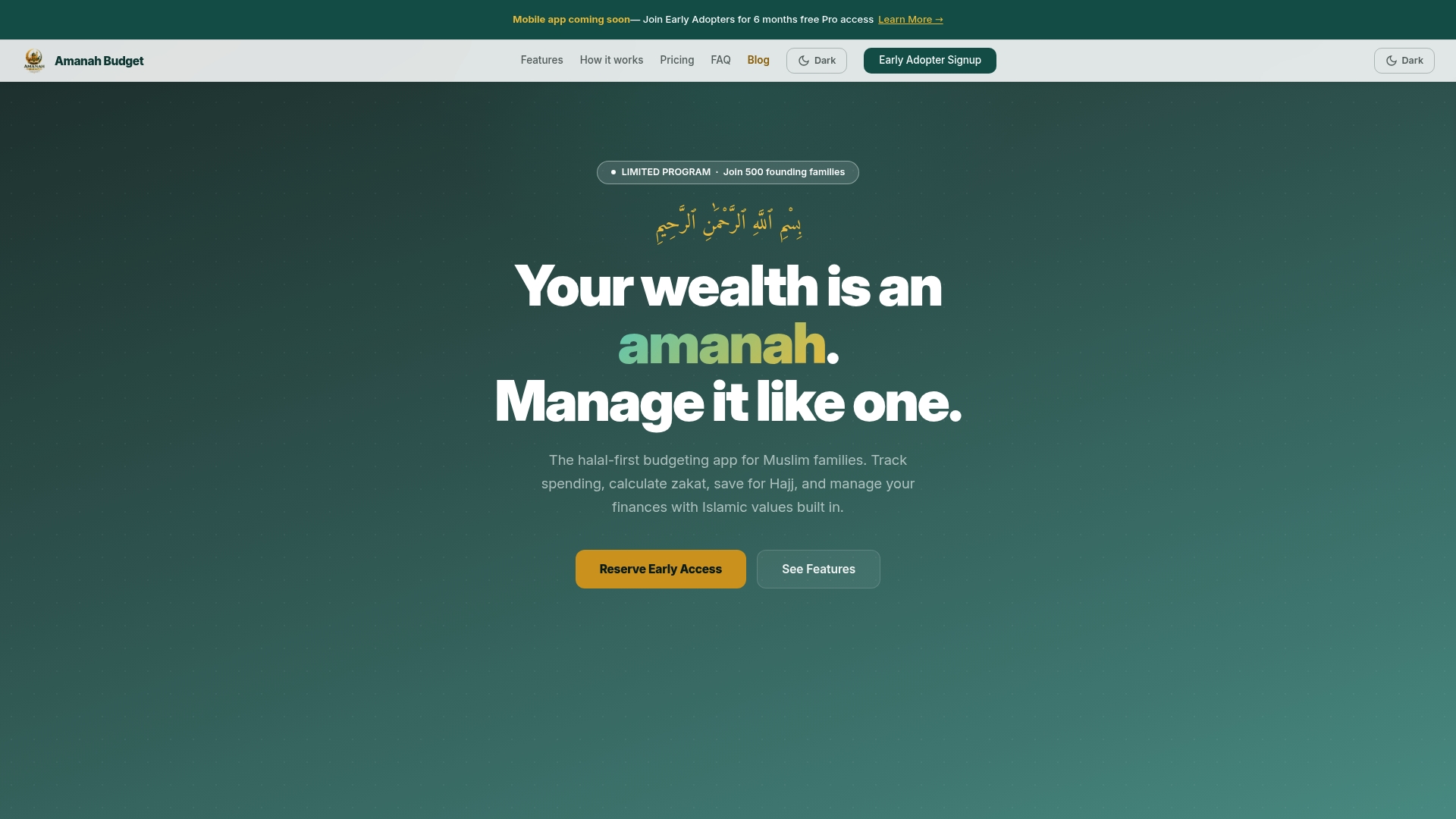
Amanahfund’s halal-first budgeting app includes halal-aware spending categories, automated zakat calculation using your preferred madhab, and dedicated savings goals for Hajj, Umrah, Ramadan, and Eid. You can share your household budget with your spouse, connect your bank accounts securely through Plaid, and receive AI-assisted transaction categorization that understands the difference between a halal grocery run and a discretionary purchase. No ads, no interest-based products, and no selling of your data. If you are ready to put this halal budgeting guide into practice with a tool built for the job, visit Amanahfund to get started.
FAQ
What is a halal family budget?
A halal family budget is a financial plan that aligns all household spending, saving, and giving with Islamic principles, including zakat obligations, riba avoidance, and halal-certified purchases. It uses structured frameworks like the 50/30/20 split to prioritize needs, religious duties, and savings simultaneously.
How much should a Muslim family spend on halal groceries?
Halal grocery costs vary by location, but bulk purchasing halal meat can reduce costs by 30 to 50%, saving families up to $1,000 annually. Applying meal logic, where each ingredient serves multiple meals, further reduces waste and keeps the grocery budget predictable.
How do I include zakat in my monthly budget?
Calculate your annual zakat liability based on your nisab threshold, divide by 12, and set that amount as a fixed monthly transfer to a dedicated account. Treating zakat as a non-negotiable bill rather than a year-end calculation builds both financial discipline and barakah.
What is a sharia-compliant emergency fund?
A sharia-compliant emergency fund holds 3 to 6 months of living expenses in a non-interest-bearing account, such as a halal current account or sharia-compliant savings product. It protects your family from taking on riba-based debt when unexpected expenses arise.
Can Muslim families use regular budgeting apps?
Standard budgeting apps lack halal-aware categories, zakat calculation, and sharia-compliant savings goals, which means Muslim families have to manually work around the tool’s assumptions. Purpose-built apps like Amanahfund address these gaps directly, making halal family budget tracking more accurate and less frustrating.
Recommended
- Household halal spending: a guide for Muslim families — Amanah Budget Blog
- Household halal spending: a guide for Muslim families — Amanah Budget Blog
- Halal Grocery Budgeting: Why Muslim Families Spend More (and How to Plan for It) — Amanah Budget Blog
- Halal Grocery Budgeting: Why Muslim Families Spend More (and How to Plan for It) — Amanah Budget Blog
Ready to manage your amanah?
Track halal spending, calculate zakat, save for Hajj — all in one app. Free forever.
Create Free Account