Eid spending budget guide for U.S. Muslim families

Eid is one of the most joyful times of the year, and it also tends to be one of the most expensive. For Muslim families across the U.S., this eid spending budget guide addresses a real and growing challenge: gifts, new clothes, travel, halal feasts, hosting extended family, and charitable obligations like Zakat al-Fitr (a required donation per person paid before the Eid prayer) all arrive at once. Without a clear plan, it is easy to overspend and carry financial stress into the new month. This guide walks you through every major spending category, practical allocation strategies, and tips rooted in Islamic financial principles so your Eid celebration feels generous and grounded, not financially draining.
Table of Contents
- Understand your Eid spending categories
- Prepare your budget: practical steps for allocating funds
- Shop smart: managing gifts, clothing, and food expenses
- Plan your charitable giving and Zakat al-Fitr early
- Avoid common budgeting mistakes for Eid and stay stress-free
- Why a mindful, tiered budgeting approach transforms Eid celebration
- Manage your Eid budget easily with Amanah Budget app
- Frequently asked questions
Key Takeaways
| Point | Details |
|---|---|
| Plan by category | Divide your Eid spending into categories like groceries, gifts, charity, and travel for clearer budgeting. |
| Prioritize essentials | Fund Zakat and essential needs first to comply with Islamic finance and avoid debt. |
| Shop early | Buying gifts and clothes early saves money and ensures availability. |
| Set gift limits | Use per-child spending caps and meaningful low-cost gifts to manage emotional spending. |
| Use halal savings | Automate monthly savings in halal accounts to fund Eid expenses without interest debt. |
Understand your Eid spending categories
The first step in any solid eid expenses planning process is knowing exactly where your money goes. Most families underestimate their total Eid spend because they think about it in pieces rather than as a whole picture.
Families typically allocate their Eid budgets across six main categories: groceries and meals (40%), gifts and clothing (15%), travel (15%), charity (10%), hosting (10%), and a buffer for unexpected costs (10%). Those percentages are not arbitrary. They reflect how most U.S. Muslim households actually spend during the holiday, and they give you a useful starting framework to build from.
Here is what each category typically includes:
- Groceries and meals: Iftar gatherings, Eid morning breakfast, and the main celebration meal. This is almost always the biggest line item.
- Gifts and clothing: Eidiyah (monetary or physical gifts for children), new outfits for family members, and any decorations.
- Travel: Visiting family, flying to see relatives, or local transportation to masjid and family events.
- Charity: Zakat al-Fitr, Qurbani (the ritual sacrifice during Eid al-Adha), and voluntary Sadaqah. In 2026, Zakat al-Fitr is approximately $15 to $20 per person in the U.S.
- Hosting: Disposable tableware, decorations, guest supplies, and any extra kitchen equipment.
- Buffer: Roughly 10% of your total budget set aside for surprises like last-minute guests or a price increase.
| Category | Recommended allocation | Example (family of 4, $2,000 total budget) |
|---|---|---|
| Groceries and meals | 40% | $800 |
| Gifts and clothing | 15% | $300 |
| Travel | 15% | $300 |
| Charity (Zakat al-Fitr, etc.) | 10% | $200 |
| Hosting | 10% | $200 |
| Buffer | 10% | $200 |
Tracking your halal grocery budgeting alongside your celebration costs gives you a clearer total. Most families are surprised to discover that food alone accounts for nearly half of what they spend.
Prepare your budget: practical steps for allocating funds
Now that you understand your spending categories, let’s explore how to allocate funds wisely in line with Islamic financial principles.

The most effective method is prioritizing essentials first and avoiding interest-bearing debt by pre-funding a halal savings account. That one principle eliminates the two biggest financial mistakes Muslim families make at Eid: paying Zakat late and charging Eid expenses to a credit card.
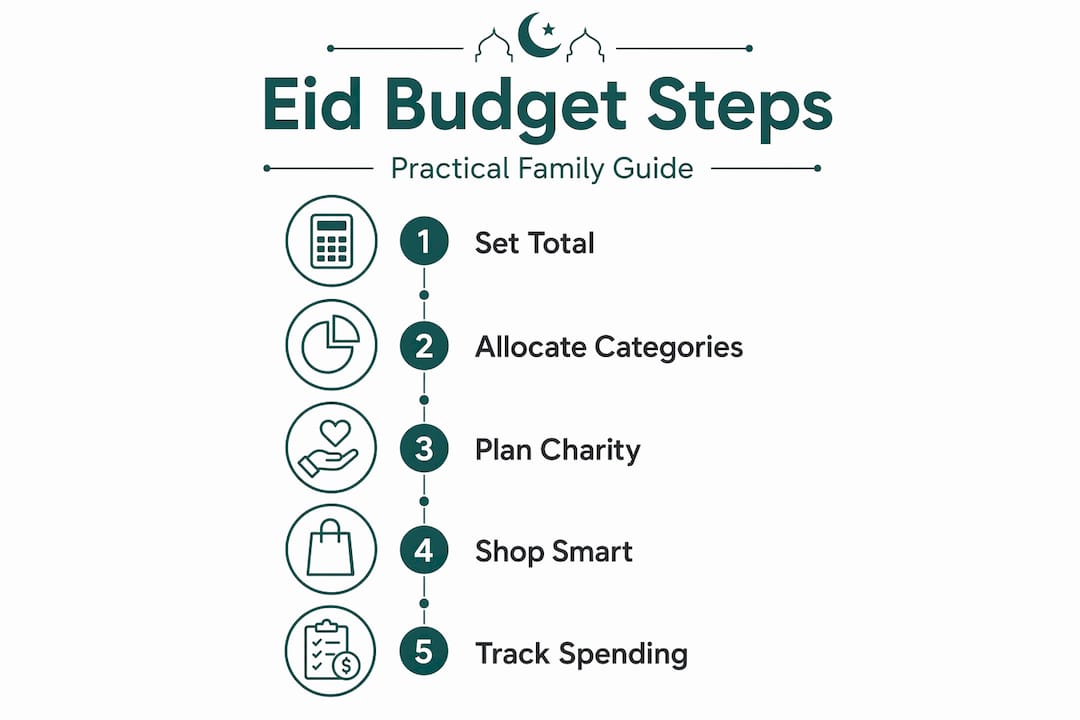
A tiered budget system breaks your spending into three levels: Must-haves (essentials), Nice-to-haves (special meals, outfits), and Optional (extras), which prevents overspending before you even open your wallet. Here is how to build your budget step by step:
- Calculate your Zakat and Zakat al-Fitr first. Start with calculating zakat before anything else. This is a religious obligation, not a discretionary expense. Count every household member and multiply by $15 to $20.
- Assign your essentials tier. Groceries, Zakat al-Fitr, and any medication or household necessities belong here. These are non-negotiable.
- Assign your nice-to-haves tier. New outfits, gifts for children, and special meals go here. These add joy but can be adjusted if money is tight.
- Assign your optional tier. Extra decorations, expensive restaurant meals, or large gift sets belong here. These get funded only if essentials and nice-to-haves are covered.
- Add a 10% buffer. Build it into your total from the start, not as an afterthought.
- Pre-fund using 11-month savings. Divide your total Eid budget by 11 and transfer that amount monthly to a halal savings account (one that earns no interest) beginning right after the previous Eid.
Pro Tip: If you receive an Eid bonus or tax refund before the holiday, resist spending it immediately. Allocate it to your essentials tier first, then your nice-to-haves, before spending anything in the optional category.
The budgeting strategy for families that works long term is the one you actually execute before the holiday begins, not during the rush of the final week.
Shop smart: managing gifts, clothing, and food expenses
With your budget planned, let’s focus on shopping strategies that help you maximize value and stick to your limits.
One of the most common budget-friendly Eid ideas that actually works is the “anchor gift” approach. Instead of buying many small items that add up fast, choose one meaningful gift per child and pair it with a handwritten note or a small treat. Setting per-child gift limits of $5 to $15 per child, using anchor gifts with small treats or notes, and leveraging post-holiday clearance sales all help stretch your gift budget significantly.
For clothing, timing matters more than most families realize. Buying core items early helps secure sizes and prices, avoiding last-minute expensive decisions when popular sizes are sold out and retailers know demand is high.
Key shopping tips for budgeting for gifts and clothing:
- Set per-child gift limits in writing. Once you write it down, emotional pressure has less power over your choices.
- Shop at least four to six weeks before Eid. Prices on modest clothing and popular children’s gifts rise sharply in the final two weeks.
- Check thrift stores and online resale platforms. Quality modest clothing at 50 to 70 percent off retail is genuinely available if you look early.
- Plan your grocery menu before shopping. A written menu with a fixed shopping list prevents impulse buys and repeat trips, both of which inflate food costs.
- Limit grocery store visits to two before Eid. Every extra trip adds unplanned items to your cart.
Pro Tip: For large family gatherings, coordinate a potluck-style meal where each family brings one dish. This cuts the host’s grocery bill by 40 to 60 percent and gives everyone ownership of the celebration.
| Shopping approach | Typical cost | Budget-conscious alternative | Estimated savings |
|---|---|---|---|
| New outfit from boutique | $80 to $150 | Thrift store or early online purchase | 50 to 70% |
| Multiple small gifts per child | $40 to $80 | One anchor gift plus small treat | 30 to 50% |
| Full catered meal | $200 to $400 | Homemade menu with fixed list | 60 to 75% |
| Last-minute gift shopping | Higher prices, limited stock | Shopping 4 to 6 weeks early | 15 to 30% |
Plan your charitable giving and Zakat al-Fitr early
Charity is a vital part of Eid. Planning your giving early ensures you meet obligations while managing your budget effectively.
Early donations for Qurbani and Zakat al-Fitr help avoid price volatility and logistical challenges, maximizing charity’s impact on beneficiaries. For Eid al-Adha especially, Qurbani prices through reputable organizations often increase as the holiday approaches, the same way flight prices rise closer to departure.
Zakat al-Fitr must be calculated per household member at $15 to $20 per person for 2026, and it must be paid before the Eid prayer. For a family of four, that means setting aside $60 to $80 specifically for this obligation, separate from any voluntary Sadaqah you plan to give.
Practical steps for managing your charitable giving:
- Pay Zakat al-Fitr in the first two weeks of Ramadan. This gives charitable organizations time to distribute funds before Eid morning.
- Book Qurbani at least four weeks before Eid al-Adha. Prices are lower and availability is better.
- Set charity as a fixed budget line, not a variable one. Treating it as optional creates the habit of skipping it when money feels tight.
- Automate Sadaqah donations during Ramadan. A recurring weekly transfer of even $5 to $10 aligns with the spirit of the month and removes the decision fatigue of giving.
- Use a single trusted organization for Zakat and Qurbani. Managing fewer transactions reduces errors and helps you track your calculating Zakat al-Fitr obligations accurately.
The families who feel most at peace during Eid are often those who completed their charitable obligations early. There is a real psychological benefit to knowing your spiritual duties are fulfilled before the celebration begins.
Avoid common budgeting mistakes for Eid and stay stress-free
To close out your budgeting preparation, let’s review common pitfalls and practical tips to keep your planning on track.
Treating the Eid bonus as disposable income leads directly to overspending. Essential needs must be prioritized before any bonus money goes toward celebration extras. This is one of the most consistent findings among families who struggle financially after Eid.
Separate gift cost from emotional value to prevent a single expensive purchase from consuming the entire gift budget. A $200 gift for one child may feel generous in the moment but creates real imbalance across a household with multiple children or extended family expectations.
Common mistakes and how to avoid them:
- Relying on credit cards or interest-bearing loans. This is haram (prohibited in Islam) and pushes financial stress into the following months. Pre-fund in a halal savings account instead.
- Skipping the buffer. A 10% buffer sounds unnecessary until an extra 12 guests arrive or a key appliance breaks the week of Eid.
- Shopping without a written list. Verbal intentions are not budgets. Write it down.
- Combining Eid shopping with non-Eid purchases. This is one of the fastest ways to lose track of your spending. Use a dedicated shopping list or expense tracker for Eid items only.
- Waiting until the last week. Late decisions across gifts, clothing, groceries, and charity all cost more.
“Managing common spending mistakes before Eid begins is far easier than managing regret after it ends.”
Pro Tip: After each Eid, spend 20 minutes reviewing your actual spending against your original budget. Note which categories went over and by how much. This single habit improves your Eid financial planning guide for the following year more than any article ever will.
Why a mindful, tiered budgeting approach transforms Eid celebration
Most budgeting advice frames the goal as spending less. That framing is incomplete, and it tends to make people feel deprived rather than intentional.
Mindful budgeting for Eid is not about limiting yourself. It is about choosing where your money goes with full awareness, so that the choices you make reflect your values rather than your impulses. When you use a tiered system, spending on essentials feels like fulfillment of obligation. Spending on nice-to-haves feels like genuine celebration. And when you skip something in the optional tier, it does not feel like deprivation. It feels like a conscious decision.
The mindful budgeting for Eid approach also removes the financial anxiety that can quietly undermine the holiday experience. Families who arrive at Eid day knowing their Zakat is paid, their groceries are bought, and their gifts are ready are genuinely more present. The celebration is not shadowed by the mental math of “can we afford this?”
There is something important here that most Eid expense guides miss entirely. The Islamic financial principles underlying this approach, prioritizing obligations, avoiding debt, giving before spending on yourself, are not restrictions. They are a framework for peace of mind. A family that spends $1,500 with full intention and zero debt has a richer Eid than a family that spends $3,000 on a credit card and spends the next two months managing the aftermath.
Intentional gifting, early charity, and a written grocery plan do not diminish Eid. They protect it. The memories that last are not tied to how much was spent. They are tied to how present everyone was, how generous the giving felt, and how free from stress the day actually was.
Manage your Eid budget easily with Amanah Budget app
Knowing how to budget for Eid is one thing. Having a tool that reflects your values while you execute that budget is another entirely.
The Amanah Budget app is built specifically for Muslim families who want their financial tools to align with their deen. It includes halal-aware spending categories, a built-in Zakat calculator, and dedicated savings goals for Ramadan, Eid, Hajj, and Umrah. You can automate monthly transfers toward your Eid celebration budget across 11 months, track gift and grocery spending in real time, and share the household budget with your spouse, all within a single platform. There are no ads, no interest-based products, and no selling of user data. If you are ready to put the budgeting strategies with Amanah Budget from this guide into practice, Amanah Budget gives you the structure to do it with confidence.
Frequently asked questions
How much should I allocate for Zakat al-Fitr per family member in 2026?
For 2026, Zakat al-Fitr is approximately $15 to $20 per person, and it must be paid before the Eid prayer to fulfill the obligation correctly.
What are effective ways to save on Eid gifts for children?
Set a per-child gift limit and pair one meaningful anchor gift with a small treat or handwritten note. Shopping early or during post-holiday sales adds further savings without reducing the thoughtfulness of the gift.
How can I avoid debt when preparing for Eid expenses?
Pre-fund your Eid budget monthly in a halal savings account starting 11 months before the holiday. Families should avoid interest-bearing credit cards or loans, which are haram and create financial strain well after the celebration ends.
When is the best time to shop for Eid clothing and gifts?
Buying core items early secures better sizes and prices. Shopping four to six weeks before Eid typically provides the widest selection and lowest costs, while last-minute shopping often leads to both higher prices and limited inventory.
Recommended
- The Best Budgeting Strategy for Muslim Families: A Practical Guide — Amanah Budget Blog
- Amanah Budget Blog — Islamic Finance, Zakat, and Halal Budgeting Guides
- Halal Grocery Budgeting: Why Muslim Families Spend More (and How to Plan for It) — Amanah Budget Blog
- How Much Does Hajj Cost and How to Save for It: A Practical Guide — Amanah Budget Blog
Ready to manage your amanah?
Track halal spending, calculate zakat, save for Hajj — all in one app. Free forever.
Create Free Account