Eid Savings Strategy Explained for Muslim Families

TL;DR:
- A disciplined, faith-aligned budgeting plan using halal accounts and automated contributions forms an effective Eid savings strategy. Families should categorize expenses like Zakat al-Fitr, gifts, clothes, and travel to avoid last-minute financial stress and ensure full celebration. Starting early, automating savings, and setting clear goals with dedicated accounts foster better control and a more meaningful Eid experience.
An effective Eid savings strategy is a disciplined, faith-aligned budgeting plan that covers every expense category, from Zakat al-Fitr to gift envelopes, using halal savings accounts and automated monthly contributions. Most families underestimate Eid costs until the week before, then scramble to cover gifts, gatherings, and obligatory payments at once. The eid savings strategy explained here treats Ramadan as a 30-day runway, not a deadline. With the right structure, you can celebrate fully, give generously, and start Shawwal without financial regret.
What are the main Eid expense categories to budget for?
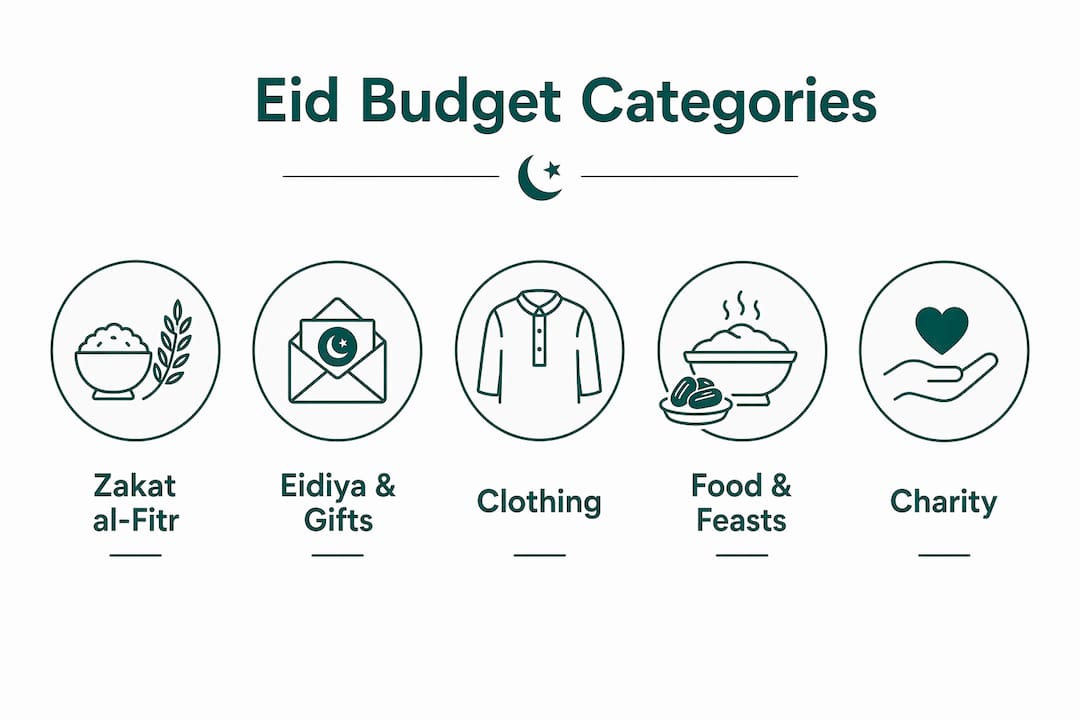
The most practical first step in any Eid budget planning process is breaking your total into categories rather than working from a single vague number. A lump-sum goal like “save $500 for Eid” tells you nothing about where the money goes or where you tend to overspend. Category-level budgets give you control and visibility.
The standard Eid expense categories most Muslim families in the U.S. need to plan for include:
- Zakat al-Fitr (fitrana): Mandatory for every Muslim in the household. Budget this first, before anything discretionary.
- Eidiya and gifts: Cash gifts for children, relatives, and neighbors. Even small Eidiya gifts of $5 to $15 are meaningful when thoughtfully given, so this category does not have to be large.
- New clothes: A sunnah many families observe. Set a per-person cap early in Ramadan.
- Food, sweets, and gatherings: Kahk, baklava, hosting costs, or restaurant outings. This category tends to creep upward without a ceiling.
- Travel: Visiting family, whether local or out of state, adds transportation and accommodation costs that are easy to forget.
- Charitable giving beyond fitrana: Sadaqah, donations to local masjids, or community iftar contributions.
The table below shows a sample Eid budget for a family of four in the U.S., using realistic 2026 figures:
| Category | Estimated Amount |
|---|---|
| Zakat al-Fitr (4 persons) | $48 to $80 |
| Eidiya and gifts | $150 to $300 |
| New clothes (4 persons) | $200 to $400 |
| Food, sweets, and gatherings | $100 to $250 |
| Travel (local) | $50 to $150 |
| Sadaqah and community giving | $50 to $100 |
| Total | $598 to $1,280 |
These numbers vary widely by family size, location, and tradition. The point is not the exact figures but the habit of assigning a specific dollar amount to each line before Ramadan begins. Families who track expenses by category consistently spend less than those who estimate loosely, because named categories create natural spending ceilings.
How to save for Eid using halal accounts and digital tools
Halal savings accounts are structured as either Mudarabah or Wadiah arrangements, meaning your money earns profit through permissible investment activity or is held in safekeeping, with no interest (riba) involved. Both structures are FDIC or NCUA insured up to $250,000, so they carry the same depositor protection as conventional accounts. This matters because many Muslim families avoid savings accounts entirely out of concern for riba, leaving Eid funds sitting in a checking account where they get spent.

The comparison below shows how halal savings structures differ from conventional options:
| Feature | Halal savings (Mudarabah/Wadiah) | Conventional savings |
|---|---|---|
| Return mechanism | Profit-sharing or safekeeping | Fixed interest (riba) |
| Shariah compliance | Yes | No |
| FDIC/NCUA insured | Yes (up to $250,000) | Yes (up to $250,000) |
| Suitable for Eid savings | Yes | No for observant Muslims |
| Automation support | Available with most providers | Standard feature |
Beyond account structure, automation is the most reliable saving mechanism available. Divide your Eid savings goal by the number of months until Eid, then schedule a transfer on the day your paycheck arrives. Transferring savings immediately when income is received, rather than waiting until month-end, increases savings discipline measurably. When the money moves before you see it in your checking account, you do not miss it.
Digital ROSCA circles (Rotating Savings and Credit Associations) are another tool worth knowing. Apps like MoneyFellows formalize the traditional “gameya” or “chit fund” model, where a group of trusted individuals each contribute a fixed monthly amount and one member receives the full pot each cycle. For Eid savings, joining or organizing a ROSCA in Rajab or Sha’ban means you may receive your lump sum right before Ramadan ends, perfectly timed for Eid expenses.
Pro Tip: Open a separate, labeled halal savings account specifically for Eid. Naming it “Eid 2026” in your banking app creates a psychological boundary that prevents you from dipping into it for everyday purchases.
When and how to plan for Zakat al-Fitr in your budget
Zakat al-Fitr is a mandatory purification payment due from every Muslim before the Eid al-Fitr prayer, covering themselves and every dependent in their household. In 2026, Zakat al-Fitr amounts in the U.S. range from $10 to $15 per person, which means a household of four owes approximately $40 to $60. Some scholars and organizations set the figure higher, around $15 to $20 per person, based on the local cost of a staple food equivalent. A family of four using the higher estimate would budget $60 to $80.
The timing rule is specific: fitrana must be paid before the Eid prayer, with the recommended window being one to two days before Eid. Paying early gives charitable organizations time to distribute funds so recipients can celebrate Eid with dignity. Waiting until Eid morning risks missing the window entirely.
| Household size | Low estimate ($10/person) | High estimate ($20/person) |
|---|---|---|
| 1 person | $10 | $20 |
| 2 persons | $20 | $40 |
| 4 persons | $40 | $80 |
| 6 persons | $60 | $120 |
Treating Zakat al-Fitr as a cash flow deadline in your budget, rather than an afterthought, prevents the last-minute scramble that many families experience in the final days of Ramadan. Budget it as the first line item, not the last.
Pro Tip: Set a calendar reminder for the 25th of Ramadan to transfer your fitrana amount to your chosen charity. This gives you five days of buffer before Eid and removes the decision from a busy, emotionally charged time.
Effective budgeting habits to avoid post-Eid financial stress
Post-Eid financial stress is almost always the result of front-loaded, unplanned spending in the last week of Ramadan. The solution is spreading purchases across several weeks and tracking each category as you go. Here is a practical sequence for Eid budget planning that works for most families:
- Set your total Eid budget in the first week of Ramadan. Use the category table from Section 1 as your template. Write down a specific dollar amount for each line.
- Buy clothes and non-perishable gifts in weeks two and three. Prices are lower, selection is better, and you avoid the Eid rush. Online retailers often discount during mid-Ramadan.
- Order or prepare sweets and food items in the final week. Perishables need to be fresh, so this is the right time. Having your budget already set means you are not making spending decisions under pressure.
- Pay Zakat al-Fitr by the 25th of Ramadan. This is a hard deadline, not a soft goal.
- Run a post-Eid audit within one week of Eid. Compare what you planned to spend in each category against what you actually spent. This single habit, done consistently, improves every future Eid budget.
The 40/40/20 behavioral framework offers a useful structure for families who receive a bonus or lump-sum income before Eid. The model allocates 40% to future savings or investments, 40% to essential needs, and 20% to discretionary celebration spending. This limits the tendency to treat a bonus as pure spending money and preserves financial stability after the holiday.
For families using Amanah Budget, the Eid spending budget guide provides a ready-made category framework you can adapt to your household size and location.
Tips for a sustainable, faith-aligned Eid savings approach
The most effective Eid financial strategies share one behavioral principle: money designated for Eid must be separated from money available for daily life. Scheduling savings transfers at the start of each income cycle, before bills or discretionary spending, secures the funds before competing priorities appear. This is the “pay yourself first” principle applied to a faith-based savings goal.
Here are the habits that distinguish families who celebrate Eid without financial regret from those who do not:
- Open a dedicated Eid savings account and label it clearly. A named account is harder to raid than a general savings balance.
- Set a per-person gift cap for Eidiya and stick to it across all children and relatives. Consistency prevents the social pressure of unequal giving from inflating your budget.
- Communicate your budget to your spouse or co-parent before Ramadan begins. Shared visibility prevents duplicate purchases and misaligned expectations.
- Separate generosity from overspending. Aligning financial management with faith obligations creates intention-based generosity rather than spending driven by social pressure. Giving within your means is not less generous. It is more sustainable.
- Use halal-aware tools that reflect your values. Amanah Budget’s halal spending guide explains how Mudarabah and Wadiah accounts can serve as your Eid savings vehicle without compromising on compliance.
“Simple behavioral budgeting is more effective than complicated tools for managing Eid expenses.” — MoneyFellows
The spiritual dimension matters here. Eid is a celebration of gratitude and community, not a competition. Families who plan their finances with intention report that the holiday feels more meaningful, not less, because their giving comes from a place of clarity rather than anxiety.
Key takeaways
A well-executed Eid savings strategy starts with a categorized budget set before Ramadan, uses halal savings accounts to hold funds separately, and treats Zakat al-Fitr as a mandatory first line item with a firm payment deadline.
| Point | Details |
|---|---|
| Categorize before you save | Break your Eid budget into specific lines: fitrana, gifts, clothes, food, and travel. |
| Use halal savings accounts | Mudarabah and Wadiah accounts are FDIC/NCUA insured and riba-free. |
| Pay Zakat al-Fitr early | Budget $10 to $20 per person and pay by the 25th of Ramadan. |
| Automate from day one | Transfer savings on payday, not month-end, to build the habit reliably. |
| Audit after every Eid | Compare planned vs. actual spending to sharpen next year’s budget. |
Why I think most Eid budgets fail before Ramadan even starts
Most families I have spoken with do not fail at saving for Eid because they lack discipline. They fail because they never set a specific number. They intend to “save something” during Ramadan, but without a category-level plan and a dedicated account, that intention dissolves under the weight of iftar costs, last-minute shopping, and social obligations.
The emotional dimension of Eid spending is real and worth naming. There is genuine pressure to give generously, dress well, and host warmly. That pressure is not wrong. But when it operates without a financial plan, it produces guilt and debt instead of joy. The families who navigate this best are the ones who decide in advance what “generous” looks like in dollar terms for their household, then give freely within that number.
What I find most encouraging is how small the required behavior change actually is. Automating one transfer, opening one labeled account, and setting one calendar reminder for fitrana payment can transform the entire Eid financial experience. You do not need a complex system. You need a clear intention and a few concrete commitments made before the first night of Ramadan.
— Imran
Start planning your Eid savings with Amanah Budget
Amanah Budget is a halal-first budgeting app built specifically for Muslim families, and Eid planning is one of its core use cases. You can assign specific dollar amounts to each Eid expense category, calculate your Zakat al-Fitr using your preferred madhab, and set up a dedicated Eid savings goal that tracks your progress month by month.
The app connects securely to your bank accounts through Plaid and uses AI-assisted categorization to keep your spending organized without manual entry. No interest-based products. No ads. No selling your data. If you want a halal budgeting app that reflects your values from the first screen, Amanah Budget is built for exactly that. Start your Eid savings goal today and give yourself the full Ramadan runway to get there.
FAQ
What is an Eid savings strategy?
An Eid savings strategy is a planned, faith-aligned budgeting approach that covers all holiday expenses, including Zakat al-Fitr, gifts, and gatherings, using halal savings accounts and automated monthly contributions to avoid last-minute financial stress.
How much should I save for Eid?
The amount depends on your household size and traditions, but a U.S. family of four typically spends between $600 and $1,300 on Eid. Start with a category-level budget covering fitrana, Eidiya, clothes, food, and travel to reach a realistic total.
When should I start saving for Eid?
Start saving at least three to four months before Eid, ideally in Rajab or Sha’ban. Dividing your total goal by the number of months remaining and automating a monthly transfer makes the process consistent and manageable.
What is the Zakat al-Fitr amount for 2026?
Zakat al-Fitr in 2026 ranges from $10 to $20 per person in the U.S., depending on the scholarly opinion and organization you follow. A household of four should budget between $40 and $80 and pay before the Eid prayer, ideally by the 25th of Ramadan.
Are halal savings accounts safe for storing Eid funds?
Yes. Halal savings accounts structured as Mudarabah or Wadiah are FDIC or NCUA insured up to $250,000, providing the same depositor protection as conventional accounts while remaining free of riba.
Recommended
- Eid spending budget guide for U.S. Muslim families — Amanah Budget Blog
- Eid spending budget guide for U.S. Muslim families — Amanah Budget Blog
- Eid Financial Preparation Checklist for Families — Amanah Budget Blog
- The Best Budgeting Strategy for Muslim Families: A Practical Guide — Amanah Budget Blog
Ready to manage your amanah?
Track halal spending, calculate zakat, save for Hajj — all in one app. Free forever.
Create Free Account