Eid Gifts Budget Family Guide for Muslim Families

TL;DR:
- A tiered gift budget plan helps Muslim families give meaningful Eid presents without overspending.
- Families categorize recipients into spending tiers and include hidden costs in their budget, such as packaging and shipping.
An Eid gifts budget family guide is a structured plan Muslim families use to give meaningful presents during Eid without overspending or neglecting financial obligations. The concept combines tiered gift pricing, recipient categorization, and a built-in expense buffer to keep celebrations joyful and financially sound. Unlike generic holiday spending advice, this approach is built around Islamic values: intentionality, generosity within means, and care for family and community. This guide covers how to estimate your total gift budget, assign spending limits by recipient group, choose gifts that reflect your values, and handle the hidden costs that catch most families off guard.

How to estimate your total Eid gift budget for your family
The first step in any Eid gift plan is calculating a realistic total number before you buy a single item. Most families underestimate their total spend because they only count the gifts themselves and forget packaging, shipping, greeting cards, and backup presents.
A practical total budget formula works like this:
- Count your recipients. List every person you plan to gift, from your children to neighbors.
- Assign a tier to each recipient. Gift tiers for Eid generally fall into under $25, $50–$100, and above $200. Assign each person to one tier before you start shopping.
- Multiply recipients by average tier spend. If you have four children at $25 each and two parents at $100 each, your base gift cost is $300.
- Add a packaging and shipping line. Wrapping materials, gift bags, and postage for out-of-town relatives add up fast.
- Add a 10–15% buffer. A dedicated expense buffer for packaging and shipping prevents last-minute overspending.
Keep your Eid gift budget completely separate from your zakat, sadaqah, and hosting expenses. Mixing these categories is one of the most common reasons families feel financially strained after Eid. Each category deserves its own line in your household budget.
| Budget component | Example amount |
|---|---|
| Gifts (base cost by tier) | $300 |
| Packaging and wrapping | $30 |
| Shipping for distant relatives | $40 |
| Backup or last-minute gifts | $20 |
| Buffer (10–15%) | $39 |
| Total estimated budget | $429 |
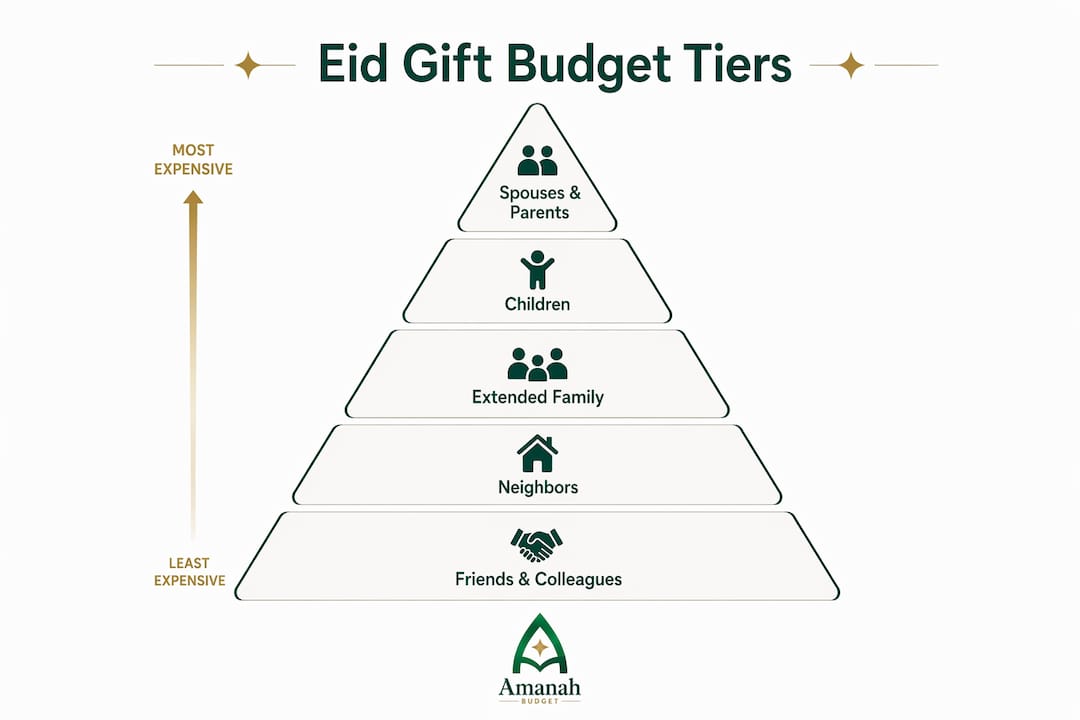
Pro Tip: Set your total Eid gift budget ceiling before you browse any store or website. Shopping with a number already in mind cuts impulse purchases by a wide margin.
How to categorize family members and assign gift budget tiers
Categorizing recipients by relationship and need is the most effective way to maintain budget integrity and avoid trendy, clutter-prone gifts. The goal is fair coverage across your full gift list, not lavish spending on a few people while others receive nothing.
A three-tier recipient model works well for most Muslim families:
- Tier 1: Immediate family (spouse, children, parents). This is your highest-spend group. Children typically receive Eidi or gifts in the $10–$50 range depending on age. Spouses and parents warrant more considered gifts in the $50–$200 range.
- Tier 2: Close relatives (siblings, grandparents, in-laws). A $25–$75 range works well here. A thoughtful gift at $40 often lands better than a rushed gift at $80.
- Tier 3: Extended family, neighbors, and colleagues. Keep this tier under $25. Sweets, candles, small prayer accessories, and curated treat bags all fit comfortably here.
Assigning a spend ceiling to each recipient before shopping avoids overspending and ensures full gift coverage across your list. Without a ceiling, it is easy to spend $150 on one sibling and then realize you have nothing left for four neighbors.
| Recipient group | Suggested range | Example gift |
|---|---|---|
| Children (own) | $10–$50 | Eidi envelope, educational toy |
| Spouse / parents | $50–$200 | Prayer accessories, modest fashion |
| Siblings / in-laws | $25–$75 | Specialty food, home fragrance |
| Extended family | Under $25 | Sweets, mugs, scented items |
| Neighbors / colleagues | Under $15 | Treat bags, small candles |
Pro Tip: Use a simple spreadsheet or a budgeting app like Amanahfund to list every recipient, their tier, and your ceiling before you shop. Seeing the full list in one place stops you from accidentally over-gifting one group.
What are the best budget-friendly Eid gift ideas for each family member?
The best Eid gifts are practical, thoughtful, and appropriate for the recipient’s life. Price is secondary. Eid gifting is more meaningful when intentionality and thoughtfulness guide choices rather than high cost.
Gifts for children (under $50)
Children respond to excitement and personal attention, not price tags. Standard Eidi amounts range from $10 to $50 depending on the child’s age and your relationship closeness. Beyond cash, consider:
- Educational kits (science sets, art supplies, puzzle books)
- Islamic storybooks or illustrated Quran stories
- Personalized Eid gift bags filled with small toys and treats
- Board games the whole family can enjoy together
Gifts for spouses and parents (under $100)
This tier rewards thoughtfulness over novelty. Prayer rugs, quality prayer beads (tasbih), modest fashion items, specialty dates, and artisan honey all sit comfortably under $100. A curated gift hamper combining two or three small items often feels more generous than a single expensive purchase.
Gifts for extended family and neighbors (under $25)
Affordable gifts for extended family and neighbors work best when they are consumable or useful. Sweets, baked goods, scented candles, decorative mugs, and small bottles of oud or rose water all land well. Presentation quality such as festive wrapping or curated hampers elevates perceived gift value even on modest budgets. A $12 box of dates in a beautiful bag feels like a $30 gift.
Physical gifts vs. digital gifts
Digital cash gifting apps have grown 40% year over year, making digital Eidi practical and low-overhead. Digital options like e-gift cards or mobile money transfers work well for long-distance relatives and older teenagers. Physical gifts still carry more emotional weight for young children and elderly parents. Use digital gifting where it saves time and shipping cost, not as a default for everyone.
Pro Tip: For neighbors and colleagues, prepare a batch of identical small gifts in advance. Uniform gifting removes the pressure of personalization and keeps your per-unit cost predictable.
How to manage hidden costs in your Eid gift budget
Hidden costs are the most common reason families exceed their Eid gift budget. Wrapping paper, ribbon, gift bags, tissue paper, greeting cards, and postage rarely appear in the initial plan. They should.
Build these costs into your budget from day one using this approach:
- Estimate packaging costs per gift. A basic gift bag and tissue paper costs $2–$4 per item. Multiply by your total recipient count.
- Calculate shipping for out-of-town relatives. Shipping a small parcel domestically can cost $8–$15. International shipping can exceed $30. Factor this in before you buy the gift itself.
- Budget for greeting cards. A set of Eid cards costs $8–$15 and adds a personal touch that recipients remember.
- Buy two or three backup gifts. Unexpected guests are common during Eid. A small stock of wrapped sweets or candles under $10 each saves you from scrambling.
“Effective family Eid budgets are built with tiered spending limits and a dedicated expense buffer for packaging and shipping to prevent last-minute overspending.” — Eid Gift Guide By Budget
Consolidating your orders is one of the most underused cost controls in Eid gift planning. Placing one large order from a single retailer often qualifies for free shipping, while five small orders each carry a separate delivery fee. Plan your full list first, then shop in batches. This approach also gives you time to prepare for Eid expenses well in advance rather than absorbing costs all at once in the final week.
Pro Tip: Reuse decorative boxes, fabric pouches, and baskets from previous years. Presentation materials are reusable assets, not single-use expenses.
Key takeaways
A tiered budgeting approach is the most reliable method for Muslim families to give meaningful Eid gifts without overspending or neglecting other financial obligations.
| Point | Details |
|---|---|
| Set a total budget ceiling first | Calculate gifts, packaging, shipping, and a 10–15% buffer before you shop. |
| Assign tiers before browsing | Categorize every recipient into a spending tier to prevent emotional overspending. |
| Prioritize thoughtfulness over price | Intentional, practical gifts strengthen family bonds more than expensive ones. |
| Presentation multiplies perceived value | Festive wrapping and curated hampers make modest gifts feel generous. |
| Separate gift budget from zakat and hosting | Mixing expense categories is the leading cause of post-Eid financial stress. |
Why intention matters more than the price tag
Eid gift-giving has a way of turning into a quiet competition, and I say that from experience watching families stress over gifts in the final days of Ramadan. The pressure to match what others spend is real, but it runs counter to what Eid is actually about.
The families I have seen handle Eid gifting best are the ones who plan early and spend intentionally. They are not necessarily spending more. They are spending with a clear list, a firm ceiling per recipient, and genuine thought about what each person actually needs. A well-chosen $20 gift given with care lands better than a $80 item bought in a panic.
What I find most overlooked is the power of presentation. A simple box of dates wrapped in a fabric pouch with a handwritten card communicates care in a way that a shrink-wrapped store item never does. The cost difference is minimal. The impact is not. You can find practical guidance on this in Amanahfund’s Eid financial preparation checklist, which walks through the full picture of seasonal spending.
My honest advice: treat your Eid gift budget as an act of amanah toward your family’s financial health. Generosity does not require overspending. It requires presence, planning, and sincerity.
— Imran
How Amanahfund helps Muslim families plan for Eid
Amanahfund is a halal-first budgeting app built specifically for Muslim families who want their financial tools to reflect their values. It includes dedicated savings goals for Eid, Ramadan, Hajj, and Umrah, alongside halal-aware spending categories and zakat calculation.

For families working through their Eid spending plan, Amanahfund provides the structure to track gift spending, set per-category ceilings, and share budgets with a spouse or co-parent. No ads, no interest-based products, and no selling of user data. Built by Muslims, for Muslims. Visit Amanahfund to set up your Eid savings goal before the season begins.
FAQ
What is a good total Eid gift budget for a family?
A realistic total depends on your recipient count and tiers. A family gifting 10–15 people across all tiers typically budgets $300–$600 including packaging and a 10–15% buffer for hidden costs.
How much should I spend on Eidi for children?
Standard Eidi amounts range from $10 to $50 depending on the child’s age and your relationship closeness. Younger children are happy with smaller amounts presented in a festive envelope.
Should I separate my Eid gift budget from zakat?
Yes. Zakat, sadaqah, and Eid gifts serve different purposes and should each have their own budget line. Mixing them leads to underfunding one category or overspending in another.
Are digital gifts appropriate for Eid?
Digital Eidi and e-gift cards work well for teenagers and long-distance relatives. Physical gifts remain more meaningful for young children and elderly family members who value the tangible gesture.
How do I avoid overspending on last-minute Eid gifts?
Assigning a spend ceiling to each recipient before you shop is the single most effective control. Keeping two or three backup gifts already wrapped at home also removes the pressure of unexpected guests.
Recommended
Ready to manage your amanah?
Track halal spending, calculate zakat, save for Hajj — all in one app. Free forever.
Create Free Account