Eid Financial Preparation Checklist for Families

Eid is one of the most anticipated moments of the year. For Muslim families, it carries deep spiritual meaning and a genuine desire to celebrate generously with loved ones. But without a solid Eid financial preparation checklist, that joy can quietly turn into financial stress. Social expectations, last-minute shopping, and competing obligations pull money in every direction. The good news: thoughtful financial planning for Eid puts you back in control, so the celebration reflects your values and not just your impulses. This guide walks you through exactly how to do that.
Table of Contents
- Key Takeaways
- 1. Your Eid financial preparation checklist starts with one number
- 2. Build your budget around categories, not a single pile
- 3. Handle Zakat al-Fitr first, before anything else
- 4. Gift budgeting: a practical strategy that works
- 5. Plan food and hosting costs with a grocery list, not a feeling
- 6. Buy clothing and gifts early to avoid price spikes
- 7. Budget for travel and transportation separately
- 8. Track your spending before, during, and after Eid
- 9. Compare budgeting methods and choose what fits your family
- 10. Create a post-Eid recovery plan before Eid arrives
- My honest take on Eid financial preparation
- Plan your Eid finances with tools built for Muslim families
- FAQ
Key Takeaways
| Point | Details |
|---|---|
| Set your total limit first | Decide a firm spending cap before buying anything to protect against social pressure and overspending. |
| Budget by category, not lump sum | Category-based budgeting improves accuracy and prevents one area from draining everything else. |
| Zakat al-Fitr is non-negotiable | Plan this separately and early. Budget approximately $15–$20 per person in the U.S. for 2026. |
| Track spending before, during, and after | Daily or weekly tracking reveals where your plan broke down and makes next year’s Eid smarter. |
| Start at least 7–10 days early | Early decisions reduce price risk, decision fatigue, and the chaos of last-minute purchases. |
1. Your Eid financial preparation checklist starts with one number
Before you open a single cart or walk into a store, write down your total Eid spending limit. Not a range. One number. Pre-deciding your budget protects your celebration from external pressure and gives every category that follows a clear ceiling to work within.
Many families skip this step and pay for it later. They start buying gifts, then realize they still need groceries, travel money, and new outfits. By then, the budget is gone and the stress has already arrived. Your total limit is the foundation of your entire Eid financial checklist. Without it, every other step is guesswork.
A useful rule of thumb: allocate around 70% of any additional income (such as a bonus or tax refund) to Eid expenses, and reserve 30% for unexpected needs or savings recovery. This single rule has kept many families out of post-Eid debt.
2. Build your budget around categories, not a single pile
The biggest mistake in Eid budgeting is treating the whole holiday as one expense. It is not. The moment you budget by category instead of one lump sum, your accuracy improves significantly.
Here are the core categories every Eid spending guide should include:
- Zakat al-Fitr — a spiritual obligation, not optional
- Gifts and Eidi — for children, family, and close friends
- Food and groceries — for family meals and hosting
- Clothing and accessories — new outfits are a meaningful tradition
- Travel and transportation — to visit family or attend prayer
- Hosting and entertainment — for guests you welcome into your home
- Decorations — optional, but worth a small line item
- Additional charity — beyond Zakat al-Fitr, for those who wish to give more
Once you have your categories listed, assign a dollar amount to each one. The total of all categories must stay at or below the single number you set in step one. If it does not, trim discretionary categories first. Decorations are a want. Zakat al-Fitr is a must.
Pro Tip: Write your category breakdown on paper or in a notes app before you shop. Seeing the breakdown in front of you makes it far harder to impulse-buy.
3. Handle Zakat al-Fitr first, before anything else
Zakat al-Fitr is due before the Eid prayer. It is a fixed spiritual obligation, and it deserves its own line in your budget before any other Eid expense is calculated. Treat it as a separate, early-planned budget line to align your spiritual obligations with your financial clarity.
In the U.S. for 2026, the standard estimate is approximately $15 to $20 per person. For a family of four, that is $60 to $80 set aside immediately. Calculate your household total and mark it paid before you allocate money anywhere else.
This is not just about fulfilling an obligation. It also sets a tone for how you approach the rest of the budget. When Zakat comes first, the rest of the spending feels intentional rather than reactive.
4. Gift budgeting: a practical strategy that works
Gift-giving is one of the biggest emotional pressure points in Eid spending. Children expect gifts. Extended family members exchange Eidi. And without a plan, you end up spending twice what you intended.
A simple approach that works: set a per-child gift budget of $5 to $15 and use an anchor gift plus one small treat. The anchor gift is something meaningful, maybe a book, a toy, or a clothing item. The small treat is something fun and inexpensive. This two-part structure feels generous without being excessive.
For adults, consider setting a family-wide agreement ahead of time. Many Muslim families are shifting toward shared experiences, such as a group meal or outing, instead of individual gifts for all adults. It reduces pressure and creates better memories.
5. Plan food and hosting costs with a grocery list, not a feeling
Food is one of the areas where Eid budgets most commonly run over. You are cooking for family, possibly hosting guests, and shopping in a rush while stores are crowded and prices are higher.

The fix is simple: create a grocery list before you set foot in any store. Plan your menu first. Then shop from that list only. Buying extras because they look festive is one of the most common and preventable Eid overspending patterns.
If you are hosting, estimate your cost per person and multiply by your guest count. Add a 10% buffer for last-minute additions. That is your hosting budget. Anything beyond it comes out of the discretionary column, not from another category.
6. Buy clothing and gifts early to avoid price spikes
Last-minute purchases near Eid consistently cost more. Retailers and markets know demand is high and prices reflect it. Families who shop early spend less for the same items and carry less stress into the final days of Ramadan.
Aim to have all clothing and gift purchases complete at least 7 to 10 days before Eid. This also gives you time to return, exchange, or reconsider purchases without the pressure of a deadline. Shopping ahead is one of the most effective and underused Eid budgeting tips in practice.
7. Budget for travel and transportation separately
Travel costs are easy to forget until they appear on a credit card statement. Whether you are driving to visit family, booking flights, or simply accounting for gas and tolls, transportation is a real Eid expense that deserves its own line.
Estimate your round-trip cost realistically. Add a 15% buffer for delays, unexpected overnight costs, or extra gas. If you are flying, book as early as possible. Prices near Eid can spike, particularly if your family is in a region with a large Muslim population and limited flight options.
Keeping travel separate prevents it from silently eating into your food or gift budget.
8. Track your spending before, during, and after Eid
A budget you do not track is not really a budget. It is a plan with no accountability. Reviewing your actual spending against your original plan is where real financial growth happens.
Here is a simple tracking approach:
- Before Eid: Log all planned amounts by category in a notebook, spreadsheet, or app
- During Eid: Record every purchase as you make it, or at the end of each day
- After Eid: Compare totals in each category against your planned amounts
This three-phase approach turns your Eid expenses tracker from a passive list into a living tool. You will quickly see which categories ran over, which stayed under, and where your assumptions were off. That data makes next year’s Eid financial checklist far more accurate.
Pro Tip: If you find tracking during the holiday itself too disruptive, save all receipts and spend 30 minutes the day after Eid logging everything. Accuracy matters more than real-time entry.
Understanding the link between financial stress and spending habits is also worth your attention. Anxiety about money can push people toward reactive spending and emotional purchases, both of which are common triggers during Eid.
9. Compare budgeting methods and choose what fits your family
There is no single correct method for Eid budgeting. The best approach is the one you will actually follow. The table below compares three common methods to help you decide.
| Method | How it works | Best for | Watch out for |
|---|---|---|---|
| Category-based budgeting | Fixed dollar amounts per spending category | Families with predictable income | Rigidity if income changes mid-month |
| Percentage allocation | Assign % of total Eid budget to each category | Variable or self-employed income earners | Requires discipline with the total budget cap |
| Manual envelope system | Physical or digital “envelopes” of cash per category | Families who overspend digitally | Less practical for online purchases |
| Budgeting app (halal-first) | App tracks categories, flags overspending in real time | Busy households managing multiple goals | Requires initial setup and habit building |
If you are looking for practical budgeting strategies for Muslim families that extend beyond just Eid, a category-based approach with a halal-first app tends to deliver the most consistency over time.
10. Create a post-Eid recovery plan before Eid arrives
Most financial guides stop at Eid day. Smart financial planning for Eid goes further. The weeks after Eid carry real financial weight: credit card statements arrive, cash reserves are depleted, and normal expenses resume without any of the excitement.
Plan ahead by creating a post-Eid reserve to replenish emergency funds over the next 2 to 3 months. Even a small monthly allocation, such as $50 to $100, prevents the lingering financial effects from turning into lasting debt.
This also applies to emergency savings. If you drew down your emergency fund for Eid expenses, treat rebuilding it as the first financial goal of the post-Eid period. Your future self will thank you.
My honest take on Eid financial preparation
I’ve watched many families, including my own, walk into Eid with good intentions and walk out with financial hangovers that linger into summer. What I’ve learned is that the problem is rarely the amount spent. It is the absence of a deliberate decision made in advance.
What changed things for me was treating the budget itself as part of the ibadah of Ramadan. Not a constraint on generosity, but an expression of it. When I know exactly how much I am giving to Zakat, to gifts, to family meals, every dollar feels purposeful. When I do not, the spending feels scattered and hollow regardless of the total.
I’ve also noticed that the post-Eid review is the most skipped step and the most valuable one. Reviewing your Eid spending guide honestly, category by category, is how you stop repeating the same mistakes. It takes 20 minutes and reshapes how you plan the following year.
The deeper insight: budgeting is not about limiting Eid. It is about protecting it.
— Imran
Plan your Eid finances with tools built for Muslim families
Amanahfund built Amanah Budget specifically because generic budgeting apps do not understand the financial reality of Muslim families. Zakat calculations, Eid savings goals, halal-aware spending categories, and family budget sharing are all part of the core experience, not afterthoughts.
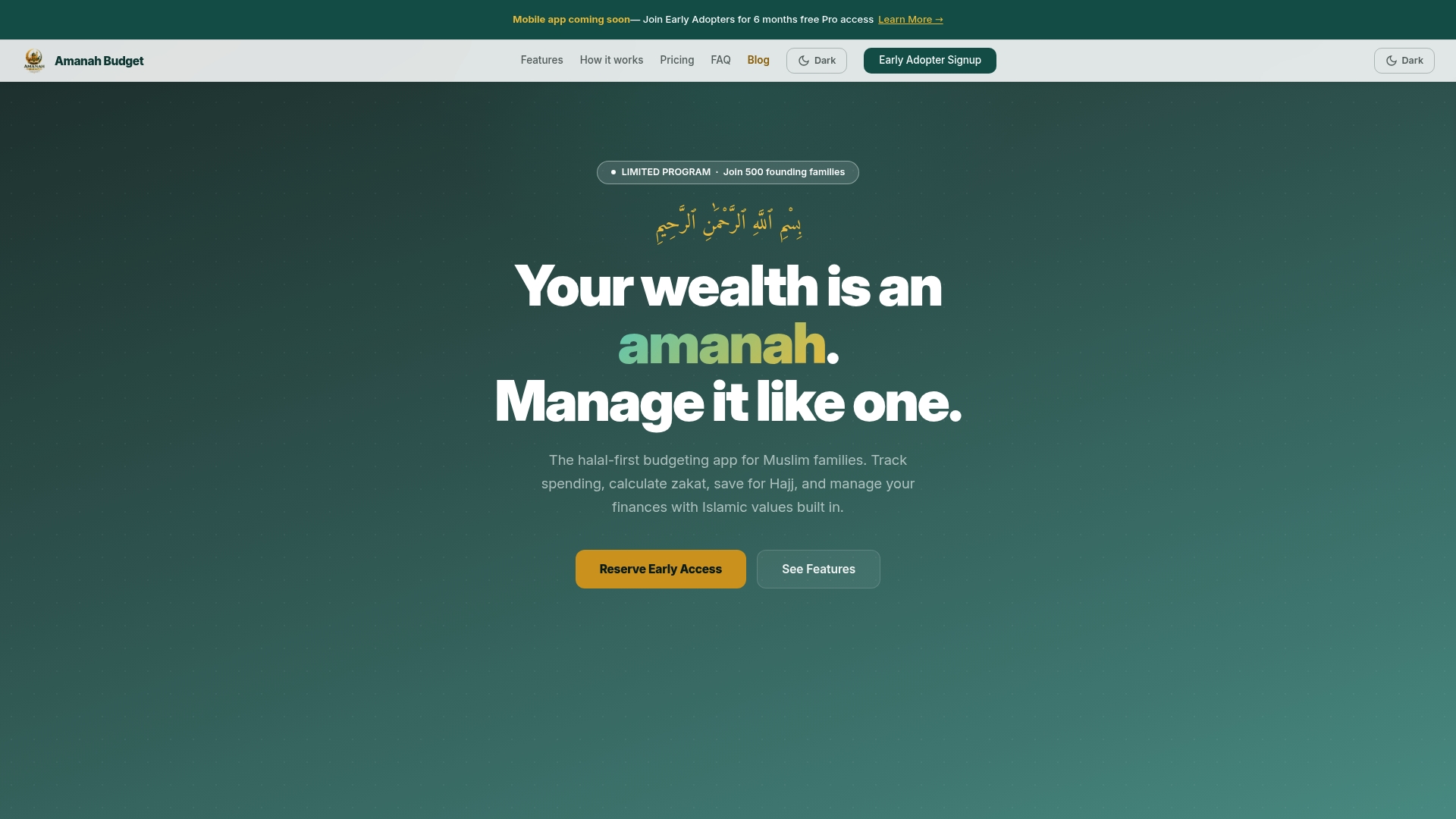
If you are building your Eid financial checklist and want a tool that reflects your values, Amanah Budget is designed for exactly that. Explore Amanah Budget to see how Islamic-first budgeting works in practice. You can also visit the Amanah Budget Blog for more guides on zakat, halal spending, Hajj savings, and everything in between. Eid should feel like a celebration. With the right plan, it will.
FAQ
What is an Eid financial preparation checklist?
An Eid financial preparation checklist is a structured list of budgeting steps and spending categories that helps Muslim families plan and manage Eid expenses before, during, and after the holiday.
How early should I start budgeting for Eid?
Start at least 7 to 10 days before Eid. Early planning reduces last-minute price spikes on gifts and clothing and gives you time to adjust your budget before money is spent.
How much should I budget for Zakat al-Fitr per person?
In the U.S. for 2026, Zakat al-Fitr is typically budgeted at approximately $15 to $20 per person. Calculate your household total and pay it before the Eid prayer.
What should I do if I overspend during Eid?
Review your spending by category to identify where the budget broke down, then create a post-Eid reserve to rebuild your emergency fund over 2 to 3 months rather than trying to recover all at once.
What is the best budgeting method for Eid?
Category-based budgeting works well for most families because it assigns specific amounts to each area of spending. Pairing it with a halal-first budgeting app improves consistency and real-time awareness.
Recommended
- Eid spending budget guide for U.S. Muslim families — Amanah Budget Blog
- Eid spending budget guide for U.S. Muslim families — Amanah Budget Blog
- The Best Budgeting Strategy for Muslim Families: A Practical Guide — Amanah Budget Blog
- The Best Budgeting Strategy for Muslim Families: A Practical Guide — Amanah Budget Blog
Ready to manage your amanah?
Track halal spending, calculate zakat, save for Hajj — all in one app. Free forever.
Create Free Account