Common family overspending categories Muslim households

Most Muslim families in the US work hard to spend with intention, but common family overspending categories have a way of hiding in plain sight. Food alone accounts for 12.9% of US household expenditures, and that is before you factor in Ramadan hosting, Eid gifts, subscription fees, and the quiet drain of carrying a credit card balance. Identifying where money actually goes, not where you think it goes, is the first step toward a budget that reflects both your financial goals and your values.
Table of Contents
- How to identify overspending categories in your family budget
- Top common overspending categories for US Muslim families
- A comparison table of common overspending categories and halal-aligned management tactics
- Practical tips to reduce overspending while respecting halal principles
- Why pre-funding seasonal expenses is the game-changer in halal family budgeting
- Manage your family budget with Amanah Budget app
- Frequently asked questions
Key Takeaways
| Point | Details |
|---|---|
| Food remains a primary spending category | Food accounts for about 13% of Muslim family budgets and requires careful halal grocery planning. |
| Subscription and convenience fees add up | Hidden recurring charges average over $250 monthly, increasing annual overspending. |
| Ramadan expenses increase seasonal spending | Families spend 30-50% more during Ramadan on hosting, gifts, and charity. |
| Avoid credit card interest | Carrying credit card balances incurs high interest rates, conflicting with halal principles. |
| Pre-fund seasonal expenses | Setting aside funds monthly for Ramadan and Eid avoids debt and emotional overspending. |
How to identify overspending categories in your family budget
Tracking spending is not just about recording numbers. It is about seeing patterns clearly enough to act on them. Many families discover their biggest household budget leaks only after they sit down and separate what they spend by category, not just by month.
Here is a practical process to get started:
- Pull three months of bank and card statements. Three months smooths out one-time spikes and shows you what is actually recurring. One month of data is rarely enough to spot a pattern.
- Break broad categories into specific lines. “Food” is too vague. Split it into groceries, restaurant meals, food delivery, and Ramadan hosting. The more specific your lines, the faster you find the leaks.
- Separate seasonal from recurring expenses. Ramadan, Eid, back-to-school, and Eid al-Adha are predictable but irregular. Separating Ramadan spending into detailed categories reduces emotional overspending and improves budget accuracy across the whole year.
- List every subscription and automatic charge. Write them all down: streaming services, meal kit deliveries, app subscriptions, gym memberships. Many families are surprised to find 10 to 15 active subscriptions they rarely use.
- Compare planned versus actual spending for each category. If you planned $600 for groceries and spent $900, that $300 gap is a household budget leak worth investigating.
The best budgeting strategies for Muslim families always start with this kind of honest audit before any changes are made. You cannot fix what you have not measured.
Top common overspending categories for US Muslim families
Now that you know how to identify overspending, here are the specific categories that most commonly cause budget strain in Muslim households.
Food and groceries
Food accounts for 12.9% of household spending, making it the single largest flexible category in most family budgets. Unlike rent or utilities, food spending responds directly to habits and choices. Buying halal meat, which often costs more per pound than conventional options, adds up quickly. Add in food delivery apps and last-minute grocery runs, and this category can quietly exceed your plan by hundreds of dollars each month. See our halal grocery budgeting tips for practical ways to manage this without sacrificing quality.
Subscriptions and convenience fees
This is the most underestimated common overspending area for families today. The average household spends over $250 per month on subscriptions and extra fees from food delivery and ride-sharing services. That is more than $3,000 per year on services many families barely use. Streaming platforms, cloud storage, premium apps, and auto-renewing memberships pile up silently because no single charge feels large enough to cancel.
Ramadan and Eid expenses
This is a category unique to Muslim families, and it is one of the most emotionally charged. Ramadan can increase grocery and hosting spending by 30 to 50%, plus additional costs for Eid gifts and charity. For a family of four, this can mean an extra $1,000 to $2,000 in a single month. The problem is not the spending itself. Generosity during Ramadan is a beautiful part of the deen. The problem is when it is unplanned and ends up on a credit card.

Credit card interest
This is both a family finance pitfall and a halal concern. Credit card interest rates average 22.12% APR, which means a $6,600 balance costs you $1,462 per year in interest alone. Carrying a balance after Ramadan or Eid spending is one of the most common ways families fall into riba, which is prohibited in Islam. It turns a one-time seasonal expense into a monthly drain that compounds over time.
Pro Tip: If you are managing family shopping expenses across multiple categories, assign each category a specific dollar cap at the start of the month, not at the end. Reviewing limits after you have already spent is too late to change behavior.
The budgeting strategy for Muslim families that works best treats each of these categories as separate budget lines, not as part of a general “miscellaneous” pool.
A comparison table of common overspending categories and halal-aligned management tactics
To clarify how these categories compare and what you can do, here is a summary table outlining costs and management strategies.
| Category | Typical monthly impact | Why it causes problems | Halal-aligned strategy |
|---|---|---|---|
| Food and groceries | $600 to $1,200+ | Flexible spending, halal meat premium, delivery fees | Meal plan weekly, batch-cook, limit delivery orders to twice per month |
| Subscriptions and convenience | $200 to $350+ | Auto-renewals go unnoticed, multiple platforms overlap | Audit quarterly, cancel unused services, set a monthly cap |
| Ramadan and Eid expenses | $1,000 to $2,500 in one month | Emotional generosity without a plan leads to debt | Pre-fund via sinking fund by dividing total expected costs over 11 months |
| Credit card interest | $100 to $200+ per month if balance carries | Riba is haram; interest compounds on seasonal overspending | Avoid revolving balances entirely; pay in full each month or use a debit card |
| Transportation and ride-sharing | $150 to $400 | Convenience spending with no monthly cap | Set a fixed monthly transport budget and track it weekly |
The best budgeting strategy Muslim families can use is to treat Ramadan as a predictable annual expense, not a surprise. When you divide your expected Ramadan costs by 11 months and save that amount each month, you arrive at Ramadan funded and debt-free.
Practical tips to reduce overspending while respecting halal principles
Having seen the categories, here are concrete actions you can take now to reduce family expenses while staying true to halal financial principles.
Audit your subscriptions every quarter
Set a reminder every three months to review every automatic charge on your accounts. Auditing subscriptions and setting intentional spending thresholds is one of the fastest ways to recover money without changing your lifestyle. Cancel anything you have not used in 30 days.
Set a monthly cap for convenience spending
Food delivery, ride-sharing, and on-demand services are not inherently bad. They become a problem when there is no limit. Decide on a fixed dollar amount for these services each month, and treat it like a utility bill. Once it is gone, it is gone.
Pre-fund Ramadan and Eid through a halal sinking fund
This is the single most effective way to avoid unexpected family costs during the Islamic calendar’s biggest months. Running two parallel budgets, a baseline budget and a Ramadan sinking fund, prevents overspending and eliminates the need to carry credit card debt after Eid. Open a separate savings account, name it “Ramadan Fund,” and contribute to it every month.
Pay your credit card balance in full every month
If you use a credit card for the purchase protections or rewards, that is fine. The rule is simple: never carry a balance. Paying interest is riba, and at 22.12% APR, it is also one of the most expensive budgeting tips Muslim families consistently overlook until the damage is done.
- Review your grocery receipts weekly, not monthly, to catch creeping costs early
- Plan iftar menus two weeks ahead during Ramadan to avoid last-minute expensive purchases
- Use cash or a debit card for halal grocery spending tips to stay within your planned amount
- Share your household budget with your spouse so both partners see the same numbers in real time
Pro Tip: Create a “spending pause” rule for any non-essential purchase over $75. Wait 48 hours before buying. This one habit alone eliminates a significant portion of impulse-driven overspending.
Why pre-funding seasonal expenses is the game-changer in halal family budgeting
Most budgeting advice focuses on cutting back. Spend less on coffee. Cancel a streaming service. These are fine suggestions, but they miss the bigger structural problem: most Muslim families do not overspend because they lack discipline. They overspend because their budget was never built to handle predictable seasonal spikes.
Ramadan comes every year. Eid al-Fitr comes every year. Eid al-Adha comes every year. These are not surprises. Yet most families treat them as emergencies when the month arrives, reaching for a credit card to cover the gap. At 22.12% APR on a carried balance, that seasonal generosity becomes a year-round financial burden.
The solution is structural, not behavioral. Pre-funding Ramadan expenses by dividing total costs over 11 months means you arrive at Ramadan with money already set aside. You give generously. You host freely. You buy Eid gifts without guilt. And you do it all without touching riba.
This approach also reframes how you think about halal budgeting strategies. A halal budget is not just one that avoids haram transactions. It is one that plans for the full rhythm of Muslim life, including the months of heightened generosity and community obligation. When your budget reflects your deen, you stop feeling like your faith and your finances are in conflict.
The families who consistently avoid overspending are not the ones who spend the least. They are the ones who plan the most intentionally.
Manage your family budget with Amanah Budget app
If these strategies resonate with you, Amanah Budget was built to make them practical for Muslim families in the US. It is a halal-first budgeting app designed around the full rhythm of Muslim life, not just generic spending categories.
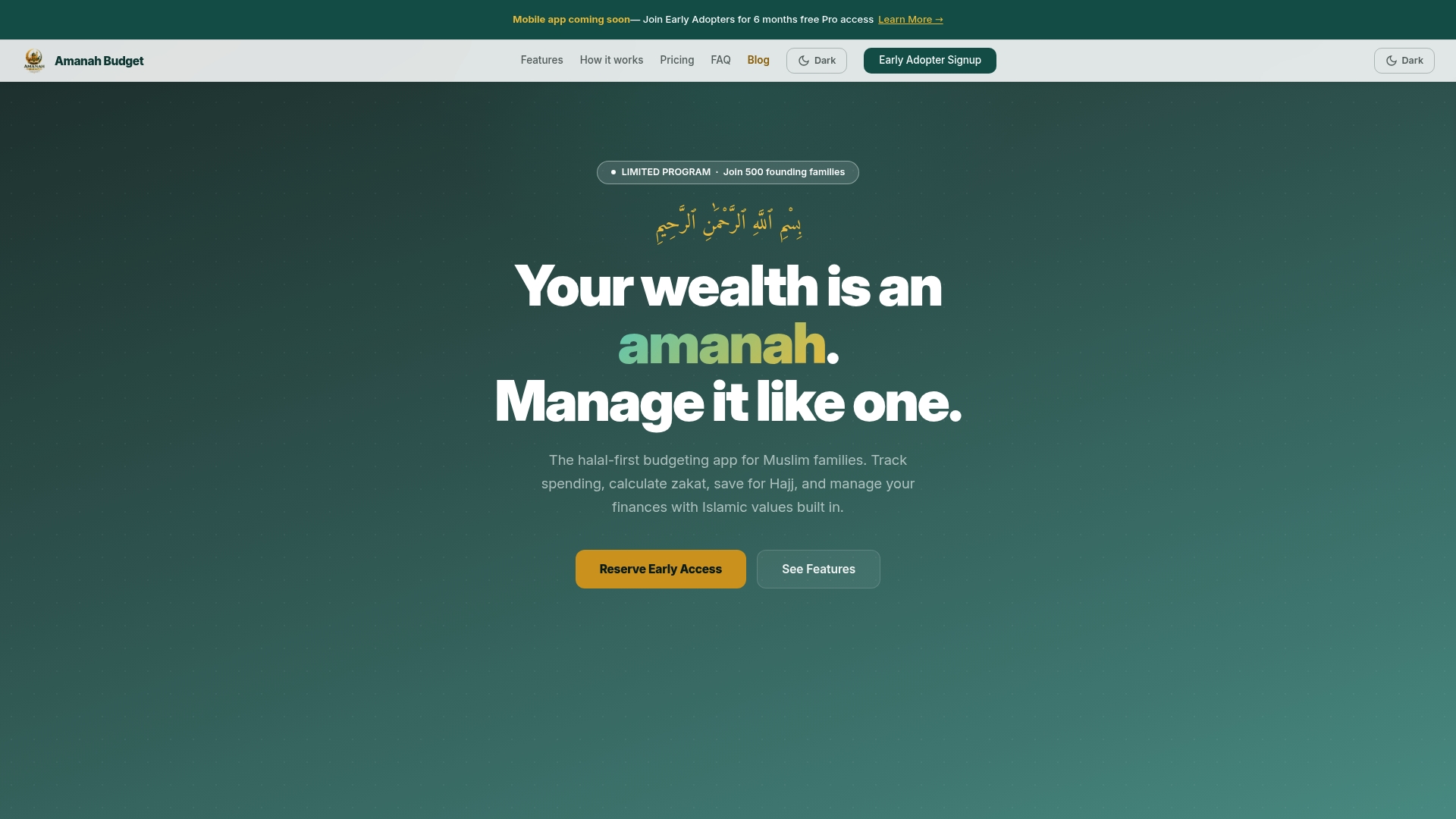
With Amanah Budget, you can track household spending using halal-aware categories, set up dedicated savings goals for Ramadan, Eid, Hajj, and Umrah, and calculate your zakat accurately using your preferred madhab. The app connects securely to your bank accounts through Plaid and uses AI-assisted categorization to flag spending patterns automatically. You can share your household budget with your spouse so both of you stay aligned. No ads. No interest-based products. No selling your data. Just a tool built by Muslims, for Muslims.
Frequently asked questions
What are the most common overspending categories for Muslim families in the US?
Food, subscriptions, seasonal Ramadan and Eid expenses, and credit card interest are the most common overspending categories. Food accounts for 12.9% of expenditures, while Ramadan spending can rise 30 to 50% above a typical month and subscription fees often exceed $250 per month.
How can Muslim families avoid overspending during Ramadan?
The most effective method is pre-funding Ramadan expenses through a halal savings sinking fund, dividing expected costs over 11 months so the money is ready before Ramadan begins. Dividing total Ramadan costs over 11 months eliminates the need to carry interest-bearing debt after Eid.
Why is carrying credit card balances problematic in halal budgeting?
Carrying a credit card balance incurs interest, which is riba and considered haram in Islam. At 22.12% APR on a balance, it also turns a one-time seasonal expense into a costly monthly drain that compounds over time.
What is an effective way to control subscription and convenience-related overspending?
Auditing subscriptions quarterly and setting spending thresholds for convenience services like food delivery and ride-sharing helps recover money quickly without major lifestyle changes. Distinguishing between planned versus automatic purchases is key.
How much do Muslim families typically spend on Ramadan-related items?
A typical US Muslim family of four may spend between $600 and $1,400 on groceries and iftar hosting, $300 to $800 on Eid gifts, plus additional charity and community contributions. Ramadan-related expenses for a family of four can total $1,000 to $2,500 in a single month without a pre-funded plan.
Recommended
- The Best Budgeting Strategy for Muslim Families: A Practical Guide — Amanah Budget Blog
- Halal Grocery Budgeting: Why Muslim Families Spend More (and How to Plan for It) — Amanah Budget Blog
- Amanah Budget Blog — Islamic Finance, Zakat, and Halal Budgeting Guides
- Amanah Budget — Halal Budgeting App for Muslim Families | Zakat Calculator, Hajj Savings
Ready to manage your amanah?
Track halal spending, calculate zakat, save for Hajj — all in one app. Free forever.
Create Free Account