Benefits of Expense Tracking Apps for Your Budget

Most people have a rough sense of where their money goes. Rent, groceries, the occasional dinner out. But that rough sense is exactly where budgets fall apart. The real benefits of expense tracking apps show up when vague estimates get replaced by actual numbers, and you can finally see your financial life clearly. Individuals who use budgeting apps consistently save 15-20% more than those who do not, and 78% of regular users report feeling more in control of their finances. That kind of clarity changes how you make decisions every single day.
Table of Contents
- Key Takeaways
- 1. Automation cuts out the manual work
- 2. Spending categories reveal patterns you cannot see otherwise
- 3. Alerts and notifications keep you from overspending
- 4. Goal tracking turns saving from abstract to concrete
- 5. Bill management and subscription tracking save real money
- 6. Tax preparation becomes far less painful
- 7. Financial awareness reduces money-related stress
- 8. How to choose the right expense tracking app
- 9. Comparing popular expense tracking apps
- 10. Matching the app to your financial goal
- My honest take on what actually makes these apps work
- Amanah Budget: built for Muslim families who want more than basic tracking
- FAQ
Key Takeaways
| Point | Details |
|---|---|
| Automation saves time and accuracy | Apps sync transactions automatically, removing the need for manual entry and reducing human error. |
| Visibility drives better decisions | Seeing categorized spending in real time helps you catch wasteful habits before they compound. |
| Consistency matters more than the app | The best app is the one you actually use every day, not the one with the most features. |
| Security should be non-negotiable | Look for bank-level encryption and clear privacy policies before connecting any financial account. |
| Values-aligned tools work better | When an app reflects your financial philosophy, you are far more likely to stick with it long-term. |
1. Automation cuts out the manual work
Tracking expenses by hand is tedious. Spreadsheets get abandoned. Notebooks get lost. The friction alone is enough to make most people quit within a week.
Expense tracking apps remove that friction by syncing transactions automatically from your bank accounts and credit cards. Every purchase gets pulled in, categorized, and logged without you lifting a finger. This is one of the most underappreciated advantages of budgeting apps. When the effort drops to near zero, consistency becomes possible.
Pro Tip: Connect all your accounts on day one, including savings and credit cards, so you see your complete financial picture from the start rather than a partial one.
2. Spending categories reveal patterns you cannot see otherwise
You might think you spend a moderate amount on food. But when an app separates grocery runs from restaurant meals from coffee stops, the real number often surprises people.
Automatic categorization gives you a breakdown that manual tracking rarely achieves. You can see which categories are growing month over month, where seasonal spikes happen, and which habits are quietly draining your budget. This is how expense tracking helps you move from guessing to knowing.

Most apps also generate monthly reports and visual charts. These are not just pretty graphics. They are the kind of data that makes a real difference when you sit down to adjust your budget.
3. Alerts and notifications keep you from overspending
One of the top expense tracking features across most apps is the spending alert system. You set a limit for a category, say dining out, and the app tells you when you are approaching it or have crossed it.
Apps flag unnecessary charges and send reminders for upcoming bills, which prevents the kind of small oversights that turn into overdraft fees or missed payments. For people who struggle with impulse spending, these real-time nudges function as a second opinion before the damage is done.
4. Goal tracking turns saving from abstract to concrete
Saying “I want to save more” is not a plan. Setting a specific savings goal inside an app, with a target amount and a deadline, is.
The best apps for expense management let you create multiple goals simultaneously. An emergency fund, a vacation, a down payment. Each one gets its own progress tracker, and the app shows you exactly how your current spending rate affects your timeline. Goal-oriented apps like YNAB use a behavioral approach that has been shown to improve debt payoff speed and savings rates significantly. Seeing that progress bar move is genuinely motivating in a way that a number on a spreadsheet rarely is.
5. Bill management and subscription tracking save real money
The average household pays for multiple subscriptions they have forgotten about or rarely use. A streaming service here, a fitness app there. These small charges accumulate quietly.
Apps like Rocket Money go a step further by identifying wasteful subscriptions and even negotiating bills on your behalf. That is saving money with apps in its most direct form. You do not have to do anything except review the recommendations and approve the action.
6. Tax preparation becomes far less painful
This benefit does not get nearly enough attention. When you track and categorize every expense throughout the year, tax season becomes straightforward. Your deductible expenses are already sorted. Your records are clean and complete. You spend less time digging through bank statements and more time actually filing.
For freelancers, self-employed individuals, and small business owners, this alone can justify using a personal finance tracking tool year-round.
7. Financial awareness reduces money-related stress
There is a specific kind of anxiety that comes from not knowing your numbers. You swipe your card and hope for the best. You avoid checking your balance because you are not sure what you will find.
Real-time dashboards and alerts break that cycle. When you know exactly where you stand, the anxiety has less room to grow. Users who engage consistently with budgeting apps report feeling significantly more in control, and that sense of control has a measurable effect on financial behavior over time.
8. How to choose the right expense tracking app
Not every app fits every person. Here is what to evaluate before committing to one.
Ease of use. If the interface frustrates you in the first five minutes, you will not use it. Prioritize apps with clean, intuitive designs over ones packed with features you will never touch.
Bank syncing options. Most quality apps connect to your bank through secure aggregators. Manual entry should be available as a backup, not the primary method.
Category customization. Generic categories like “Shopping” are not useful if your actual spending is more specific. Look for apps that let you create and rename categories to match your real life. For Muslim families, this includes halal-aware categories that reflect values-based spending.
Security credentials. Bank-level encryption and clear privacy policies are the baseline. Read the privacy policy before you connect a single account. Know whether the company sells your data.
Cost structure. Many apps offer free tiers with core features and paid tiers for advanced tools. Decide which features you actually need before paying for a premium plan.
Device compatibility. You want an app that works well on your phone, since that is where most spending decisions happen.
9. Comparing popular expense tracking apps
Different apps serve different budgeting philosophies. Here is how the major options stack up.
| App | Best for | Standout feature | Cost |
|---|---|---|---|
| YNAB | Proactive budgeters | Zero-based budgeting system | Paid subscription |
| Rocket Money | Subscription auditors | Automated bill negotiation | Free and paid tiers |
| PocketGuard | Impulse control | “In My Pocket” spending limit | Free and paid tiers |
| Simplifi | Cash flow tracking | Real-time spending plan | Paid subscription |
| Amanah Budget | Muslim families | Zakat calculator, Hajj savings | Values-aligned pricing |
A few notes on these options. YNAB works best for people who want to change their financial behavior, not just observe it. The zero-based method assigns every dollar a job, which forces intentionality. PocketGuard is ideal for someone who wants one simple number: how much can I spend today without hurting my goals?
For a broader look at personal finance tracking tools beyond the mainstream options, there are several emerging fintech apps worth exploring depending on your specific needs.
Pro Tip: Run any app you are considering for 30 days before deciding to pay for it. Most offer free trials, and 30 days is enough time to know whether the interface fits how you actually think about money.
10. Matching the app to your financial goal
The right app depends on what you are trying to accomplish, not which one has the most features.
- Paying off debt: Choose an app with debt payoff tracking and goal milestones. YNAB’s method works particularly well here.
- Building an emergency fund: Any app with goal-based savings tracking will do the job. The key is setting a specific target and checking progress weekly.
- Casual spending awareness: A free app with automatic syncing and basic categorization is all you need. No subscription required.
- Family budgeting: Look for shared access features so both partners see the same data. Misaligned financial pictures are a common source of household friction.
- Values-based budgeting: If your financial decisions are guided by religious or ethical principles, choose an app built with those values embedded, not added as an afterthought.
For Muslim families specifically, the best budgeting strategy involves more than just tracking numbers. It means aligning spending with Islamic principles from the start.
My honest take on what actually makes these apps work
I have spent a lot of time thinking about why some people transform their finances with these tools while others download an app, use it for two weeks, and go back to guessing.
The answer is almost never the app itself. Consistent engagement drives financial improvement, not the feature list. I have seen people do remarkable things with the simplest possible setup and others accomplish nothing with the most sophisticated tools available.
What I have found is that the apps that actually stick are the ones that match how a person already thinks about money. If you are a visual person, you need charts. If you are goal-oriented, you need progress bars. If your financial decisions are tied to your faith, you need an app that treats that as a feature, not a footnote.
My other honest observation: start with awareness before strict budgeting. Spend one month just watching where your money goes without trying to change anything. The data you collect in that month will tell you exactly where to focus. Jumping straight into restrictive budgets without that foundation is why so many people quit.
The goal is not to find the perfect app. The goal is to build a habit of knowing your numbers. The app is just the tool that makes that habit easier to keep.
— Imran
Amanah Budget: built for Muslim families who want more than basic tracking
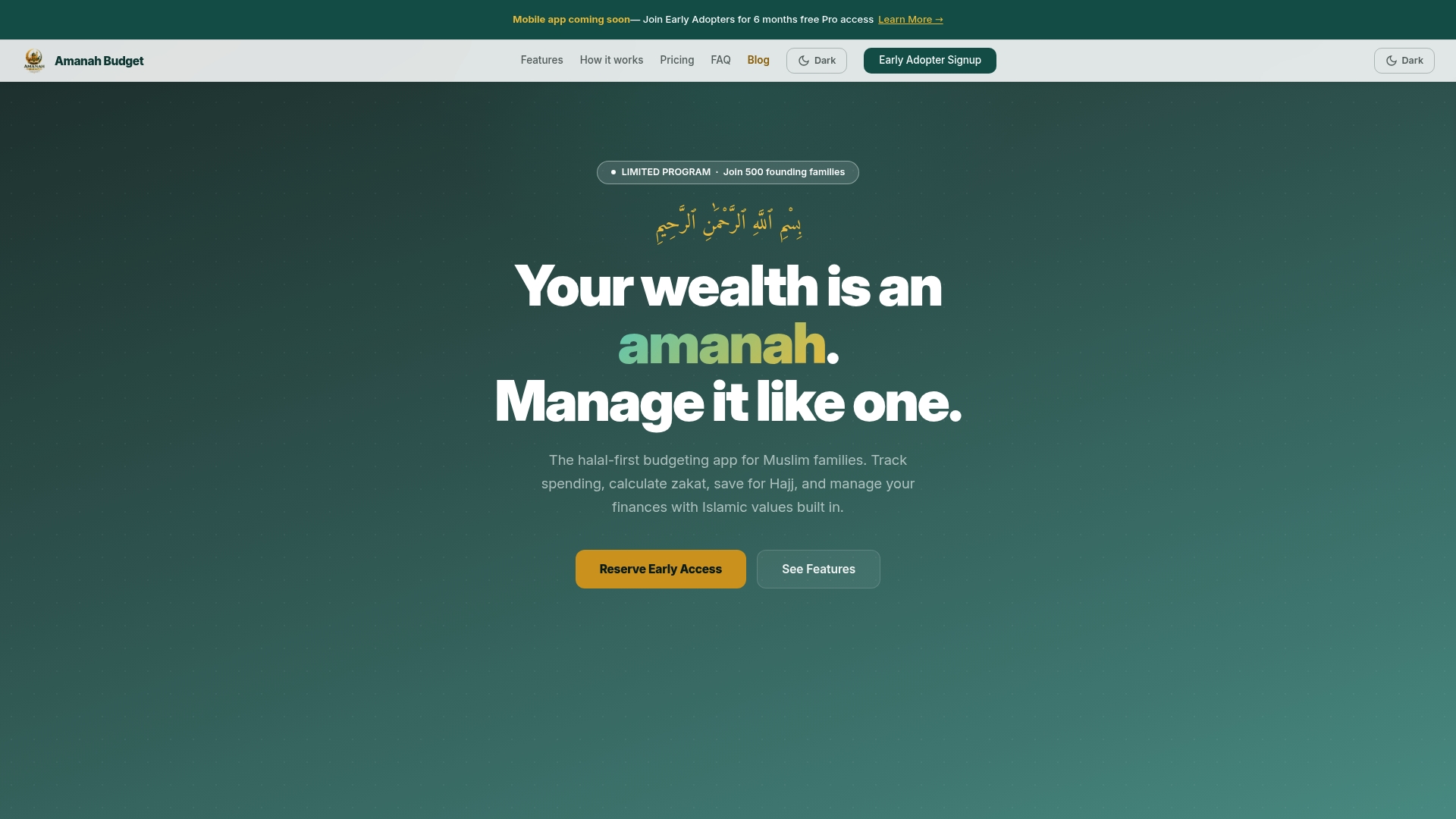
If you are a Muslim family looking for an expense tracking app that reflects your values, Amanah Budget was built specifically for you. It goes beyond standard budgeting tools by including a zakat calculator, dedicated savings goals for Hajj and Umrah, halal-aware spending categories, and shared household budgeting for spouses and family members. There are no ads, no data selling, and no interest-based products. Everything is built around both your financial health and your deen. Explore what values-aligned budgeting looks like at Amanah Budget and see how intentional financial management can work for your family.
FAQ
What are the main benefits of expense tracking apps?
Expense tracking apps automate transaction logging, categorize spending, send overspending alerts, and support goal-based saving. Consistent users save 15-20% more on average than those who track manually or not at all.
Are expense tracking apps safe to use with bank accounts?
Most reputable apps use bank-level encryption and read-only account access, meaning they can view transactions but cannot move money. Always review the app’s privacy policy before connecting your accounts.
Which expense tracking app is best for beginners?
Apps with automatic bank syncing and simple dashboards work best for beginners because they require minimal setup and deliver immediate value. Start with a free tier to learn what features you actually use before upgrading.
How do expense tracking apps help with saving money?
They identify wasteful subscriptions, flag unnecessary charges, and show exactly which spending categories are over budget. Some apps also negotiate bills automatically, which generates direct savings without any effort on your part.
Is there a budgeting app designed for Muslim families?
Yes. Amanah Budget is a halal-first budgeting app that includes zakat calculation, Hajj and Umrah savings goals, halal-aware spending categories, and family budget sharing, all built around Islamic financial values.
Recommended
- The Best Budgeting Strategy for Muslim Families: A Practical Guide — Amanah Budget Blog
- Halal Grocery Budgeting: Why Muslim Families Spend More (and How to Plan for It) — Amanah Budget Blog
- Amanah Budget Blog — Islamic Finance, Zakat, and Halal Budgeting Guides
- Amanah Budget — Halal Budgeting App for Muslim Families | Zakat Calculator, Hajj Savings
Ready to manage your amanah?
Track halal spending, calculate zakat, save for Hajj — all in one app. Free forever.
Create Free Account